




Your next surgeon could be a robot

Healthcare is a leading industry in the use and development of robotics. With constant demand for better quality care and higher success rates, the industry has responded by expanding the development of computer-based robotic tools. From high-risk surgeries to robot therapists and pharmacists, robots are set to revolutionise the industry.

When it comes to surgery, robots provide superhuman accuracy and dexterity; they can perform intricate and repetitive tasks in operating theatres for hours without tiring. But their main advantage is that they can perform procedures with smaller incisions and causing less trauma than a human would. This means smaller scars, less blood, less pain, faster recovery and an overall shorter stay in hospital.

Robots could help reduce surgeon fatigue and procedure times

Not only are robots becoming more capable, but the drop in the price of sensors and software means they are cheaper too. Transparency Market Research projected the market for medical robotics will reach $13.64bn in the next two years, while Grand View Research said the medical robotic systems market will be worth $18bn by 2020, growing at an estimated CAGR of 12.6 percent from 2014 to 2020. According to Visiongain, revenues and volumes are forecast to expand in the surgical (which already accounts for 60 percent of medical robots), rehabilitation, non-invasive radiosurgery, and hospital/pharmacy submarkets. North America will account for the largest share of the medical robotics market, followed by Europe and the Asia-Pacific.

AI in healthcare
Of the existing developments in healthcare robotics, the Da Vinci has been one of the most important. Approved by the FDA in 2000, this system assists the surgeon with the fine control of instruments and provides visual aids. Last year, approximately 652,000 surgical procedures were performed by the Da Vinci system, an increase of around 14 percent on 2014. In the same period, instrument and accessory revenue increased by 12 percent to approximately $1.2bn.

The Da Vinci has performed more than two million operations worldwide. Surgical robots are assisting brain surgeries, reshaping joints and using lasers to correct vision. But not everyone is happy about this.
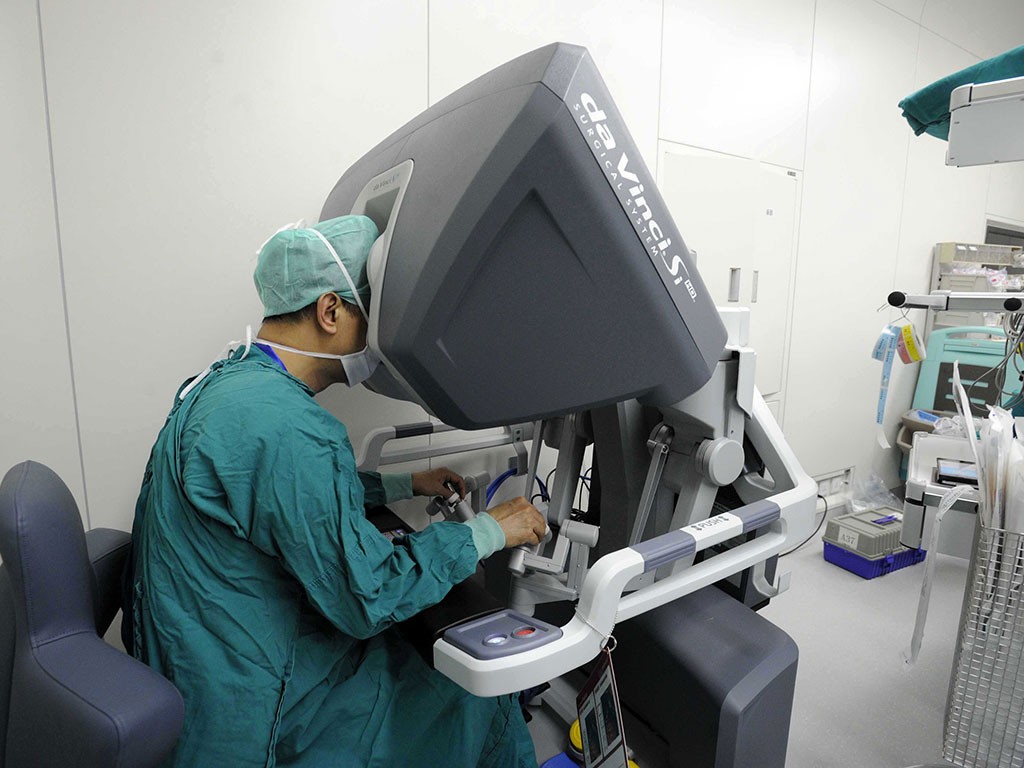
Da Vinici Surgical System
The Da Vinci Surgical System is one of the most successful pieces of healthcare robotics already in use. It was used in approximately 652,000 surgical procedures in 2015

One controversial concept is autonomy. The University of California (UC), Berkeley is one of the leading centres in the development of autonomous medical robots. Ken Goldberg, a Professor of Engineering at the university and a founder of the Center for Automation and Learning for Medical Robots, told The New York Times: “Our goal is to help surgeons focus on the critical aspects of surgery, rather than having to perform each tedious and repetitive subtask.” By taking over jobs such as suturing, cutting and debridement, robots could help reduce surgeon fatigue and procedure times.

UC Berkeley has successfully automated robots such as the Da Vinci to perform jobs with accuracy, but its scientists recognise the importance of maintaining the surgeon’s role within the operation theatre. “Humans are good at abilities such as manipulation, dexterity and perception, robots are very very far away far away from getting to that stage”, Sachin Patil, a postdoctoral researcher at UC Berkeley, told CNET News.

Miniaturising medical robots
Another significant research area is miniaturisation. The Hamlyn Centre, established by Imperial College London, gears its efforts towards creating robots that are lighter, of better quality and more cost-effective than those currently available. Much of this work focuses on handheld robotics, which Professor Guang-Zhong Yang, Director and co-founder of the centre, said will advance “imaging and other diagnostic techniques”, allowing diagnoses to be determined much earlier: “You will be able to intervene before it’s too late.”

The centre’s developments, such as the ‘snake robot’, are advancing quality of life after surgery, not just preserving it. Yang said the snake “will be able to navigate along the anatomical pathways, it reduces access trauma, and, at the same time, you don’t have limitations where the incisions are being made”, making robot-assisted procedures “more attractive to patients”.

Yang denied bigger, more expensive and autonomous robots will dominate surgery in the future. “It may look like a normal operating theatre without machines towering over the patient, but every single instrument that the surgeon is using may be a robotic instrument.”

The steps taken by the Hamlyn Centre suggest handheld robotics will be used in clinical practice within the next five years. Beyond that, Yang said he expected to see much smaller robots that could be injected directly into the body, integrated into clinical practices and completely transform the healthcare industry.

The future of robotics in healthcare is nothing short of awe-inspiring, though with research ranging from artificial intelligence to miniaturised robotics, even the market’s short-term future is difficult to predict.

Small businesses aren’t prepared for cyber-attacks

The UK Government’s Cyber Streetwise campaign and KPMG have released their Small Business Reputation and the Cyber Risk report, which urges smaller businesses in the financial services sector to appreciate the reputational damage cyber-attacks can cause.

“Small businesses know that their reputation is critical to their success but it seems that many haven’t considered quite how many factors can affect it”, said George Quigley, a partner in KPMG’s cybersecurity practice. “Every piece of data in a business can be of interest to a cyber criminal – even if the business itself may not realise it – and with SMEs a key target for this very reason, it’s vital to take steps to protect your data, and with it the trust of your customers and ultimately your reputation.”

Small financial services companies do not understand the value of the data they hold

According to the report, 58 percent of consumers surveyed said a cybersecurity breach would put them off using the affected business in the future.

“A cyber-attack may prove so serious that it impairs an organisation’s ability to operate and even function longer term”, said Danny Lawrence, the National Police Chiefs’ Council PROTECT Co-ordinator for Cyber Crime [sic]. “Doing nothing can no longer be an option – SMEs place their reputation and existence on the line if they fail to take action.

“I would encourage all SMEs to consider their cybersecurity, seek out support from resources available and consider making this piece of work a critical part of their business strategies in 2016.”

One explanation for so many small financial services companies failing to recognise the reputational risk posed by a cyber breach is that they do not understand the value of the data they hold. In fact, up to 30 percent of companies surveyed in the report said they did not consider the data they held on their systems to be commercially sensitive.

“Small businesses need simple, straightforward cybersecurity advice like that provided by Cyber Streetwise”, said Sandra Dexter, Vice-Chairman for the Federation of Small Businesses. “All small firms should now be aware of the risks, and take steps to protect themselves against the escalating level of cybercrime.

“Cyber breaches can happen to any business, any size, and the repercussions should not be underestimated… [They can lead] to damaged reputations, hindered growth and, in the worst cases, entrepreneurs being put out of business.”

The Cyber Streetwise campaign is urging small businesses and consumers to install security software on all their devices and update them on a regular basis. It also recommends they improve the strength of existing passwords by including at least three random words.

Visit www.cyberstreetwise.com to learn more about the simple ways to stay cyber-secure.

India bans Facebook’s Free Basics

Mark Zuckerberg’s plan to provide free internet to the developing world has stumbled after Indian telecom regulators decided to block Facebook’s Free Basics initiative. The service, which provides free access to certain websites (including a limited version of Facebook’s social networking platform), caused much controversy when proposed and prompted public protests both for and against it.

The Telecom Regulatory Authority of India (TRAI) ruled that making some but not all web services available for free violated net neutrality and would give an unfair advantage to select internet services. “No service provider shall offer or charge discriminatory tariffs for data services on the basis of content”, the TRAI said in a press release on February 8.

Even at this low rate of connectivity, India is already Facebook’s second largest market

Free Basics offered access to more than 100 apps and sites, including local news and health websites, as well as weather forecasts, Wikipedia and the BBC.

The decision was supported by the World Wide Web Foundation, which emphasised the ruling’s particular importance given the size of India’s population and the precedent it sets for the rest of the world. “The message is clear: we can’t create a two-tier internet – one for the haves, and one for the have-nots. We must connect everyone to the full potential of the open web”, wrote Renata Avila, the organisation’s Web We Want programme manager.

While expressing his disappointment in a press release, Zuckerberg relayed his commitment to connecting millions of Indians in order to spread education, create jobs and help lift people out of poverty. At present, only around 18 percent of India’s 1.2bn citizens have access to the internet, according to the World Bank, making the market a huge opportunity for internet giants such as Facebook. Even at this low rate of connectivity, India is already the social media company’s second largest market.

While Zuckerberg’s philanthropic ambitions are certainly commendable, the idea of favouring some companies over others goes against the idea of a free market – a major hurdle when it comes to telecom regulations. As Avila wrote, the aim must be to connect everyone to the internet, but, without the help of Facebook and subsidisation from telecom providers, this is still a very long way off for India’s vast population.

The US has a new highest-paid executive

A filing registered with the US Securities and Exchange Commission indicates Google’s Sundar Pichai is now the country’s highest-paid executive. The filing shows Pichai was awarded 273,328 Class C Alphabet shares at the beginning of February, which together are worth approximately $199m.

Pichai’s stock award is his first since taking over. Google typically grants equity awards to executives on a two-yearly basis, and his shares will vest in quarterly increments through to 2019 should he remain in the hot seat. Diane Greene, who has been leading Google’s cloud business since November, was awarded $42.8m in restricted stock while the group’s CFO Ruth Porat was awarded $38.3m in equity.

Pichai was awarded 273,328 Class C Alphabet shares, which together are worth $199m

The Indian-born Pichai stepped into Larry Page’s shoes in August as part of the company’s surprise restructuring. His appointment was a shrewd move on the part of Google, with rival technology firms on the lookout for top talent.

“Sergey and I have been super excited about his progress and dedication to the company. And it is clear to us and our board that it is time for Sundar to be CEO of Google”, wrote Page in a blog post. “I feel very fortunate to have someone as talented as he is to run the slightly slimmed down Google and this frees up time for me to continue to scale our aspirations.”

The news comes less than a week after Alphabet reported profits of $4.9bn in the three months to the end of the year and surpassed Apple to become the world’s most valuable company.

Why EU tariffs on Chinese solar panels need to end

There are many parallels that can be drawn between solar photovoltaics and the computer microchip industry. Both are semiconductors. Both have seen staggering falls in costs as manufacturing economies of scale increase thanks to what is known as Moore’s law for computing hardware and Swanson’s law for solar.

But both have also been plagued by trade wars between the US, the EU and the big Asian players. The computing industry went through this in the 1980s; the solar industry is tangled up in it today.

We make solar, but we make the Ferraris of the solar world, and only a handful a year

At present, all solar panels and modules imported into the EU from China have to be sold at or above a Minimum Import Price well above world prices (and even above the prices of some EU manufacturers), or else importers need to pay an anti-dumping tariff of 64.9 percent. This is one of the highest import tariffs in the history of EU trade defence measures and means almost all imports are done under the price controls.

Solar PV in the UK
Who is paying the price for this? Businesses and homeowners who want to go solar across the EU.

A typical homeowner in the UK has to pay £397 (or seven percent) extra to put 4kWp of solar on their roof. A typical 10MW solar farm costs £123,000 more to build than it would otherwise.

And by extension it is the UK and EU solar industries that are paying the price – all except for one vertically integrated manufacturing business that is benefiting from being shielded from competition with China. The UK solar industry is predominantly a downstream industry and a net importer of solar panels. Over 99 percent of solar jobs are in installation and construction, and the sector therefore suffers when prices are high and benefits when they are low.

There is some solar manufacturing in the UK, but it is largely in the niche, building-integrated and premium end of the market, and is very small in size. In 2014, the UK manufactured the equivalent of eight percent of the solar it installed. We make solar, but we make the Ferraris of the solar world, and only a handful a year.

Finally it is also governments that are being done over; they are having to dish out more in subsidies in order to get people to invest in solar and meet the EU renewable targets. We estimate the price controls will cost the UK Department of Energy and Climate Change an extra £700m over the next 20 years.

Uncertain future
All this is considerably slowing the technology’s progress towards competing subsidy-free in the UK. Combined with the major cut in the Feed-In Tariff introduced in January, the closure of the solar Renewables Obligation and the threatened hike in VAT, it is a dangerous policy mix for the sector.

The European Commission is currently conducting a review of the import tariffs, which is due to report back by March 2017. UK ministers are already pressing for the tariffs to be dropped, but it is as yet unclear which way the final decision will go.

The solar industry is no standard industry; it is a key part of the solution to climate change and a central tenet of affordable low carbon energy. We need to return to free and fair trade in solar PV and other renewable technologies, and avoid the mistakes the computer microchip industry made in the past, for the sake of the UK, the EU and indeed the planet.

Saudi Arabia and Venezuela discuss oil production cut

The oil ministers of OPEC’s two largest exporters, Venezuela and Saudi Arabia, met in Riyadh yesterday (February 7) to discuss a cut in oil production. The meeting was described favourably by the two producers, with Saudi Minister of Petroleum and Mineral Resources Ali Al-Naimi calling it “successful” with a “positive atmosphere”, while his Venezuelan counterpart, Eulogio del Pino, said the meeting had been productive. However, no clear agreement on production was reached (or at least announced to the public).

Since 2014, the price of oil has fallen by roughly 70 percent

Since 2014, the price of oil has fallen by roughly 70 percent, floating at around $30 a barrel for most of 2016. Venezuela, along with other poorer OPEC members, has consistently raised the need for action on oil prices. As far back as August 2015, Venezuela called for an emergency meeting between OPEC producers and Russia to discuss a production cut. The Saudis, however, have been wary of scaling back production without getting non-OPEC producers on board first for fear of losing market share without seeing a significant price increase.

The Saudis, following the talks with the Venezuelans, did not address the call for an emergency OPEC meeting. However, recent talk of a potential meeting between the Saudis and the Russians to discuss a deal may make the prospect of getting Russia around a table with OPEC producers more likely. However, as a result of past failures to follow production cut agreements, the lack of trust among OPEC members – and between certain OPEC producers and Russia – still presents a significant obstacle to any deal being reached.

The Super Bowl is losing advertisers

Super Bowl 50 kicks off this Sunday and, for a long time now, the event has been as synonymous with big branding as it has been with the NFL. Big brands spend $5m a piece for each of the 30-second advertising slots.

One of the most famous Super Bowl ads was Coca-Cola’s 1979 classic starring Pittsburgh Steelers defensive tackle “Mean” Joe Greene. The commercial won a Clio Award for being one of the best of the year and is considered one of the best of all time by industry experts.

For years, big name brands have tried, and sometimes failed, to emulate the success of adverts such as Coca Cola’s, spending millions of dollars to premiere their commercial during the coveted half-time Super Bowl slot.

But advertisers and brands are beginning to question whether they are getting sufficient bang for their buck. Despite over 114m people tuning in to watch Super XLIX last year, the majority watched the ads online, rather than during the half-time slot.

Despite over 114m people tuning in to watch Super XLIX, the majority watched the ads online

“Consumers, on average, watch more than five hours of video per day, making video the single most popular media activity”, said Christoph Pleitgen, Senior Vice President of Sales and Business Development, EMEA and APAC for Wochit, a video creation platform that helps brands capture and expand their audiences. “In addition to this, video advertising is starting to seriously threaten this status quo and is considered to be just as, if not more, effective as TV advertising, at a fraction of the cost.

“Ever since Oreo monumentally stole the online show with their simple ‘Dunk in the Dark’ Super Bowl stunt, other brands have been scrambling to follow. Many will forgo the huge costs associated with a paid-for Super Bowl ad slot and instead put their budgets and efforts into ensuring they are ready to grab public attention with responsive video content, based around the game.”

Cisco to buy IoT firm for $1.4bn

On February 3, California-based Cisco Systems announced plans to purchase Internet of Things (IoT) company Jasper Technologies for a cash payment and equity awards worth $1.4bn.

Classed as a tech ‘unicorn’ (meaning it is valued at over $1bn) Jasper connects devices to the internet via a cloud-based system for a number of high-profile clients. Coca-Cola uses the software to link vending machines to the internet so stock levels can be monitored, while General Electric has connected its jet engines in order to provide crucial service data. Jasper’s customers also include Starbucks, Ford, Heineken and Nissan.

The IoT is a viable way for tech companies as large as Cisco to secure continued growth

With multiple industries now adopting IoT technology, it is a viable way for tech companies as large as Cisco to secure continued growth in the long term. The demand for this technology is already mounting as Cisco’s customers seek ways to connect devices such as cars and pacemakers to the internet – a difficult task without the right technology.

Cisco hopes that, by bringing Jasper into the fold, it can connect client’s devices and then use its existing products to provide data analytics and network management services. This is a vital strategy for Cisco as it will allow it to meet the growing demands of its telecommunication customers AT&T and Ericsson.

The deal is expected to be closed by the end of the third quarter. As well as hiring around 385 of Jasper’s employees, Cisco will also welcome the company’s CEO Jahangir Mohammed as leader of its newly established IoT Software Business Unit.

The businesses bringing barter to the web

The Australian Broadcasting Corporation recently revealed the Northern Territory Police is monitoring the Darwin Beer Economy, a Facebook group in which 14,000 members trade alcohol for things as varied as old video games and fence repairs. The police became interested because the trades fall within a legal grey area in the Northern Territory Liquor Act; they aren’t sales, but they are transactions. Local ‘buy, swap and sell’ groups are common on Facebook, as are other online trading forums such as Craigslist, but these messy services are being replaced with online bartering platforms, creating formal services for such trades.

It was just after the financial crisis, and Jared Krause was looking for his next venture. “I was really pissed at the banks”, he said. “I was just really, really angry at the big banks and I was thinking ‘What can I do about this problem? What can I do about this intense overrun of power of the big banks?’”

These messy services are being replaced with online bartering platforms

His answer was TradeYa, an online platform on which people post and arrange trades; the example given on the website is a digital camera being exchanged for a designer handbag, but trades could as easily include services such as personal training. In essence, the platform facilitates transactions without cash.

Barter never really went away, but it has drifted in and out of obscurity. It most recently lurked at the back of newspapers in the classifieds section, but has now found a new home on the internet. While consumers were the initial target, Krause discovered TradeYa’s appeal stretched further.

“Interestingly we found… the largest benefits are [predominately] for small businesses, independent contractors and sole proprietors”, he said. “Your local plumber, or your local web designer, or an owner of a local shop… Small business owners own small businesses for the express purposes of providing their livelihood. It’s not a hobby, it’s the way that they earn their money, and so being able to cut down on cash expenditures is really a big benefit.”

Other benefits include an increased sense of community in the transaction. “When you start trading, people develop more; they develop deeper relationships than they do when they’re buying and selling. I’m helping you and you’re helping me, I know that, and so when I get into the transaction I’m doing it with a spirit of reciprocal benefit.”

Cutting out coincidence
But bartering isn’t a flawless system; its problems date back to the dawn of money. The biggest is the need for a ‘double coincidence of wants’. In order to barter with someone, three things need to happen: you have to have something they want; they have to have something you want; and you both have to find each other to make the trade. It’s a problem currency solves; since everyone wants money all the time, only one of those coincidences is needed for a trade to occur.

If the internet had existed in 600 BC, King Alyattes of Lydia probably wouldn’t have bothered minting the first coins. A global communication network ensures that, if there is someone out there who wants what you have, finding them is relatively easy.

Krause said that, in his research, he discovered virtually all small businesses already barter, but there are four things standing in the way of them doing it more. The first is simply finding people to barter with, the ‘coincidence of wants’. The second was the act of negotiation. Actually discussing the details of a trade is a time consuming, exhausting and pretty unpleasant task. Third is accountability, since there is a lack of assurances that trades won’t go wrong. Finally is the lack of a review for a transaction, something basically every online purchase now gives people the power to do.

“After listening to all of those, what we realised is people don’t want to barter per se”, said Krause. “What they want is to pay with their goods and services. They want the experience to be as frictionless as cash.”

Barter is exactly the kind of problem technology is great at solving

Krause said barter is exactly the kind of problem technology is great at solving. “Barters are hard to do right now. You’re a shopkeeper, you have a little clothing store, how do you find people to trade with? Your friends? You post it on Facebook? It’s ridiculous. If business owners had a way to meet their business needs that was totally frictionless and didn’t require them to put out cash, they would just do it more.”

There is no shortage of bartering services online. A quick skim will turn up dozens of results, from Yerdle and Listia, which provide person to person trading, to Bartercard, which focuses on business to business trades. These platforms solve bartering’s problems slightly differently by employing an internal currency. When people sign up they get a set amount of ‘credits’ they then use in transactions. This is designed as another solution to the ‘coincidence of wants’ since everyone inside the system should want the internal currency. Users receive the benefits of bartering, such as not having to touch cash reserves when transacting, without having to wait for a direct trade to come up or exchanging like-value things. But Krause said that, quite aside from the regulations that come along with running a virtual currency, in practice it doesn’t quite work.

“What ends up almost always, almost 100 percent of the time, is that virtual currency ends up getting devalued because people won’t take it. If you go on to the forums and stuff you’ll see people saying: ‘Yeah you can pay me but you’ll have to pay me three-to-one. My cash rate is $200 per hour, but you have to pay me $600 an hour in barter bucks.’ That really unravels the whole financial system inside of your little economy. And then people who have highly desirable things get bombarded with requests, and people who don’t have highly desirable things can’t really get any money. And so it doesn’t solve the problems that currency has. It just has exactly the same problems and then it adds more problems on top because it’s a more limited ecosystem.”

Rio Olympics mascots
The mascots for the 2016 Rio Olympics. According to Bloomberg, more than 60 percent of the Game’s sponsorship deals have been made on a barter basis.

Barter for business
In strained global markets people and businesses are more hesitant to throw around cash, making barters a more tempting option. It can lower expenditure (cash a business might not even have) while keeping productivity up. It obviously cannot replace money, but works as a supplement. While bartering seems to be most effective on a smaller scale, there is no reason the model could not be scaled up like it has in the past.

According to Bloomberg News, more than 60 percent of the sponsorship deals made for the upcoming Rio Olympics are ‘value-in-kind’ exchanges, where companies are supplying organisers with products or services in exchange for promotional branding. Rental car company Localizia is supplying 150 cars in exchange for marketing space. It seems like a smart move, given the limited cash organisers have at their disposal is probably reserved for employees. And it’s not completely without precedence; London made similar deals in 2012.

Velta Co gave employees a bicycle each month in lieu of a pay cheque

Bigger still, barter allowed trade with the former Soviet Union when the ruble could not be converted. Pepsi was the first US consumer product to be manufactured there, in 1974, thanks to an agreement whereby the syrup was traded for Stolichnaya vodka, which was then sold in the US. The deal reached a peak in 1990 when PepsiCo received old Soviet freighter ships that were due to be scrapped. At the time the deal was valued at $3bn. Similarly, Debis, the financial services section of Daimler-Benz, traded bananas from Ecuador in exchange for Mercedes buses in 1994. The swap circumvented EU laws that, at the time, made importing from Latin America difficult.

But bartering can also be the sign of a very sick economy. When Russia’s economy was being hammered in 1999, barter became a necessary reality for businesses and citizens. With no cash coming in, what was once the Soviet Union’s biggest bicycle company, Velta Co, gave employees a bicycle each month in lieu of a pay cheque. The company’s 4,000 employees were left simultaneously trying to rid themselves of the bikes and forced to sell them far below their actual value. Businesses facilitating barters between companies that couldn’t pay each other flourished at the time. Similar growth of a barter economy has also been recently reported in rural Greece as the cash flow dries up.

But in a healthy economy, bartering can be good. It is never going to be a complete replacement for money, but can provide an alternative form of trade when the money isn’t there. The only challenge is finding a service widespread enough to eliminate most of the coincidences of wants. While it’s all well and good for the Olympics, not every business can offer such compelling opportunities. Similarly, the value an online bartering service can bring is only as varied as its user base. Having said that, with new platforms constantly appearing, it only feels like a matter of time until one reaches a scale that makes it a must-have tool.

Yahoo hints at upcoming sale

In what appears to be another episode in its drawn-out demise, Yahoo has announced a drastic strategy to offset Q4 losses: one many believe to be a heavy hint at its forthcoming sale.

According to a press release published on February 2, as part of Yahoo’s “aggressive strategic plan” to streamline the company and boost growth, its workforce will be reduced by around 15 percent. With around 9,000 fewer employees and 1,000 fewer contractors on the books, Yahoo hopes to achieve an annual operating cost saving of $400m.

The Yahoo worldwide employee base has been reduced by 42 percent since 2012

As part of the process, Yahoo will close its offices in Buenos Aires, Dubai, Madrid, Mexico City and Milan. The closures are expected to take place during the first quarter of the year. This is just the latest cut to the Yahoo worldwide employee base, which has been reduced by 42 percent since 2012, according to the press release.

The announcement came on the same day as another, in which Yahoo gave its Q4 results: an income loss of $4.5bn for the last quarter, totally around $4.7bn for the full year.

Since Marissa Mayer took the helm in 2012, she has taken various measures aimed at ending the company’s slow demise. These have included acquiring start-ups, refocusing on the business’ mobile division, and investing in new talent. But profits have continued to shrink as the company buckles under the pressure of competition from the likes of Google.

Given Yahoo’s unsurprising results for the past year and its decision to streamline the business worldwide, it does appear Mayer is preparing the company to be sold. If she’s not, then it’s going to be even more difficult for her to motivate Yahoo’s remaining staff – should she remain in her current role, of course.

Uber’s had a bit of a rebrand

The popular ride-sharing app Uber has rebranded itself. When the company’s millions of users open up their smartphones, they will be greeted by an updated, colourful app design and new logo. The redesign is part of a larger effort by Uber to change both its identity and make its brand more recognisable as it expands into new areas of transport.

The new design features a circular icon in the centre for riders, and a hexagonal one for drivers. This will replace Uber’s previous logo of a silver or white U. The new circular icon is being tediously referred to by Uber as “the bit”. According to a press release: “One of the big changes over the years is that Uber no longer moves just people; we’re now moving food, goods, and soon maybe much more. With the potential for many apps with many app icons, we needed one approach that connected them all.”

The redesign is part of a larger effort by Uber to change both its identity and make its brand more recognisable

The new multicoloured design, upon which the so-called bit is stamped, will now vary between regions, instead of the firm’s previous uniform black. In the US, the design will include dark teal, while China’s will incorporate red. As Uber said in the press release: “In Mexico, we were inspired by Mexican pink and the patterns in the local tiles; in Ireland, from the Georgian architecture and the lush greens; and in Nigeria, from the ankara, which came up again and again because of its bright colours and beautiful geometric patterns.”

In an interview with Travis Kalanick, the CEO of Uber, Wired noted the rebranding process had been years in the making. Kalaknick, the article said, “worked alongside Uber design director Shalin Amin and a dozen or so others, hammering out ideas from a stuffy space they call the War Room. Along the way, he studied up on concepts ranging from kerning to colour palettes. ‘I didn’t know any of this stuff’, says Kalanick. ‘I just knew it was important, and so I wanted it to be good.’”.

Finovate Europe returns to London

As the only conference focused exclusively on showcasing the best in financial and banking technologies, Finovate Europe will bring together the sector’s brightest talents to discuss where financial services are headed. The conference will take place over February 9 and 10 in London, where those in attendance will set a pathway for the future of industry.

Having attended hundreds of banking and technology events over the past 20 years, the Finovate team is well versed in what constitutes successful innovation. Founded in 1995 by Jim Bruene, a banker who worked with Microsoft, Wells Fargo, Chase, US Bancorp and others to launch the Home Banking Network, the Finovate event series has furthered the sector’s understanding of the digital marketplace.

Finovate Europe focuses on the most exciting and innovative ideas in fintech

“Finovate is the premier financial technology conference for a reason”, said Bradley Leimer, Lead of Digital Channel Strategy at Mechanics Bank. “You’ll see the best examples of leading innovators from around the globe, every single time. Finovate delivers.” This year’s event will be attended by Goldman Sachs, JP Morgan, PayPal and Visa, to name a few. Each will be looking to further their understanding of how technology can make a difference in today’s complex financial marketplace.

For established financial titans, Finovate offers an opportunity to see the future of finance and challenge conventional wisdom. For start-ups, the event means access to new business opportunities and the potential to develop whole new revenue streams.

Technology continues to evolve, and with it the competition in financial services grows fiercer. Those who refuse to innovate will fall by the wayside, and the focus on financial technology innovation holds the key to success. Finovate Europe focuses on the most exciting and innovative ideas in fintech and, in doing so, offers a fresh perspective on the evolution of financial services.

The conference this year returns to Old Billingsgate Market Hall. Perched alongside the Thames in London’s bustling financial district, it is one of the capital’s premier technology event venues.

To find out more about this year’s event, visit the Finovate Europe website.