At the annual Mobile World Congress, the GSMA announced the launch of the Connected Women Commitment Initiative: a scheme aimed at tackling the mobile gender gap. The GSMA, an organisation that represents mobile operators from across the globe, hopes to provide connectivity to millions of women in developing countries by 2020.
Cost remains the biggest challenge for the 1.7bn women who do not own a mobile phone
Research carried out by the GSMA estimates that, in low- and middle-income nations, around 200m fewer women than men own a mobile phone. Moreover, the gap between those using mobile services appears to be even greater. “Even when women do own a mobile device, they are far less likely to use it for more sophisticated services, such as mobile internet and mobile money, and therefore miss out on key socioeconomic opportunities”, said GSMA Director General Mats Granryd in a press release.
Ensuring digital and financial equality is crucial; when women prosper, so do their local economies. Increasing the number of female mobile customers in developing nations will also support the United Nations Sustainable Development Goal to promote greater gender equality and female empowerment around the world.
The GSMA forecasts this relatively untapped group represents a market opportunity worth $170bn by 2020. Yet, at present, cost remains the biggest challenge for the 1.7bn women who do not own a mobile phone, while service delivery issues, technical literacy and confidence are also barriers.
Challenging social norms and increasing the financial independence of women in various cultures is a huge challenge to overcome if the GSMA is to fulfil its ambitious plans. But as more women are connected, and the benefits spread across their communities, this difficult challenge will become achievable.
Mobile executives in Europe have underlined the importance of common standards for new 5G technologies in facilitating plans to offer next generation data speeds. Speaking at Mobile World Congress in Barcelona, Vodafone’s Chief Executive Vittorio Colao said it best when he warned: “China and the US will lead, simply because we don’t yet have rules around spectrum and access that are uniform across Europe.”
Nokia said it expected a shift to “5G-ready” wireless networks as early as next year
With 5G technology, networks will be able to handle billions more connections at any given moment and extend the Internet of Things. Ericsson said it expects 150m users to be on 5G networks five years from now, while close rival Nokia said it expected a shift to “5G-ready” wireless networks as early as next year.
The European Commission (EC) last month called on telecoms groups to build a workable 5G development strategy in the hope that European mobile companies will be among the first to develop the next generation of mobile technology.
“Europe had a success story with 3G”, said Spanish MEP Pilar del Castillo, in an EC statement. A 5G standardisation framework will be worked out this year and will showcase the first results by 2018. The hope for now is that Europe can make good on its traditional industry dominance and take the lead on “the main technological revolution of recent decades”, according to the EC.
In an interview with industry website Light Reading at the Mobile World Congress, Colao said: “I would be very focused on making sure the standards are designed in the interests of European operators and on making sure the release of spectrum and the rules around access, privacy net neutrality and so on are the same across Europe.”
ZTE’s Senior Director of Mobile Devices Waiman Lam talked up the potential of the company’s new budget smartphone series at this year’s Mobile World Congress (MWC) in Barcelona. He revealed the world’s sixth largest smartphone maker is targeting a 60m to 70m increase in unit sales this year, which would represent a seven to 20 percent rise in sales on the previous year.
As penetration rates in Europe and the US approach 90 percent, handset makers are looking to new markets
Slated for release later this year, the ZTE Blade will be available in Germany, Spain, South Africa, Ethiopia and Mexico. The Blade V7 Lite will launch this spring in Russia, Mexico, Spain, Germany and Thailand. Notice how many of the release locations are emerging markets, as ZTE looks to make good on the budding mobile opportunity in Emerging Asia, Africa and beyond.
As penetration rates in Europe and the US approach 90 percent, handset makers are looking to new markets for the next cash cow. A Gartner report released late last year showed smartphone sales in emerging markets were 18.4 percent higher in the third quarter of 2015 than in the third quarter of 2014, while mature markets were up 8.4 percent over the same period.
“The availability of affordable smartphones in emerging markets saw consumers upgrade their ‘feature phones’ to smartphones more quickly because of the small price gap”, Anshul Gupta, Research Director at Gartner, wrote in the report.
As a Chinese company, ZTE should be familiar with the prices consumers in developing nations are willing to pay. Though it hasn’t disclosed pricing for the new models, it has indicated they will be among its new value-priced line up.
HSBC is launching a new ID system in the UK; customers will have the option to use voice and fingerprint identification to access telephone and online services. The bank hopes this new layer of protection will better protect customers from increasingly sophisticated cyber-attacks.
The new controls mark a move away from traditional passwords and key questions for up to 15m of the bank’s customers. As well as being less vulnerable to hackers, the system will eliminate the issue of forgotten passwords.
The technology uses 100 unique “signifiers” to identify each individual
Joseph Gordon, the bank’s UK Head of Contact Centres, told The Telegraph the technology uses 100 unique “signifiers” to identify each individual, from their pronunciation, cadence and accent, to physical characteristics such as vocal tract and larynx shape. The biometric technology, which is being provided by Massachusetts-based Nuance Communications, will even work if customers have a cold, though traditional security may still be used in some cases.
HSBC is not the first bank to use this kind of technology: RBS and NatWest began offering fingerprint identification last year, while Barclays rolled out voice recognition software to around 300,000 of its wealthiest UK clients in 2013.
With identity fraud and hacking growing concerns among the public, financial institutions are now charged with finding new and clever ways to provide protection for their customers. Alphanumerical passwords no longer make the cut.
HSBC’s new identification service is expected to be available to the public by the summer.
During a ‘fireside chat’ in Vancouver, Uber’s CEO, Travis Kalanick, admitted to Betakit that his company was losing over $1bn a year in China. Kalanick made the admission when asked if he had any advice for entrepreneurs seeking funds. While the advice was helpful, the scale of the losses came as a shock to analysts.
“We have a fierce competitor that’s unprofitable in every city they exist in, but they’re buying up market share”, he said.
Didi Kuaidi last year racked up 1.43bn rides, twice the number of total taxi rides in the US
Of the $200m Uber recently raised to help it compete in emerging markets, Kalanick said: “I wish the world wasn’t that way. I prefer building rather than fundraising. But if I don’t participate in the fundraising bonanza, I’ll get squeezed out by others buying market share.”
The rival Kalanick was referring to is Didi Kuaidi, Uber’s biggest rival in China and the largest app-based transport service in the world. The company is the result of a merger between two of China’s leading taxi-hailing apps, Didi Dache and Kuaidi Dache, which held a 55 and 45 percent share of the market respectively. Backed by tech giants Tencent and Alibaba, the company recently partnered with Lyft and Ola, and is the market leader in China by some distance. Didi Kuaidi last year racked up 1.43bn rides, twice the number of total taxi rides in the US and 1.4 times the size of Uber’s global rides in the six years since launch.
Uber started its move into China last year and, according to sources there, went from occupying a one percent share of the market at the beginning of the year to a 30 to 35 percent share by the end. It remains to be seen whether Uber can fight off the competition and turn a profit, but it will probably take significantly more capital for it to do so.
On Tuesday, Apple announced its intention to issue 10 tranches of US-investment grade corporate bonds, estimated to be worth somewhere in the region of $12bn. The bonds are expected to sell with both fixed and floating interest rates, and sell well in a time when many investors are clinging to cash for fear of getting caught up in the market tumult.
The timing of the bond issue is slightly unusual in that it jars with Apple’s $215bn in cash reserves. What’s more, the company last month reported another record quarterly profit ($18.4bn) in spite of what remains a difficult macroeconomic situation. That being said, the purpose of the issuance is not to raise cash per se, but to return money to shareholders without having to repatriate any of the company’s overseas holdings, so as not to incur a higher tax charge in the US.
Schemes such as this capitalise on low tax jurisdictions and reduce the tax bill
The move is likely to attract the ire of critics, who say schemes such as this hand multinationals like Apple an unfair advantage over SMEs in that they capitalise on low tax jurisdictions and reduce the tax bill. The criticism will be all the worse given Apple is subject to a European Commission investigation for its use of Irish tax shelters.
However, few can blame Apple for choosing to sell now, given interest rates are all but non-existent and investors are cash rich. The company’s bond issue was the largest of several conducted by big businesses on Tuesday after a particularly dry spell for the market: IBM, Toyota Motor, Comcast and BNY Mellon all announced deals of their own on hearing of the market’s relative stability.
After nearly two years of declining prices and an increasing global glut, oil production levels are now set to freeze, after an agreement by four of the world’s biggest producers. Following a long-anticipated meeting, OPEC members Saudi Arabia, Qatar and Venezuela, as well as non-OPEC producer Russia, finally agreed to hold production at January levels.
According to Saudi Oil Minister Ali Al-Naimi: “Freezing now at the January level is adequate for the market.” He went on to say the producers “don’t want significant gyrations in prices, we want to meet demand. We want a stable oil price”.
Production for many producers is already at or near record levels
While the agreed freeze is not the cut that had been hoped for, it does mark a move away from Russia and Saudi Arabia’s previous reluctance to restrict supply. Petromatrix strategist Olivier Jakob told Reuters the agreement is “the first supply management decision taken since November 2014, so even though there will be some [who] will try to discount it and say it’s not a cut, it’s a change. It’s a big change in policy”.
While the freeze means supply will not increase any further, production for many producers is already at or near record levels. Russia produced almost 10.9m barrels per day in January – a post-Soviet high. In the same month, Saudi Arabia produced 10.2m barrels per day. While this is down from the 10.5m Saudi Arabia managed in 2015, it is still high, making it unlikely the Saudis would have increased production much further without the freeze. While supply (along with prices) may now stabilise, it will do so at already high levels.
In the late 1880s, the US was locked in a war of competing electrical standards: direct current (DC) and alternating current (AC). While Thomas Edison’s DC found initial success, it was difficult to convert to higher or lower voltages. AC, a technology refined by Nikola Tesla, didn’t have that issue and earned support from entrepreneur George Westinghouse. Not wanting to lose royalties from the patents he held on DC technology, Edison began a smear campaign against AC, claiming it was the more dangerous of the two standards. One of the more alarming ways he did this was through demonstrations to journalists of how AC could kill stray animals at lower voltages than DC.
Thankfully, today’s public displays of technology are far less barbaric, but remain just as useful and important. In fact, the inspirational, technical and scientific endeavours of a company’s bleeding edge technology may be worth even more than the products it actually sells.
These wild projects play a big part in the public’s perception of Google/Alphabet
Google was turned on its head last year when it was transformed into Alphabet. The new corporate structure revealed a lot more than was previously known about how much the company spends on its experimental projects: the ‘other bets’. These include products currently on the market such as the Nest thermostat and the company’s fibre optic internet service, as well as ideas that are still in the experimental stages, such as driverless cars, internet-delivering hot air balloons and contact lenses that measure glucose. Overall, the other bets had an operating loss of $3.57bn in their last quarterly revenue report. This might have investors worried if it wasn’t for the overall revenue of $17.3bn Alphabet posted, thanks to its highly successful advertising business.
Despite the losses they incur for the business, these wild projects play a big part in the public’s perception of Google/Alphabet as a leader in innovation. The corporation frequently ranks high in surveys measuring people’s admiration of companies, despite the vast majority of its business being in the comparatively dull field of online advertising.
Marielle Baylis is Account Director at Sketch Events, an experiential PR and stunt firm in England, whose staff are experts at large scale public marketing events. Some of the projects Sketch has worked on include the installation of a clockwork lion sculpture to promote National Geographic’s Big Cat Week and a 12ft sculpture of Mr Darcy for the launch of the UKTV Drama channel.
“The right PR stunt can earn a brand an awful lot of kudos and cool points if it’s done the right way”, said Baylis. “They can earn a huge return on investment and gain a lot of media coverage the world over when it’s paired with social media. PR stunts don’t necessarily sell a product, but they really bring an idea of that brand to life and heighten a brand’s visibility, its perception, and give a brand a personality.”
Google doesn’t have to spend money advertising its car business; the mere fact a self-driving car is being worked on is newsworthy in itself.
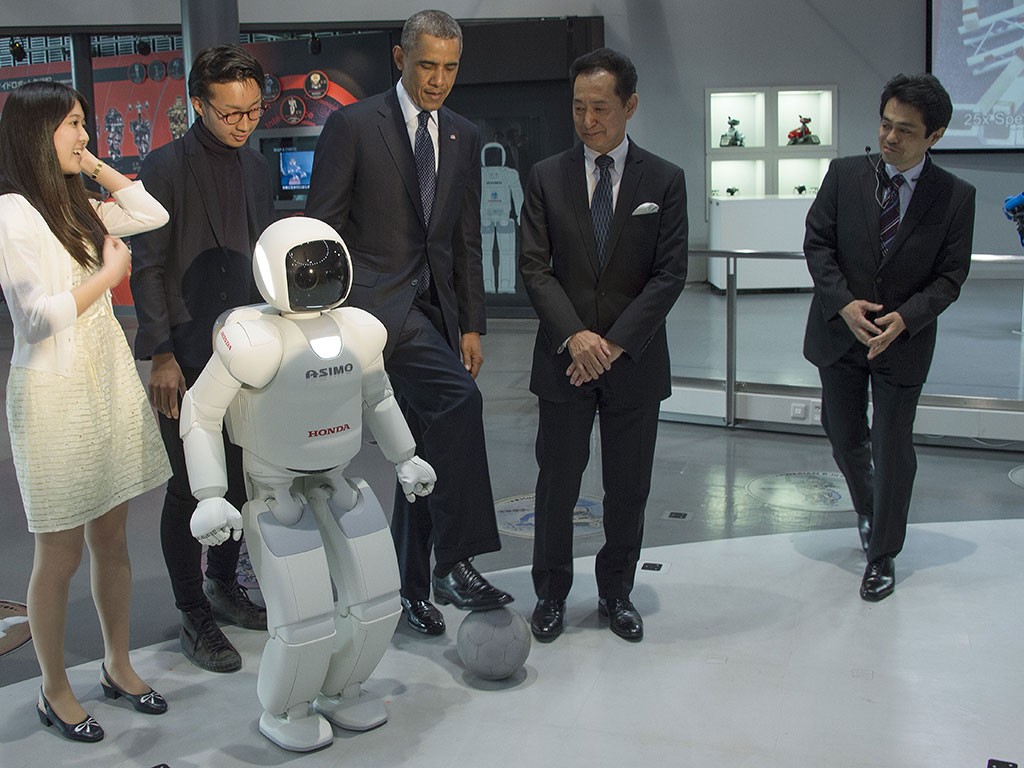
President Obama plays a game of football against Honda’s Asimo. The robot has been in development for 30 years; though it has never been released commercially, it has brought the company a huge amount of publicity
Shall we play a game?
The board game Go proved difficult for computers to master. There were just too many moves available to the player at any one time. The best human players make moves through gut instinct, finding patterns in the board they might not even be able to explain themselves. Since there isn’t a playbook, computers struggle to make the truly creative moves the best players use to win tournaments. This year, however, Google researchers cracked it with DeepMind, toppling Europe’s reigning Go champion, Fan Hui.
Investors will have to make do with that victory for now, but they have reason to hope they might get some financial return out of Google’s big artificial brain.
Work began on the chess-playing computer Deep Blue at Carnegie Mellon University in the 1980s, before its development team was hired by IBM in 1989. Continued work eventually led to Deep Blue defeating chess Grandmaster Gary Kasparov in 1997. While no doubt an impressive development in artificial intelligence, the publicity it brought IBM following the match was far more valuable.
It’s not a great look for a company when your rival built a server rack better known than your CEO
Three years later, long after what could have been the computer’s 15 minutes of fame, Marketing Evaluation/TvQ awarded Deep Blue a Q Score; a measurement of the popularity and recognition of a person, fictional or otherwise, among the public. Deep Blue became the first computer to earn one and was ranked close to Larry King, Carmen Electra and Carson Daly. Most notably, it rated higher than the CEOs of IBM’s rivals: Larry Ellison of Oracle and Scott McNealy of Sun Microsystems. It’s not a great look for a company when your rival built a server rack better known than your CEO.
It costs to be spectacular
The reason these technological achievements don’t appear more often is they aren’t easy. While the completed projects might be worth an incalculable amount in brand recognition, advanced technology is, by definition, hard to create.
A prime example is Honda’s Asimo. Development of the child-sized robot began in 1986 as a pair of unpleasant looking robotic legs that took up to 20 seconds to take a single step. Some 30 years later, Asimo can now run and jump. Development of the robot continues, though its appearance has remained largely unchanged since 2005, when it became a mascot for Honda.
While the results are impressive, you cannot buy an Asimo yet. Honda hasn’t broken out the cost of the project, but it is no doubt at least hundreds of millions of dollars. If Honda wasn’t such a large and successful company, investors would be furious at the seemingly huge waste. Still, President Barack Obama playing a short game of football with your creation isn’t an event easily organised without something spectacular. Besides, Asimo may still yet pay off in the long run; the recognition software developed to help the robot avoid obstacles and recognise people might make its way into Honda’s inevitable self-driving car.
The same could be said of Elon Musk’s proposed Hyperloop. The CEO of SpaceX and Tesla is well known for his investments into ambitious technology. His idea for a hyper-fast rail system spawned a recent competition to design something that fitted his brief. While he may not be implementing the design himself, his ambitious proposal and the construction of a test track is no doubt beneficial to his public appearance. You can’t write ‘Elon Musk’ without adding ‘CEO of SpaceX and Tesla’ (check out the top of this paragraph).
The greats of the technology sector are always forward looking, so it’s no surprise the companies are too. Though they may panic shareholders, big, expensive and highly experimental projects come with the territory, especially with today’s multibillion dollar companies. It’s a win-win no matter how you look at it: at worst, a company generates headlines for its impressive endeavours. But if an ‘other bet’ hits the jackpot, the returns can be enormous.
The mobile industry has dramatically shaped the way we communicate and live, and is likely to keep doing so for the foreseeable future. We look at the big trends for 2016.
The French-based satellite provider Eutelsat is partnering up with the Californian communications company ViaSat to launch a joint venture project that will expand the scope and speed of satellite broadband across Europe.
The plan is to launch three new satellites. The first two will focus on Europe, the Middle East, Africa and the Americas, with the third aimed at servicing the Asia-Pacific.
The new satellites will provide 1TB of network capacity
“Eutelsat is the clear leader in the European broadband market and is an obvious partner in extending our global reach”, said ViaSat’s Chairman and CEO, Mark Dankberg. “We have worked together for more than a decade – creating the satellite broadband market and sharing a vision for the future of satellite broadband.
“The joint venture combines an unprecedented collection of expertise in satellite operations and technology, broadband networks, and wholesale and retail distribution throughout Europe that forms the foundation for next-generation internet services. We’re excited to be working with Eutelsat to bring a proven model to the European and Mediterranean markets.”
Construction is already underway on the first two satellites (ViaSat-2 and VisSat-3). Boeing is the official build partner for both, which are expected to be launched into geostationary orbit in Q1 2017 and Q4 2019 respectively.
The new satellites will improve ease of access to the internet and connection speeds, as well as providing 1TB of network capacity.
“Eutelsat has built an effective, high-quality, broadband platform for Europe in which ViaSat has played a key role as technical partner”, said Michel de Rosen, Eutelsat Chairman and CEO. “Broadband is an important component of our strategy, and we seek to partner with market-leading companies that contribute to enriching our offer.
“ViaSat is a partner that we both trust and value for its track record in setting industry standards and developing technologies that unlock broadband opportunities. Our joint venture will take our relationship to a new level and give further impetus to affordable, high-quality Internet services in Europe.”
Twitter has once again disappointed investors with an earnings report that will show user growth has faltered. Twitter has taken a new approach to reporting, providing all shareholders with an earnings letter detailing its operational performance and offering a commentary from the senior management team. However, the company’s fourth quarter results are disappointingly familiar, and the report once again highlights stagnant user growth as an area of concern.
“2015 was another very strong year for Twitter”, said the letter, although a net loss of $90.2m for the quarter and the same number of average monthly active users as in the previous quarter have done little to drum up positivity among investors. Shares were down by as much as 13 percent in extended trading before they recovered to a three percent loss.
Shares were down by as much as 13 percent in extended trading
Twitter went public in 2013 with a valuation of $25bn, but troubles in the years since mean its value has fallen to under $10bn.
This quarter is the first in the company’s almost 10-year history that monthly users haven’t grown. Despite the disappointment, Twitter was quick to highlight a few reasons to feel positive about the future. “We saw a decline in monthly active usage in Q4, but we’ve already seen January monthly actives bounce back to Q3 levels”, said the letter. “We’re confident that, with disciplined execution, this growth trend will continue over time.”
Revenue for the quarter was up 48 percent on the previous year, although shareholders are concerned Twitter’s management is unable to sort out the firm’s deeper problems (such as its ongoing identity crisis). The company wrote in the letter that 2016 will be “a year of many changes for Twitter”, with a “new product roadmap which includes significant changes, the changing mix of our business, and the investments we plan to make in significant growth opportunities”. However, the company is yet to convince investors that these new prospects are quite so exciting.
Same as every year, there are plenty of rumours about the next iPhone. The biggest is that Apple’s new device will do away with the old 3.5mm audio jack. It’s a design that’s been in use for almost 100 years, but it could soon be replaced by a wireless system or Apple’s proprietary Lightning cable. Every time a standard looks like it might be changed, businesses should pause for a moment to see how it might affect them.
The 3.5mm connector the iPhone currently uses has been around since the 60s, but became the standard for almost all consumer headphones when Sony released the Walkman in 1979. The original 6.35mm size connection – these days most easily found on electric guitars – dates back to the very first telephone switchboards. The design is efficient, cheap and simple. It has enduring appeal. People have developed a healthy collection of devices that use the standard plug, all of which will gradually be rendered redundant if conventions change.
Apple has never shied away from abandoning technology it deems outdated
The almost 300,000 people who have signed a petition demanding Apple keep the classic plug shouldn’t be surprised the company is thinking of changing it; Apple has never shied away from abandoning technology it deems outdated. Apple’s original iMac was the first to ditch the floppy drive. The company phased out the dial-up modem in 2005 and was an early adopter of USB. Where Apple goes, the rest usually follow.
Though not necessarily the biggest expense on a company IT sheet, updating all the audio connections in an office would be costly and annoying. It would be a bad idea to rush out to get it done, but waiting too long could be even more costly.
More than changing plugs
Last year, Paris Orly International Airport was forced to shut down due to a computer failure. The program that failed, DECOR, communicated local weather conditions to pilots and ran on Windows 3.1 – which was released in 1992. Maintenance problems led to a bug and flights had to be grounded. The failure was a long time coming, as the experts who had previously kept the system on its legs weren’t there anymore. The overwhelming majority of people who knew the programming language DECOR was written in had long since retired, and new staff members were only familiar with the newer programs. The Secretary General of France’s UNSA-IESSA air traffic controller union, Alexandre Fiacre, told Vice News there were only three specialists left in Paris who had the required expertise to repair the system.
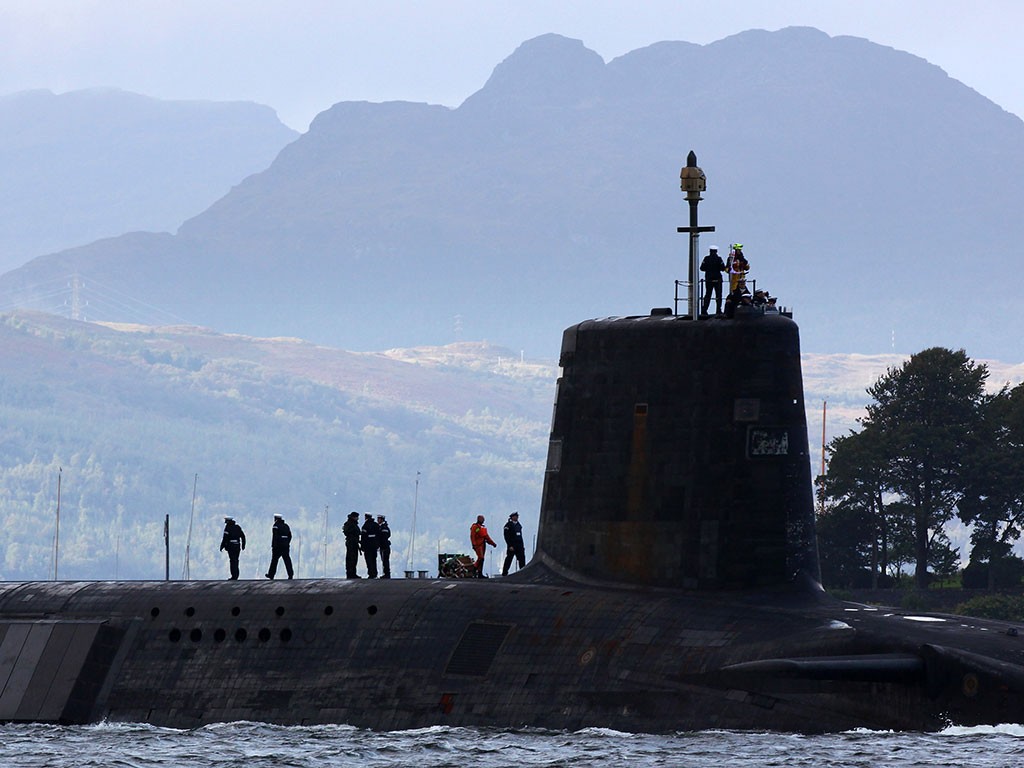
The submarines carrying the UK’s Trident nuclear missiles still use a version of Windows based on XP, despite it being almost two years since Microsoft ended general support for the operating system
A less extreme but far more widespread example is the continuing use of Windows XP, Microsoft’s 2001 operating system. Research published by AppSense in 2014 found three quarters of UK businesses were still running XP in some form just days before Microsoft ceased supporting security updates. Particularly reliant were local councils, and the UK government made a last minute deal with Microsoft to pay for an extra 12 months of support while they upgraded. Despite this extra time, investigations by CRN showed many local councils had still not completed an upgrade when the deal expired.
The steep fees for continued support are out of reach for even the biggest corporate customers, with only governments able to pay what Microsoft is charging. The US Navy is paying Microsoft $9m per year to keep support going until July 2016. The UK’s Trident nuclear missiles are housed on submarines running ‘Windows for Submarines’, which is based on XP.
The vulnerability of computers still running unsecure programs was demonstrated in January. The Royal Melbourne Hospital network was brought to its knees when an attack took down computers and forced staff to manually process blood, tissue and urine samples. Urgent tests were prioritised due to the extra time manually processing samples took, and questions about the security of patient data were raised.
Shape of things to come
Though the loss of the 3.5mm jack is never going to have the same security impact as avoiding a new operating system for a decade, Apple’s track record of setting hardware standards is worth paying attention to. While the decision might seem like a minor one, it’s not very often a technology that has endured for 100 years gets superseded. The cost could be tremendous if companies are slow to move.
According to research conducted by the Stimson Centre, it would cost the US $352bn to modernise its nuclear weapons system; the weapons computers were designed in the 60s and 70s and still use eight inch floppy disks at some bases. While the military considers the system extremely safe, the use of such old technology is still surprising.
So if the next iPhone doesn’t come with a headphone jack, don’t worry straight away. But do worry in 20 years, when the only way to repair your equipment is by trawling through eBay auctions.