German carmakers pledge to invest €60bn in electric and self-driving technology

On March 2, ahead of the Geneva International Motor Show, the head of the German Association of the Automotive Industry (VDA) promised German carmakers would invest €60m ($68.03m) in electric cars and automation technology over the next three years. It’s a signal that electric vehicles are to dominate the prestigious Swiss auto show this month.

“We will invest over €40bn [$45.4bn] in electric mobility during the next three years, and another €18bn [$20.4bn] will be invested in digitisation and connected and automated driving,” read a statement from VDA President Bernhard Mattes.

As mounting evidence points towards the damaging environmental impact of the carbon emissions produced by petrol and diesel-fuelled vehicles, manufacturers are set to face stricter guidelines. “The ramp-up of electric mobility is coming in Europe; without it, the EU’s [carbon dioxide] targets cannot be achieved by 2030,” Mattes said.

New European regulations are set to be phased in next year, compelling car manufacturers  to significantly reduce their carbon emissions

New European regulations are set to be phased in next year, compelling firms to significantly reduce their carbon emissions – those infringing on the rules are likely to face hefty fines. The regulations will be applied as an average measure across a company’s whole fleet, meaning the law is unlikely to significantly impact carmakers possessing lines of low or zero-emissions cars.

German auto firms have led the way in the transition to a more sustainable model, with the number of electric models produced by Volkswagen, Daimler and BMW set to reach around 100 in the next three years. Daimler and BMW have also agreed to cooperate on self-driving vehicles, while Volkswagen has teamed up with American manufacturer Ford.

As worldwide sales have slumped, various automobile manufacturers have struggled to turn a profit. Consequently, with tighter margins and companies spending less, the influence of car shows has begun to subside. However, this year’s Geneva International Motor Show provides a platform for the most forward-thinking firms to showcase their new technology.

Google claims it faces “fierce competition” in Australian market

Google has rejected the findings of an enquiry by the Australian Competition and Consumer Commission (ACCC), which asserts that it has “substantial market power” in search, advertising and news referral, according to documents published on March 4.

The California-based tech giant rebuked the claims in a 73-page submission to the ACCC, published by the regulator on February 18, in which it said “the preliminary report bases many of its recommendations on the mistaken premise that Google has market power” in the stated areas.

Google asserted that the Australian watchdog was wrong to conclude it is immune from direct competition in the internet search market

Google asserted that the Australian watchdog was wrong to conclude it is immune from direct competition in the internet search market, adding that it faces “fierce competition from other providers, including vertical search sites like Amazon, Expedia, Domain and Carsales.com”.

The search engine told the ACCC that it faces substantial competition in the advertising market from travel, e-commerce and publisher sites, as well as other forms of online and offline advertising.

Google also challenged the allegation that it competes in a news media referral market, even disputing whether such a market exists at all.

“We compete for two sets of customers: users that search Google for information and advertisers that advertise to users. News referral traffic is incidental to the provision of high-quality search results to users,” the company said in the submission.

The ACCC’s report, which was released in December 2018, found that platforms such as Google and Facebook “had both the ability and incentive to favour related businesses or those businesses with which they may have an existing commercial relationship”. The report also criticised search engines’ lack of transparency regarding how their algorithms rank and display advertising and news content.

Chair of the ACCC Rod Sims said in December: “Organisations like Google and Facebook are more than mere distributors or pure intermediaries in the supply of news in Australia; they increasingly perform similar functions as media businesses like selecting, curating and ranking content.”

Overall, the report concluded that Google had a “near monopoly” position in internet search, and estimated the tech firm earned AUD 47 ($33.30) for every AUD 100 ($70.84) spent on digital advertising in Australia.

Following its findings, the ACCC made 11 key recommendations, which seek to curb the influence of market leaders and promote increased consumer choice. These include preventing Google from installing its browser, Chrome, as a default on computers and mobile devices, and introducing a new market regulator to investigate, monitor and report on digital platforms.

Google strongly criticised these proposed regulatory changes and warned against their implementation. It argued that rules against default browsers “would disrupt procompetitive benefits for users and industry participants”, adding that it believes Australian consumer law is effective in its current iteration.

While the ACCC’s preliminary enquiry is the first of its kind, Google has faced scrutiny from other regulators across the globe due to its strong market position. In 2018, the search giant was fined a record €4.3bn ($4.88bn) for abusing the dominant position of its Android operating system, and it is currently locked in a battle with EU lawmakers over the new Copyright Directive, which Google argues will limit consumer access to certain news sources.

The ACCC must compile a full report and present its final findings to the Australian Government by 3 June 2019.

Tesla announces price slash on Model 3

Tesla has finally fulfilled its promise to sell a car accessible to the mass market. On March 1, the California-based business announced a version of the Model 3 that would retail for $35,000. To offset the lower price, the electric car company also announced that it would close a number of its brick and mortar stores as it transitions to online sales.

Tesla’s Model 3 was unveiled in 2016, as CEO Elon Musk pledged to offer an alternative to the automobile firm’s luxury offerings. The car has a range of 220 miles, a top speed of 130mph and can hit 60mph in 5.6 seconds.

In addition to the ongoing struggle to lower vehicle prices, Tesla has yet to settle the remaining half of a $40m lawsuit filed against Musk

Musk claimed that the online sales model would not put off customers: “It’s 2019… People want to buy things online.” While customers would no longer be able to try before they buy, a Tesla blog post confirmed that clients could return a car within seven days if dissatisfied.

“Quite literally, you could buy a Tesla, drive several hundred miles for a weekend road trip with friends and then return it for free,” the company wrote. “With the highest consumer satisfaction score of any car on the road, we are confident you will want to keep your Tesla.”

Tesla also revealed Q1 losses for 2019, contradicting earlier statements that promised a “very small” net profit. However, Musk assured investors that the company would recover its earnings over the course of the next quarter.

So far, Musk has refused to confirm how many of Tesla’s 378 physical stores will be shut or how many jobs are likely to be lost. However, in January, the entrepreneur signalled that the business would be cutting 3,150 jobs – seven percent of the workforce – informing staff that “the road ahead is very difficult”.

In addition to the ongoing struggle to lower vehicle prices, Tesla has yet to settle the remaining half of a $40m lawsuit filed against Musk for tweets he posted last September that “misled” investors.

Shares in Tesla dropped 3.4 percent as news of the Model 3’s new price tag broke. Shareholders expressed their concerns at the cuts being made and were also left unsure as to whether the newly priced vehicle would be able to turn a profit. Tesla’s move to the mass market should provide a boon to company finances, but recent cost-cutting efforts indicate that margins will be tight.

Robot labour booms in the US

US companies put more robots to work in 2018 than ever before, according to data from the Association for Advancing Automation (AAA) that was seen by Reuters.

A record 28,478 robot shipments were made last year to companies operating in a range of sectors across the US economy, a 16 percent increase on 2017 figures, the report, released on February 28, reveals.

Automation is becoming increasingly prevalent across manufacturing industries in particular due to the need to trim labour costs while boosting factory output

Shipments increased in every sector mentioned in the report, with the exception of the automotive industry, as carmakers cut back on automated labour after finishing a major tooling project for new truck models.

In the food and consumer goods sectors, shipments of robots swelled by 60 percent, while semiconductor and electronics plants saw a 50 percent rise in consignments. Metal producers also purchased 13 percent more robots than in 2017.

Automation is becoming increasingly prevalent across manufacturing industries in particular due to the need to trim labour costs while boosting factory output.

Historically, robotics has had a strong foothold in the car production sector, but the increasing availability of cheaper machines has made automation viable across a wider range of businesses.

Bob Doyle, Vice President of the AAA, told Reuters that automation is moving far beyond its traditional position in auto assembly plants and other large manufacturers into warehouses and smaller factories.

Increasing automation has prompted concerns about how robotic labour will impact job markets. Employment figures, however, show that between July 2017 and July 2018, the US added 327,000 manufacturing jobs, the highest figure since 1995. The sector further benefitted from a boost in overall economic activity and a federal tax cut in the same period.

Data from the Bureau of Economic Analysis also indicated that US manufacturers are producing at near-record levels.

Economists have questioned the longevity of this jobs growth as the role of manufacturing in the US economic landscape continues to diminish, falling from 28.1 percent of GDP in 1953 to 11.6 percent in 2017.

When production demand inevitably falls, it’s likely manufacturers will choose automated labour over its human counterpart, given that robots offer both a productivity and cost advantage.

Google forced to reveal which products have microphones following privacy backlash

Google has been accused of violating users’ trust after it failed to disclose that its Nest Secure home security and alarm system contained a microphone.

The company’s secret was revealed earlier this month when it announced that voice-activated Google Assistant technology could now be used on the Nest device.

The existence of a microphone on the Nest Secure has never been mentioned in any product material for the device, which a Google spokesperson said was “an error” on the company’s part.

The existence of a microphone on the Nest Secure has never been mentioned in any product material for the device

“The on-device microphone was never intended to be a secret and should have been listed in the tech specs,” the spokesperson told Business Insider.

Google added that the microphone has never been on and is only activated when users specifically enable it.

It claimed the microphone was originally included to the security device to support the addition of new features in the future, such as the capacity to detect broken glass.

A number of other Google security products, such as the Nest Cam camera and Nest Hello doorbell, do contain microphones, which facilitate their primary functions.

Some users have been surprised to learn that Google’s smoke and carbon monoxide alarm, Nest Protect, also contains a listening device. Unlike the Nest Secure, however, the existence of this microphone was divulged in all of the product’s marketing materials and product specification sheets.

This incident will do little for Google’s public image, which has been damaged by a number of privacy-related scandals in recent years. In 2010, an audit by Germany’s data protection authority revealed that Google Street View cars had been collecting private information including emails from domestic Wi-Fi networks. Google claimed that the gathering of this data was accidental and said it had never been used in any of the company’s products.

Google’s online products have also been plagued by security issues. Last October, the company announced it was shutting down the consumer version of social network Google+, due in part to a design flaw that allowed a mass data leak affecting up to 500,000 user accounts. According to a blog post on Google’s website, up to 438 different third-party applications may have had access to private information in the leak.

A number of prominent US lawmakers have jumped to criticise Google over this latest privacy issue, with California Senator Kamala Harris saying: “Americans shouldn’t have to fear that the products in their home could be spying on them.”

Silkie Carlo, Director of UK-based privacy campaign group Big Brother Watch, also lambasted the tech giant, adding: “Many of our worries about smart home devices appear to be proving true… Google should be held to account for wrongly advertising this product.”

Google’s failure to disclose the existence of the microphone in any product documentation is particularly concerning. Many are likely to see this omission as deliberate secrecy rather than a thoughtless error.

If it has any hope of rehabilitating its public image, Google must work to put an end to these secretive practices and demonstrate transparency in every area of its business in the future.

Samsung launches foldable smartphone

As smartphone sales decline due to a lack of global demand, on February 20, Samsung launched its most innovative product yet. At first glance, the Galaxy Ford appears to be a standard smartphone, with a 4.6-inch screen. However, the device folds outwards to reveal a 7.3-inch ‘Infinity Flex’ AMOLED, or active-matrix organic light-emitting diode, display, ideal for “watching videos, playing games or multitasking”, Samsung said.

Shares in the world’s largest smartphone seller fell by 1.4 percent as trading in Seoul opened on February 21

At the launch, the South Korean company stated that you could “watch a YouTube video of Hawaii, text your friend about it and browse travel options at the same time”. DJ Koh, Head of Samsung’s IT and Mobile Communications Division, said: “Today, Samsung is writing the next chapter in mobile innovation history by changing what’s possible in a smartphone.”

Investors, however, appear less than enthused. Shares in the world’s largest smartphone seller fell by 1.4 percent as trading in Seoul opened on February 21. With a price tag of $1,980, the product is unlikely to make an impact on the mainstream market, with many customers unable to fork out such a sum.

While sales of Samsung and Apple smartphones have cooled, Huawei saw purchases increase by 44 percent in spite of global security concerns and obstruction from the US market. Huawei’s smartphones are designed to comply with China’s strictly regulated markets, where more than 10,000 apps and websites are banned. This strategy saw Huawei overtake Apple in terms of worldwide sales late last year.

The broad range of Huawei’s products has allowed the company to develop lower-cost models, while Samsung and Apple’s prices continue to increase. Samsung listed its new S10 range at $900, a $100 increase from the previous model, while Apple’s iPhone X retails at $1,000.

Samsung is known for taking risks – even if they fail to pay off – often unveiling new products before its competitors. However, despite revealing a string of new technologies, including 5G development and improved components, the South Korean firm has been hardest hit as industry trends shift.

By increasing its prices further, Samsung has opened up a gap in the market, which Huawei is swiftly moving to fill. It would seem that, even with its latest innovation, Samsung is set to be outshone by rivals once again.

Uber agrees to pay VAT in Egypt

On February 18, Egyptian officials confirmed that Uber had agreed to pay VAT in the country, potentially bringing to an end the company’s long-running row with local taxi drivers. As a result, Uber raised its fares in anticipation of the charge eating into its margins.

Abdel Azeem Hussein, head of the Egyptian Tax Authority, told news agency MENA: “Reaching an agreement and determining the tax treatment that will be applied to Uber and other companies operating in the same area will enhance confidence and cooperation between the authority and the tax community.”

Uber has already been forced to halt its services in Hungary and Denmark and has faced a backlash from taxi drivers in a number of other regions

The 14 percent VAT charge will also be levied on other ride-hailing apps in the country, including Uber’s main competitor, Careem, a UAE-based start-up that claims to already pay the tax. Hazem Ghorab, Careem Egypt’s Head of Corporate Communications, insisted that Careem was operating “in accordance with our compliance with Egyptian laws”.

The two firms have both faced several lawsuits over the past year. In May 2018, Egyptian officials introduced a law that enforced stricter regulations on ride-hailing apps. This followed a lawsuit filed by the country’s taxi drivers, which alleged that the two companies were illegally employing private vehicles as taxis.

Earlier that same year, another lawsuit against the two companies resulted in a court suspending their services. However, a different court deferred the suspension after Uber and Careem appealed the ban. The case, again presented by local taxi drivers, argued that Uber and Careem failed to abide by the law and were having a detrimental impact on conventional taxi operators. In addition, they alleged that Uber and Careem drivers do not pay taxes. A final ruling is expected later this week.

Uber is no stranger to controversy. It has already been forced to halt its services in Hungary and Denmark and has faced a backlash from taxi drivers in a number of other regions. Given that Egypt is the company’s largest Middle Eastern market, with 157,000 drivers and four million users, Uber will be hoping that the court rules in its favour.

How Estonia became Europe’s tech hotspot

In June last year, Estonian President Kersti Kaljulaid left her 13,000 Twitter followers confused when she tweeted: “Estonia is 1.3 million people and we have four unicorns.” The tweet, as it later transpired, had not been referring to the mythical creature, but to Estonia’s technological success.

The term ‘unicorn’ was coined by venture capitalist Aileen Lee in 2013, and is used to describe start-ups with a market valuation of $1bn and over. As Kaljulaid alluded to, Estonia currently has four – a number that no other small country in the world has reached so far.

In fact, despite its size, Estonia has become one of the world’s most technologically advanced countries. This is largely due to the efforts the Estonian Government made in the 1990s to reform the country and turn it into a digital society, a movement now known as ‘e-Estonia’. As part of this movement, 99 percent of public services are online, 96 percent of taxes are declared online and 99.6 percent of banking transactions also take place online.

Policymakers have taken radical steps towards digitalising the country, ensuring that internet access is a basic human right and offering ‘e-residency’ to anyone who would like to set up a business in the country from a virtual base. Estonia also has the second-fastest public Wi-Fi in the world, and digital processes are a key part of everyday life, with virtual signatures preferred to physical ones for many transactions.

In 2019, Estonia will release the first official visa for ‘digital nomads’, allowing foreign nationals to work in the country for 365 days. The visa is designed to attract top talent from around Europe.

Estonia has been an innovator in almost every aspect of public life. It was the first country to:

  • hold a nationwide election online;
  • implement smart parking and sharing economy model in mobility; and
  • open a nationwide electric vehicle fast-charging network.

Additionally, it is the first country in the EU to legalise the road-testing of vehicles classified as level SA3 2 or SAE 3, and it expects to implement the Kratt law later this year, to legalise Artificial Intelligence.

All this shows that Estonia, with its innovative government and people, is a perfect test ground for new and bold ideas. Skype, TransferWise and Taxify are just some of the leading companies to hail from the country, and many more are expected to emerge in the near future.

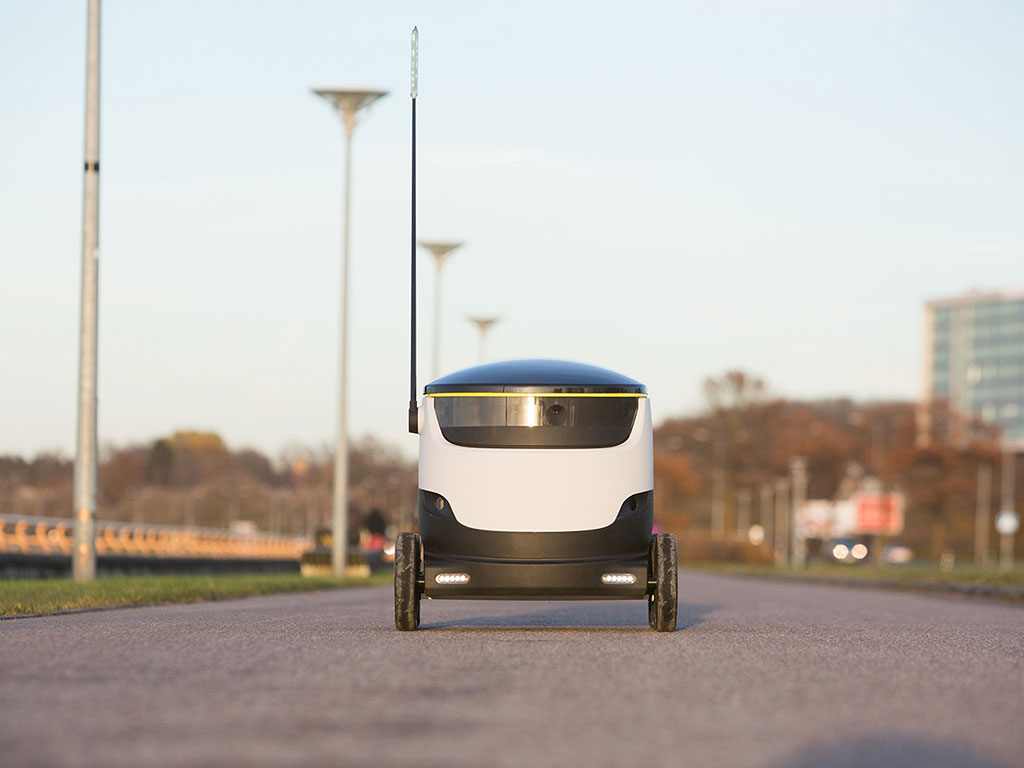
A self-driving delivery robot from Starship, which has already driven on some of the streets of Estonia

One of the major ways Estonia has encouraged technological development is by embedding blockchain into many of its processes – in fact, Estonia was the first country to use the technology at a government level. Blockchain has since gained huge commercial appeal, with its ability to provide heightened security and speed up many otherwise-lengthy processes proving beneficial to a host of different sectors. The world’s largest blockchain company, Guardtime, was created in Estonia, and offers its services to the US and Thai Governments, as well as American telecommunications conglomerate Verizon.

As a result of its commitment to innovation, Estonia was named as the number one entrepreneurial hotspot in the World Economic Forum’s Europe’s Hidden Entrepreneurs: Entrepreneurial Employee Activity and Competitiveness in Europe report, 2017. The study suggested that the country’s entrepreneurially orientated policy had greatly promoted its economic development. It also noted that almost 80 percent of Estonians work for SMEs, a significant increase on the European average (67 percent).

Estonian Investment Agency, a part of Enterprise Estonia, is a government agency that promotes foreign investments in the country, as well as supporting companies investing and expanding there. It offers free of charge investment consultancy services, which are always tailored to meet potential and existing investors’ needs. These include: 

  • information services and investment preparation;
  • investment proposals and visits;
  • consulting and project management;
  • facilitating contacts, negotiation with authorities;
  • organising recruitment and identifying suitable properties; and
  • post-investment / aftercare services.

World-class human capital, unique digital capabilities and a competitive business environment make Estonia a smart, agile location for businesses with global ambitions. To find out more visit investinestonia.com or @estoniainvest on Twitter.

Top 5 largest fines levied on tech companies by the European Commission

Last minute negotiations will see the EU’s controversial copyright directive head to Brussels, with only MEPs standing in the way of the legislation being enacted into law. The directive will further tighten already strict technology regulations in an attempt to even out a playing field that has generally favoured the industry’s biggest names.

The bloc has levied fines on a long list of tech giants that have denied smaller companies the opportunity to grow. At times, this has put the commission at loggerheads with firms such as Google, Apple and Facebook. The New Economy lists the five largest penalties handed to tech giants by the European Commission.

Apple – $14.8bn in 2016

Governments have long wrangled with tech companies to pay their fair share of tax. In 1991, Ireland and then little-known tech firm Apple made an agreement that enabled the US company to pay between 0.005 and 0.05 percent tax on global sales. In 2016, 25 years later, the EU classified the scheme as illegal state aid and slapped Apple with a fine of $14.8bn.

Qualcomm, the world’s biggest maker of mobile phone chips, used its influence and sizeable profits to prevent rivals from entering the market

In response to the EU’s decision, Apple CEO Tim Cook penned an open letter that read: “Beyond the obvious targeting of Apple, the most profound and harmful effect of this ruling will be on investment and job creation in Europe. Using the commission’s theory, every company in Ireland and across Europe is suddenly at risk of being subjected to taxes under laws that never existed.” Reuters reported late last year that the Irish Government had recovered the full amount owed, despite initial appeals from Apple.

Google – $5bn in 2018

In 2018 the EU slapped a landmark fine of $5bn on Google. Margrethe Vestager, the bloc’s competition commissioner, claimed Google had participated in “serious illegal behaviour”. It was found that Google forced smartphone manufacturers using its Android operating system to pre-install the Silicon Valley giant’s search and browser apps on devices. Those that refused were denied access to the US firm’s streaming services and the Google Play store.

While Android users were not restricted to downloading alternative browsers, the bloc found that due to the set-up, only one percent of customers downloaded a competing search app, and 10 percent an alternative browser.

US President Donald Trump attacked the EU – which he shares a frosty relationship with – for the fine. Trump declared on Twitter: “I told you so! The EU just slapped a Five Billion Dollar [sic] fine on one of our great companies, Google. They truly have taken advantage of the US, but not for long!” In response to the penalty, Google CEO Sundar Pichai claimed the ruling “rejects the business model that supports Android, which has created more choice for everyone, not less”.

Google – $2.7bn in 2017

Google has taken the second and third spots on the list. In 2017, the firm received a penalty in similar circumstances to 2018’s $5bn fine. The company was accused of abusing its dominance of the search engine market in relation to its shopping service, which demoted rival comparison services in favour of Google’s own, thereby distorting the competition. European regulators stated: “Google denied both its consumers real choice and rival firms the ability to compete on a level playing field.”

A Google spokesman said of the ruling: “When you shop online, you want to find the products you’re looking for quickly and easily. And advertisers want to promote those same products. That’s why Google shows shopping ads, connecting our users with thousands of advertisers, large and small, in ways that are useful for both. We respectfully disagree with the conclusions announced today.”

Intel – $1.45bn in 2009

At the time, Intel’s $145bn fine was the largest ever handed to a tech company. Once again, the penalty related to skewed competition, which Intel went to great lengths to cover up. The chipmaker had paid computer manufacturers to delay or cancel products that contained chips produced by rival firm AMD. Bruce Sewell, Intel’s chief lawyer, said he took “great exception” to the ruling and pledged to appeal the outcome.

The fine signalled the strengthening of European regulation, with the commission stating it was “taking a leadership role in enforcing competition rules”.

Qualcomm – $1.2bn in 2018

In similar fashion to Intel, Qualcomm, the world’s biggest maker of mobile phone chips, used its influence and sizeable profits to prevent rivals from entering the market. The San Diego-based company paid Apple billions of dollars to exclusively use its products in iPhones and iPads, thus denying other chipmakers the opportunity to challenge Qualcomm’s market dominance. Disputing the ruling, Qualcomm immediately appealed, stating it strongly disagreed with the EU’s findings.

Margrethe Vestager said Qualcomm’s actions had “denied consumers and other companies more choice and innovation”. Shares in Qualcomm dropped 1.2 percent in New York as news of the decision broke. Apple escaped without any repercussions after the bloc found no wrongdoing on its behalf.

Europe in danger of missing 5G revolution

As President Donald Trump and his Chinese counterpart Xi Jinping were agreeing a 90-day trade truce during the G20 summit late last year, in Canada the arrest of Meng Wanzhou, Chief Financial Officer of Huawei, was unfolding. It came after a US extradition request and quickly sparked fears of reignited tension between Washington and Beijing. The arrest also led to concerns over the future of mobile telecommunications the world over.

Huawei has long supplied equipment and services that underpin Europe’s best-known mobile networks. Yet the company has faced increasing scrutiny in the West. New Zealand, Australia, the US and Japan have banned Huawei’s 5G equipment, threatening to derail the development of a technology that experts and businesses believe will change the world. Despite the hype, consumers appear unenthused.

The increased data rates of 5G will be able to support more than one million devices per square kilometre, enabling smart energy harvesting and storage

According to a report carried out by Waveform, 59 percent of consumers aren’t even aware that 5G is set to launch over the coming years. The report found that people felt largely indifferent about the technology: 55.6 percent of respondents were unsure of the benefits of 5G and 38.1 percent were not excited for the impending launch. Although the technology has been in the media spotlight recently, it has failed to secure the public’s interest.

To an extent, this apathy is understandable. Many users still experience issues with 4G, eight years after the introduction of the service. However, while consumers may not be taking notice just yet, businesses certainly are. The new technology will provide the infrastructure required to deliver the Internet of Things, augmented reality (AR) and many more technological solutions.

More than speed
With each progression in mobile communications, fresh business opportunities have arisen. When 4G launched, it transformed network technology so much that entirely new business models were created as a result. Lindsay Notwell, Senior Vice President of 5G Strategy at Cradlepoint, says the same will happen with 5G.

“Uber would have never been able to exist before a 4G network and the kind of things that network enabled,” Notwell said. “The same thing will happen with 5G, but the consumer today can’t see those applications because they are in the imagination of some developer out there. In five years we’ll look back at X, Y, Z company and say: ‘Oh goodness, without 5G these companies would have never occurred’.”

While it is largely assumed that 5G will solely increase network speeds – they will be around 20 times faster than 4G – the technology promises to go considerably further. For businesses, the technology will drive three main benefits: cost, quality and productivity.

Ben McInerney, Head of Innovation at Wavemaker, said: “It’s easy to think of 5G as just ‘faster internet’, but with increased bandwidth, new opportunities arise. We are likely to see the Internet of Thing truly take off where everything is connected. We’ll start losing ‘dead-time’ and every minute can become productive.”

The advancement of Internet of Things technology is one of the most significant benefits of 5G. For example, the technology could allow your smart mirror to list your upcoming meetings, the best route to take to them, and what to wear that day, all while you brush your teeth.

“It’s like letting the machines take the strain,” said Kamal Bhadada, President of Tata Consultancy Services. “This approach gives us more time for the important stuff. Effectively, 5G brings us into the internet, rather than bringing the internet to us – and it will immerse us into a fully interactive online world. It marks the beginning of the Fourth Industrial Revolution, or Industry 4.0 as it is often referred to [as]. Not only will 5G revolutionise day-to-day household items, it will spark the development of smart cities.”

The increased data rates of 5G will be able to support more than one million devices per square kilometre, enabling smart energy harvesting and storage, and building automation and smart traffic management.

For years, autonomous vehicles have been on the verge of release, yet various technical issues have held back the rollout. When pedestrian Elaine Herzberg was killed in Arizona in May last year following a collision with a self-driving Uber vehicle, investigators found that the car had six seconds to avoid the incident. Ubiquitous 5G coverage could have acted quicker and prevented the accident.

A smaller world
For businesses, in particular, 5G will make travelling less necessary. Last year, Vodafone offered a glimpse of the work meetings of the future. From the company’s Manchester office, professional footballer Steph Houghton appeared as a hologram in Newbury to give football tips to a young fan. 5G could make this kind of communication an everyday occurrence. Online conference calls will be more reliable and AR could put two people situated on different sides of the earth in the same room.

Vodafone’s marketing campaign signalled the beginning of a significant change in the way businesses interact with their customers. Notwell believes virtual reality (VR), in particular, will fundamentally and positively change businesses’ marketing strategies, in terms of interaction with consumers and customer support.

AR will have a similarly transformative effect on manufacturing. Mark Stansfeld, Chairman of the Worcestershire 5G Consortium and mobile network giffgaff, explained: “Rather than having to send out skilled engineers to different places, AR can start repairing machines because 5G enables you to be able to do that.” Companies can save money and time, as the need for employees to travel to do certain jobs, such as maintenance, is reduced.

In general, 5G should help ease the pressure on manufacturing companies, where competitiveness is key. Increased automation, and a rise in the flexibility of that automation, allows companies to operate in a far more productive way. Not only will factories become more productive, costs will fall as quality improves.

The tourism sector is hopeful that 5G-enabled AR will be able to provide potential customers with immersive virtual tours of their destinations. Experiences at historic landmarks will become ever more immersive; AR could allow visitors to experience Rome’s Colosseum, for example, as it was during the Roman Empire. Travellers increasingly want to use their phones to plan their holidays, and AR, VR and expanded Wi-Fi coverage can achieve that.

Lagging behind
While 5G is already available in parts of Asia and the US, progress is slower in Europe. “We’ll probably start to see a rollout of 5G around 2020,” said Stansfeld. “That will be the early stages of it. It will be focused around localised areas, and then you’ll see the expansion. But it is that balance between the infrastructure and customer premises equipment; those need to come together at the same time otherwise you don’t get the quality.”

With numerous mobile service providers operating within Europe, as opposed to a smaller number in the US and China, the continent’s fragmented network has significantly inflated the cost of implementation. Strict EU rules, regulatory inertia and uncertainty over bandwidth have caused additional issues.

Mika Skarp, Founder of Cloudstreet said: “Now considered the jewel in the crown of 5G, Industry 4.0 will certainly happen, but it will require a communication network that is reliable, provides high bandwidth speeds, blanket coverage and most importantly, low cost.” As a result, Giordano Albertazzi, president of Vertiv in Europe, Middle East and Africa, said, “potential lenders need convincing of the value of 5G to understand how it will bring new revenue streams into the sector.”

However, companies have warned that Huawei’s fall from grace could impact the system’s development. Numerous operators currently use Huawei products for 4G networks and will do the same with the next generation of the technology. Replacing these networks would come at a substantial cost. Deutsche Telekom cautioned that Europe could fall behind the US and China if governments ban the Chinese equipment supplier.

As Angela Merkel seeks assurances on Huawei’s use of consumer data, pressure is increasing on EU leaders to finally take a definitive stance regarding the Chinese firm and, more generally, the development of 5G technology in Europe. The future of the continent’s business environment depends on it.


Alphabet and Shell join forces in electric-generating kites venture

On February 12, Royal Dutch Shell confirmed it had invested in an Alphabet venture that makes electricity-generating kites. Makani Power – part of Alphabet’s X research lab – will use the investment to become independent from the tech giant, following in the footsteps of Loon and Wing to become a freestanding subsidiary.

Alphabet did not disclose the size of Shell’s minority investment, instead stating the arrangement would establish a partnership between the two businesses. Shell, meanwhile, said the agreement would help the company develop its offshore wind business. As the energy giant looks to wean itself off fossil fuels, it has increasingly committed to investing in sustainable energy to meet its climate targets.

Alphabet is keen for its X projects to move on from its prototyping lab and develop into independent companies

At present, Makani Power’s prototype is tethered to the ground and floats roughly 1,000ft in the air, with its rotor keeping the kite in the sky while also generating power. With the Shell investment, the company can develop a kite suitable for operation in coastal waters, where winds are much stronger.

If successful, Makani’s kites will provide companies with the upper hand in offshore developments as its kites could be attached to floating buoys, rather than the ocean platforms required by wind turbines, saving time and money.

Alphabet is keen for its X projects to move on from its prototyping lab and develop into independent companies. With Makani Power blossoming, Alphabet can look towards future projects in glass, robotics and optics.

Shell has made other investments in similar projects, for example, British start-up Kite Power Systems. While various wind energy start-ups have failed to find success, Shell will be hoping that its investment can help buck the trend.

Paris Agreement will reward signatories with GDP boost

If the EU achieves a smooth transition to a low-carbon economy by 2030, as set out in the 2015 Paris climate agreement, the bloc will be rewarded with increased GDP and reduced unemployment, a report by Cambridge Econometrics and Eurofound’s European Jobs Monitor, released February 12, has said.

The EU’s GDP could increase by 1.1 percent and unemployment fall by 0.5 percent if the terms of the agreement are met

In total, the EU’s GDP could increase by 1.1 percent and unemployment fall by 0.5 percent if the terms of the agreement are met. China is expected to reap similar rewards, with a predicted 4.7 percent growth in GDP and a 2.3 percent boost to employment.

The US, on the other hand, would experience a 3.4 percent contraction in GDP and a 1.6 percent increase in unemployment if it transitioned to a low-carbon economy. Such figures are likely to gratify US President Donald Trump, who pulled the country from the Paris agreement in 2017.

Within the EU, Latvia, Malta and Belgium are among the countries likely to experience the most positive effects of implementing cleaner energy. The report predicts that Latvia would see a nearly six percent increase in GDP, over double the 2.5 percent increase Malta looks to experience.

Belgium meanwhile, would see approximately a 0.9 percent boost to employment. Countries such as Denmark, which are already at an advanced stage of implementing sustainable reforms, will see less of an impact.

Miguel Arias Cañete, EU Energy and Climate Action Commissioner, tweeted: “The Juncker Commission is sparing no effort in making Europe a modern, competitive and socially fair Paris-aligned economy. Here’s why: Implementation of the #ParisAgreement could boost EU GDP by 1.1%.”

Globally, the economy could expand by 0.1 percent if the terms of the Paris Agreement are met. The report cites large variations between countries, especially the poor figures predicted for the US, as the reason for this small overall figure.

China, the planet’s biggest polluter, has stepped up to shrink its environmental impact by reducing its reliance on coal and investing in renewable energy.