According to a source familiar with the plans and cited by Reuters, Mercedes is set to revive its luxury brand Maybach, in an effort to capitalise on an emerging class of super-wealthy clients.
Although the brand was declared defunct as recently as 2012, the parent company clearly believes the market today to be more receptive to luxury goods, and again looks to position the Maybach brand as a close competitor to both Rolls Royce and Bentley.
Demand emanating from Chinese markets has lifted luxury car sales in Europe of late
Demand emanating from Chinese markets has lifted luxury car sales in Europe of late, with the likes of BMW, Rolls Royce and Mercedes Benz all having benefitted from the boom. Mercedes announced in March that its monthly sales were up 13.3 percent to a record 158,523, whereas first quarter sales were up 15.2 percent to 374,276. “Our CLA is making strong headway in the entry luxury arena with sales of more than 20,000 units after just six months on the market,” said the company’s president and CEO Steve Cannon in a press release. “With another knockout series of products waiting in the wings, we expect even higher growth this year and beyond.”
To illustrate the opportunities in the luxury space further still, year-on-year premium car sales were up 10.3 percent in March, whereas mass-market car sales plummeted 6.2 percent. According to Credit Suisse’s Global Wealth Report, almost two million millionaires have come onto the scene since mid-2012 – around about the time Mercedes decided to discontinue the underperforming Maybach brand.
Mercedes will be hoping that the upward curve continues for some time to come as it prepares to showcase an exclusive version of its S-Class limousine at the Guangzhou and Los Angeles auto shows come November, according to the source. What’s more, at double the €165,000 price of the Mercedes Benz S600, Mercedes are banking on the possibility that wealthy individuals will shell out huge sums of money for a Maybach.
Yahoo’s chief executive Marissa Mayer has welcomed the return of co-founder David Filo, who she called the “heart and soul of the company”. Filo, who was a founder of the company in 1995, said he was “incredibly proud” to be back.
The FT reports that Yahoo is nominating three new members to the board at its annual meeting in June. The other two appointments are also noteworthy – Charles Schwab, chairman of American brokerage Charles Schwab Corporation, and H Lee Scott, who is a former president and CEO of Walmart.
[T]he company’s online advertising business has struggled in recent years, but Filo, who has 19 years of experience within the company’s structure, could be the one to help revive that part
The company announced that it made $186m in the first three months of the year. Last year the company only made $30m in the same period. Mayer hailed the announcement, saying that it was a “good start” but that the “type of growth we’d like to see will take multiple years”. It does signal that Yahoo has perhaps finally overcome a period of slow decline that it had been suffering through.
In particular, the company’s online advertising business has struggled in recent years, but Filo, who has 19 years of experience within the company’s structure, could be the one to help revive that part of the company. With online advertising becoming ever more important, Yahoo is keen to regain its share of the market. While its advertising sales business shrank 2.2 percent in 2013, rivals reported double-digit growth.
Rob Norman, chief digital officer of GroupM, the world’s largest online ad buyer, speaking about if Yahoo could retake their share of the market, says that “the jury is still out on whether Yahoo will succeed or not”.
One positive sign for the company is their investment in China’s Alibaba Group. Yahoo holds a 21 percent stake in Alibaba.com, whose net incomes grew by 110 percent last year. Mayer’s choice to invest in the company early has paid dividends for Yahoo, but ahead of Alibaba’s IPO later this year, she may have to find another way to bolster revenue.
Analysts are still divided about Mayer’s strategies since taking the position of CEO. When she joined in July 2012 after 13 years at Google the company was in dire straits, with declining revenue and plummeting stock prices. Since then, analysts have said that the company’s strategy has had no real focus on one particular area.
The FT also reports that Mayer received $25m in compensation in 2013, down from $36m in 2012, and that she missed her target for operating income and therefore did not receive that part of her bonus.
Google beat Facebook in completing the deal to buy Titan Aerospace for undisclosed terms. The internet giant has recently been escalating a race to offer access and services to remote areas as they fight for new users.
New Mexico-based Titan Aerospace manufactures drones for a variety of purposes, but the deal will propel the company to the forefront of internet innovation. The technology to beam internet access from the sky is still unproven and has never been tested on a large scale.
The drones remove the need for traditional internet infrastructure – cell towers or traditional phone cables. Google also say that the drones will be used for imagery of remote areas.
Titan Aerospace is now believed to be building jet-sized drones that could fly for years at
a time thanks to
solar power
Titan Aerospace is now believed to be building jet-sized drones that could fly for years at a time thanks to solar power. Google said that Titan would work closely with Project Loon, the tech giant’s balloon-based global internet provider.
Project Loon works by sending balloons into the stratosphere, where they slowly circle the globe and relay internet access to remote areas. It is not yet known if Project Loon and the new drones will work co-operatively in a two-stage system.
According to inside sources, Google prefer a drone-based solution because balloons can be blown off course and are generally harder to keep in one place. The search engine giant said that their teams were now researching advanced material design for lightweight flying vehicles and how to best calculate flight plans.
The company expects “initial commercial operations” in 2015, contradicting recent claims from Amazon, who are developing short-hop drones to deliver packages, that drones are four or five years away from meaningful commercial use.
Meanwhile, the Wall Street Journal reports that Facebook had been in negotiations with Titan for “weeks”. The talks broke down after Google pledged to beat Facebook’s best offer, according to sources familiar with the deal.
The social network giant has also been developing its own drone-based internet solution after it first became interested around six months ago. In a recent announcement Mark Zuckerberg, the company’s founder, said that Facebook’s ‘Connectivity Lab’ was building “drones, satellites and lasers to deliver the internet to everyone.”
Recently, Facebook say they have helped three million people access the internet in Paraguay and the Philippines by partnering with operators to improve mobile data access in the country.
A new paper published by the World Bank states that bringing an end to extreme poverty requires far more than economic growth, and calls for greater inclusiveness in eradicating the issue before 2030.
“Economic growth has been vital for reducing extreme poverty and improving the lives of many poor people,” said the World Bank Group President Jim Yong Kim. “Yet, even if all countries grow at the same rates as over the past 20 years, and if the income distribution remains unchanged, world poverty will only fall by 10 percent by 2030, from 17.7 percent in 2010. This is simply not enough, and we need a laser like focus on making growth more inclusive and targeting more programs to assist the poor directly if we’re going to end extreme poverty.”
The bank last year set 2030 as the predicted year in which extreme poverty would be brought to an end, though the institution’s newest findings have since made the target look rather too ambitious. In place of focusing solely on economic growth, the World Bank believes that ending extreme poverty calls for more effective channels of distributing wealth, whether this be through more inclusive mechanisms or government programmes.
[T]he World Bank believes that ending extreme poverty calls for more effective channels of distributing wealth
“It is a sad commentary on our prosperous world that over one billion people live in extreme poverty,” said Kaushik Basu, Senior Vice President and Chief Economist at the World Bank. “It is a welcome call from the World Bank Group to not just mitigate poverty but bring it to closure and also to strive for a more equitable world. To achieve these ends we will need determination, but also ideas and innovation, for the ways of the economy can be strange.”
One of the key challenges in tackling extreme poverty, says the institution, is in recognising the bottom 40 percent of any one single country and understanding the ways in which the population differs from place-to-place. For example, whereas in Rwanda 63 percent live in extreme poverty, as little as eight percent suffer the same fate in Colombia. By pinning down the actual extent of poverty in each country, the bank can then craft country-specific policies to more effectively address the issues at hand.
Regardless, the bank has long been criticised for being too slow to change its methods, and the organisation’s propensity for large-scale infrastructure projects means that poor countries are now being forced to borrow excessive sums of money to fund the changes.
The drastic need for better infrastructure across South Asia has been highlighted in a new report by the World Bank. Despite the rapid growth seen across the region, especially in India, there is a huge gap in infrastructure that needs to be addressed if the poorest are to enjoy improved living standards.
According to the report, as much as $2.5trn is needed to address the problem, as well as a series of sweeping reforms. Many in South Asia lack access to “roads, toilets, reliable electricity, clean water and telecoms,” according to the ‘Reducing Poverty by Closing South Asia’s Infrastructure Gap’ report.
While $2.5trn is a huge amount of money to be invested, the subsequent benefits for poorer citizens and potential sustained economic growth are obvious
Luis Andres, the World Bank’s Lead Economist for Sustainable Development in South Asia, said in the report that closing the gap must be the main focus of governments in the region.
“If South Asia hopes to meet its development goals and not risk slowing down growth and poverty alleviation, it is essential to make closing its huge infrastructure gap a priority.”
Echoing these concerns were the reports co-author Dan Biller, who said that the region lags behind other developing parts of the world, even though its economy has been growing at fast rates.
“For the past twenty years, the South Asia and East Asia regions have enjoyed similar growth rates. Yet South Asia’s access to infrastructure services lags significantly behind both East Asia and Latin America with some access rates comparable only to Sub-Saharan Africa.”
While $2.5trn is a huge amount of money to be invested, the subsequent benefits for poorer citizens and potential sustained economic growth are obvious.
Certainly throughout India there is a need to overhaul complex planning laws and regulations, so that the country’s vast population is better connected and more equal. It is an issue that is playing a central part of India’s general election, which is currently taking place.
Biller adds, “It is possible to build infrastructure in a way that targets inequality and poverty alleviation while enhancing economic growth. Alternatively, countries could just keep providing infrastructure services to the rich in society, threatening the environment and social stability.
“Ironically, those are exactly the ones who can often afford many of these services from private provision. Countries should aim at building infrastructure in a way that reduces inequality, not
enhances it.”
In a US district court in California, Apple’s lawyers said the firm is entitled to $2.2bn in damages from Samsung for infringing on five of its patents because the infringement came during a period of rapid growth in smartphones.
Apple’s damages expert, Christopher Vellturo, said it lost sales and royalties as a result of Samsung’s sale of more than 37 million smartphones and tablets in the US from August 2011 to end 2013.
Without knowing the total sales revenue, Vellturo justified the damages claim, as it “covered software features that made phones easier to use — an area of weakness for Samsung”.
“That had a dramatic effect on Apple, and the compensation is therefore substantial,” said Vellturo.
Samsung’s lawyers called Apple’s billion-dollar request a “gross, gross exaggeration”
The trial involves five Apple patents and 10 Samsung products: nine models of smartphones and one tablet.
The patents are the “slide-to-unlock” function; universal search; the ability to sync data in the background; automatic word correction during typing; and contextual links that attach a menu to phone numbers, email and addresses.
Samsung’s lawyers called Apple’s billion-dollar request a “gross, gross exaggeration” that “vastly overrated the scope” of its patent claims. In comparison, Samsung is asking for $7m for two software patents that it says Apple violated.
Another Apple expert, MIT professor John Hauser, surveyed Samsung phone owners in an attempt to determine whether and how much buyers of Samsung phones valued the features related to the five patents.
Apple used a similar analysis from Hauser in the first Apple-Samsung trial in which he found customers might pay as much as $100 more for a Samsung phone that included patented features. In that case, two juries awarded Apple $929m in damages.
However, Samsung attorneys argued that Hauser’s study didn’t take into account the value of Samsung’s brand, the Android operating system or other key features of the phone.
For example, Samsung lawyer Bill Price said that in Hauser’s survey, the alternative to Apple’s automatic word correction patent was to have to choose from among suggestions.
Price used a Galaxy S III to show how that device automatically corrected the word “birfday” to “birthday” without infringing on Apple’s patent.
A new report released by the Anita Borg Institute, entitled ‘The case for investing in women‘, outlines several key benefits businesses stand to gain by expanding opportunities for women in the workplace.
The report brings together research from a range of institutions, to concisely collate the main reasons why investing in women is so important.
We summarise five of the report’s most interesting findings.
1. Increased ROI
Fortune 500 companies with at least three women in directorship positions, compared to those with less, saw a return on invested capital increase of at least 66 percent, a return on sales increase of 42 percent, and an average return on equity increase of 53 percent.
2. Organisational and financial performance
Findings published annually by McKinsey & Company in a series entitled Women Matter show that companies with women within senior management exhibit far greater organisational and financial performance, with 72 percent of the study’s respondents also believing this to be the case.
3. Unlocking innovation
The Centre for Talent Innovation concluded last year that inclusive behaviours “unlock the innovative potential” of companies, and a 2007 London Business School also found that psychological safety, team experimentation and team efficiency are at a peak with a 50 percent female workforce.
4. Problem-solving
A study conducted by Carnegie Mellon economist Anita Woolley and Thomas Malone in 2010 found that the collective intelligence of a workgroup correlates strongly with the average social sensitivity of a group, its ability to take turns contributing, and the proportion of females.
5. Enhanced reputation
Cumulative Gallup workplace studies have together concluded that organisations with an inclusive company culture find it far easier to employ and retain workers. The study also found that employee turnover is 22 percent lower at companies with a diverse make up as opposed to those without.
When it comes to technological innovation, two foot tall humanoid robot Nao is hot property. The New Economy travelled to the 2014 Innorobo conference in France to find out about the robot that sings, speaks eight difference languages, and can even recognise faces
Marine Fabre: Nao? Nao! Nao. Nao?
Nao: Je peux faire quelque chose pour toi.
Marine Fabre: Parler anglais! Ah – I think he’s decided to dance for you. And not to switch to English.
The New Economy: Meet Nao: an autonomous, programmable humanoid robot, capable of emulating human behaviour and expressing emotions.
Nao: Hello. My name is Nao. I’m a humanoid robot, imagined and manufactured by Aldebaran Robotics. I come with a software and I’m fully programmable.
I’m autonomous and I can connect to the internet through WiFi. I can recognise your face, answer your questions, play music, grab objects, and even play soccer like a pro.
The New Economy: At almost two foot tall, Nao acts, moves and interacts like a mini human.
Marine Fabre: What does he do? I prefer to say who he is, because he’s not a functional robot, he’s kind of an emotional robot. We would like him to be a companion at home in the near future. To be like a new pet, a new kind of pet for you at home, for your family. And be sympathetic with you, be nice, make you laugh, something like that.
Currently for the moment, this robot is used in education, for academic purposes. For higher education, secondary education, and now even primary education.
He can do everything, it’s just a matter of imagination, because you have to program it.
The New Economy: Nao uses four microphones to track sounds, and his voice recognition and text-to-speech capabilities allow him to communicate in eight languages. He also has two cameras, and can track, learn, and recognise images and faces.
Marine Fabre: There is a lot of noise here, so he gets more and more, you know? He’s breathing more and more rapidly, and he’s quite excited, because you know he hears a lot of sounds coming from everywhere. So he’s becoming like, a little stressed. And you can see in his body language. And if you touch him on these tactile sensors he can detect it, detect you are touching him. It’s what we call his ultimate life. We want him to be all the time alive, and not a puppet. So he’s breathing, he has his own behaviour, he has his own life.
The New Economy: Nao has been in development since 2005, and is constantly evolving. Developers believe he represents the future.
Marine Fabre: It’s like computers in the 70s. We are at the same level of development, I mean in the 70s we created computers and we didn’t know exactly why, and what they would do. But now we are always using computers, and 20 or 30 years ago we had pioneer people who created advanced uses for computers. I think it’s now the same for robotics and humanoid robots. Right now we have a community of 300 people developing hubs, developing content, developing dialogue for the robot. Because they want to imagine the future of humanoid robots, and imagine what they can do at home.
The New Economy:Nao has already made quite a name for himself. From 2008, he competed in the Robocup Standard Platform League, an international robot football competition. He also made headlines doing a synchronised dance routine at the Shanghai World Expo in 2010.
However developers believe the key to his popularity and human acceptance is his very own simulated humanity.
Marine Fabre: We think that the humanoid shape is very important for acceptance, because we are used to interacting with humanoid shapes. You, me, everyone; from the beginning of humanity it’s the ultimate interface, the human interface.
We think that thanks to his humanoid form and shape, we have a positive effect for him. We have a positive emotion for him, that allows us to accept him at home, or in our life.
The New Economy: With his acutely lifelike movements and mannerisms, it raises the question: how far are robots from developing their own thought process, and eventually acting on that thought process?
Marine Fabre: There are a lot of science fiction movies that give us lots of ideas, we have in our imagination a lot of stuff like that, that humanoid robots will control everything, control humanity. I think we are very far far away from that! At Aldebaran we have a strong vision that humanoid robots should be kind, they should be kind robots, you know? They should be here to help people, here to help humankind.
The New Economy: A hefty price tag of about $10,000 is however the one thing standing in the way of a robot like Nao being part of every household in the near future. But, as technology develops, he price tag is expected to lower, and Nao will be ready for the consumer market.
Nao: I guess that’s enough for the moment. Thank you for listening to me.
Set to grow 7.3 percent in 2014, China and Hong Kong is the most rapidly growing market in EY’s recent report. Real GDP growth is down from 7.6 last year, but is still set to be the top growing market as the Chinese government has outlined key economic reforms. These include a lifting of the 50 percent limit on private ownership in state-owned enterprises, more banking privatization, greater property and social security rights and land reform.
Nevertheless, EY expects annual growth of 7.2 percent a year from 2015–17 as the Chinese economy shifts toward more consumption and less credit-fuelled investment.
2. Kazakhstan
Kazakhstan is set to grow 6.3 percent in 2014 as its economy leaps forward from 2013’s 5.5 percent real GDP growth. The country is the second fastest growing country in the world, as its inflation recently dropped to a low of 4.7 percent, aided by lower price rises for food, fuel and education.
Similarly, the appointment of a new central bank governor is offering stability to the economy, with no changes in monetary policy. Finally, Kazakhstan’s growth is especially helped by stronger industrial output as production rose by about 4 percent in 2013, with oil production being a key driver.
3. Nigeria
Nigeria has long been set to become the leading economy in Africa, thanks to its impressive growth. With a forecast of 6.1 for 2014, the economy is slowing down slightly, after real GDP growth reached 6.5 percent in 2013. The country’s non-oil sector is still the main driver, led by agriculture, services, and wholesale and retail trade.
However, EY forecasts a further easing in growth in 2015–17, as the Nigerian government struggles to implement reforms that can pre-empt a growing budget deficit, while subdued oil prices continue to weigh on activity.
4. Ghana
Another African nation enjoying buoyant growth is Ghana, which with a 6.1 forecast for 2014 growth, is tied with Nigeria as one of the most rapidly growing nations. Ghana’s economy has been slightly hindered by smaller oil production in 2013, where the country otherwise enjoyed a growth rate of 6.4 percent.
Similarly, lower world gold prices may drag on activity, but this should be offset by strong services and agricultural growth. Problematically, inflation remains stubbornly high, while public spending has put the budget deficit close to 9 percent of GDP and poses an increasing threat to growth.
5. Qatar
With a booming non-oil sector, Qatar is set to continue its growth rate of six percent in 2014. Large infrastructure projects, such as the Doha metro and Hamad International Airport, are driving growth, while a rapidly expanding population is boosting domestic consumption. There are concerns that inflation will rise above 4 percent in the coming years, as food, rent and fuel prices continue to spike.
Nevertheless, EY said it expects Qatar’s economy to grow by six percent in 2015–17, as stronger global demand and buoyant infrastructure spending continues.
Ending a legal dispute that dated back to 2011, when now-ousted CEO Leo Apotheker said that HP would focus on its business unit and possibly spin off its PC arm, the tech giant agreed to pay the money into an interest-bearing escrow account.
Speaking to Reuters, Sarah Pompei, a spokeswoman for HP, said that the settlement was “mutually acceptable resolution” and that it would be a financial benefit to the shareholders. The settlement must still be approved by a US District Judge to ensure that it is in the best interest of the plaintiffs.
The case was levied against HP in response to Apotheker’s intention to enact drastic strategy shifts during his tenure. Most controversial was the surprise announcement that the company would refocus on business services instead of personal computers. The company also announced that they would stop selling the TouchPad after just two months on the market.
The company is still trying to recover from the upheaval of Apotheker’s term, where he cut sales forecasts three times
During Apotheker’s tenure the company’s stock dropped by 40 percent and investor confidence was eroded. At the time Apotheker blamed his predecessor for the troubles, Mark Hurd, saying in a rare interview that the company “talked strategy, [but] just failed to execute in the past“.
When Meg Whitman, the former CEO of Ebay, took over from Apotheker, who was removed after just ten months in charge, many of the controversial decisions were reversed. The company is still trying to recover from the upheaval of Apotheker’s term, where he cut sales forecasts three times.
HP is trying to reduce their reliance on their PC business and move towards providing server and network equipment for enterprises, albeit in not as dramatic a fashion as Apotheker suggested. Plaintiffs in the case say that Apotheker was on the verge of abandoning HP’s well-established business model.
Meanwhile, in January the company announced a further 5,000 jobs would be cut, bringing the total to 34,000 jobs being slashed internationally. Representing 11 percent of HP’s total workforce, many of the jobs will be cut by the end of 2014 in an attempt by Whitman to breathe life back into the company.
Separate cases have also been brought against Whitman, Apotheker and the company’s board accusing them of not properly checking irregularities and failing to vet finances of several acquisitions, including British software firm Autonomy, which HP bought for $10.3bn. Those cases are still ongoing.
It’s no secret the prospect of diminishing energy supplies is high on the agendas of various national powers. That was until recently, when the introduction of hydraulic fracturing saw unprecedented gains in the energy sector. The US in particular has benefited from a so-called shale revolution, with its daily production of crude oil increasing from five million to 7.5 million barrels between 2005 and 2013. The country also had its largest production increase on record in 2012, and many believe the superpower’s daily capacity could reach as much as 11m barrels by 2020 – better even than Saudi Arabia. What’s more, the US now ranks as the world’s largest producer of natural gas, and the country’s production rate has soared some 20 percent in the past five years alone.
[T]he full impact of shale extraction will most likely take years to be fully comprehended
US energy independence
Owing to the simple dynamic of supply and demand, the price of oil and gas has fallen significantly since the onset of shale drilling. From 2008 until now, the price of natural gas has plummeted approximately 75 percent, offering an indication of the rate at which the technology is sparking change. The drop has been welcomed by consumers and businesses alike, which are enjoying cheaper goods and wider margins at an ideal time, given the ongoing effects of the financial crisis.
The rate at which the US’ oil and gas production is gaining has brought an end to the country’s longstanding reliance on nations as far afield as the Middle East. Some have even grown so confident as to suggest the US’ emboldened productivity and prices could usher in a new era of economic dominance. While US production is still short of demand at the present, if the country’s production rate continues to gain at the same pace, energy independence could be possible in the not-too-distant future.
In response to the price advantages that come with increased production, numerous companies have opted to return their operations to US soil – otherwise known as ‘reshoring’. The movement applies to all manner of enterprises, although the vast majority of them are in manufacturing (lending further credence to the possibility of a new industrial age). The fracking boom is also anticipated to bring as many as two million new jobs to US shores by 2020. In states such as North Dakota, where there are vast shale oil and gas deposits, unemployment has already fallen to as little as three percent.
Global interest
The shale revolution is far from confined to the US, however, with countries as far afield as China, Argentina and Russia also playing host to huge reserves of shale oil and gas. If these countries proceed to take up fracking in much the same way as the US has done, an overdependence on Middle Eastern reserves will diminish and global prices will fall. Provided countries across the globe implement fracking technology and extract their untapped shale reserves, global gas production could rise by as much as 50 percent by 2035.
The process of fracking is not without its share of controversy, however. The most notable bone of contention is the slump in renewable investment that has accompanied the boom. Many believe fracking is sorely under-regulated and that its environmental impact is still poorly understood.
However, the full impact of shale extraction will most likely take years to be fully comprehended, and many of the keenest criticisms today amount to mere speculation. What is certain is that fracking has far less of an impact on the environment than coal, and many see it as a low-carbon alternative.
Dig a little deeper
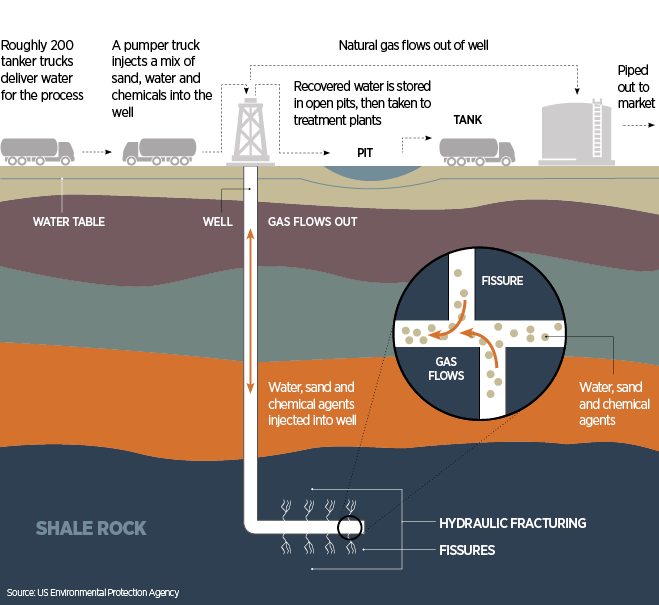
Shale gas extraction explained
01
Hydraulic fracturing, known as ‘fracking’ is where more than a million gallons of fluid is injected into rock formations to stimulate the flow of natural gas or oil. This fractures the rock and increases the volumes of gas or oil that can be recovered above ground.
02
The fluid used in hydraulic fracturing commonly consists of water, proppant and chemical additives that open and enlarge fractures within the rock formation. Each company uses a different mixture of chemicals and works to protect its secret formula.
03
The chemically induced fractures can extend several hundred feet away from the wellbore. The proppants, which consist of sand, and ceramic pellets or other small particles, fill the cracks caused by the liquid and keep the newly created fractures open.
04
Once the injection process is completed, the internal pressure of the rock formation causes fluid to return to the surface. This fluid can contain injected chemicals as well as natural materials such as
brines, metals, radionuclides and hydrocarbons.
05
Wells are drilled vertically and can extend to hundreds and thousands of feet below the land surface. The drilling may also include horizontal or directional sections, extending thousands of feet on their own, to maximise the amount of natural gas and oil collected.
06
The full impact of shale extraction is not yet known and will likely take years to calculate, but many are concerned about its environmental impact. In 2013, 1,000 people gathered in Manchester for largest ever fracking protest.
Workplace fatalities in the US are decreasing, according to the Bureau of Labor. However, this is not cause to be complacent – accidents at work can still be deadly. As this infograpic illustrates, there were more than 4,000 work-related fatalities in 2012. Causes ranged from transportation incidents and homicide to slips and fires.