



Eltel Group: powering Europe’s infranets for a smarter recovery

As Europe tries to restore its competitive edge, the role of energy policy has come under review. The optimistic view of Europe as a showcase of well-managed climate policy has been challenged by the continent’s biggest economy: Germany. The radical policy of Energiewende – through which Germany boosted the share of renewables in its energy mix – has lately faced the realities of budget: the cost and fairness of subsidies, as well as the cost to citizens (with some being forced into so-called ‘fuel poverty’), have come under scrutiny.

Energy policy is a balancing act between availability, acceptability and affordability. For a period, it seems, too little attention was paid to affordability – a trend that has come under criticism as the recovery of the European economies has proven slower than expected. The shale gas boom in the US has also had a major impact on the competitiveness of Europe: the price European industry is paying for energy is suddenly too high. The question is, what should be done to secure a long-term future with enough energy, in which the impact on the climate is acceptable, and the prices industry and consumers pay are affordable?

Trends and drivers
A recent study by Eltel identified the following trends and drivers affecting European energy transmission and distribution: ageing grids; the fulfilment of an internal EU energy market; the continued introduction of renewable energy sources (RES), and their connection to the grid; increased demands on load management; net availability and reliability; and smart grids.
Many of Europe’s transmission and distribution networks are over 50 years old and approaching the end of their technical life. This means a natural need for rehabilitation and technological upgrades. Several key projects have been identified to reduce grid congestion and allow a higher degree of electricity market coupling. Higher load variability is driving investments in transmission upgrades due to RES. Peak load power will increase until 2020. Modern transmission nets and congestion management are needed due to intermittent power sources (such as wind and solar power) and load variability.

Stricter requirements from regulators encourage utilities to increase net availability and reliability. Extreme weather conditions have shown the vulnerability of distribution infrastructures: in Northern Europe, for example, storms have inflicted significant damage on electricity infrastructures over the past couple of years. This is partly due to the number of overhead lines in rural areas. Due to new regulations on climate-proofing electricity networks, utilities have established 15-year investment programmes to convert to underground cabling.

Many of the trends we have mentioned are driving the development of smart grids – a process that began with the automation of transmission networks in the 1970s and which has since taken huge steps through the introduction of medium- and low-voltage nets. However, the automation is not complete and a lot remains to be done if the whole supply chain is to be brought online and under better control.

Pioneering the infranet solution
Eltel is a Northern European infranet service company whose main business is engineering, building and caring for electricity and telecommunication networks. For decades, the company has worked with the leading operators both in electricity (El) and telecommunications (Tel). Eltel was divested by the Nordic energy company Fortum in 2001 and sold to private equity investors. The company launched a new strategy to integrate its best competences in El, Tel and IT/IP, to offer outsourced solutions and services to utilities: economy of scale and scope, compared to in-house operations, would give the company its competitive edge. Since its establishment, Eltel has grown six-fold, operating in 10 European countries and undertaking a number of electrification projects in fast-growing African countries. The company is typically a partner to all the leading power and telecom operators in the markets in which it operates.

Eltel has grown six-fold, operating in 10 European countries and undertaking a number of electrification projects in fast-growing
African countries

“We have all the technical competences that today’s infrastructures require,” says Axel Hjärne, President and CEO of Eltel Group Corporation. “Next, we must act as a service organisation, delivering value to our customers in all kinds of situations. And thirdly, this must be a business for us. The need for change for our employees, management and culture has been huge. Looking at our success, we could claim we have been successful at changing the earlier government-led, monopolistic markets and culture into an open and competitive marketplace. We need to understand the needs of utilities in a bigger picture, and we need to master the smallest details day after day. Our management system is called ‘the Eltel Way’, which sets all the important company practices needed to run a successful business.”

Shaping future infranets
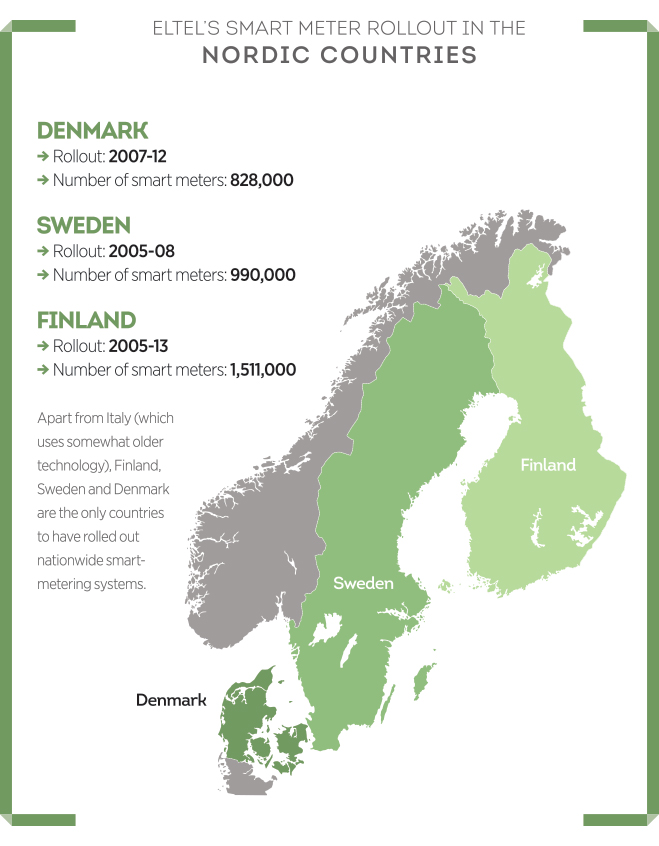
Having established itself as a reliable partner to operators, it has become more important that Eltel proves itself a proactive partner in the deployment of new technologies. At the end of 2013, Eltel fitted the last homes in Finland with smart metres – completing Fortum’s 600,000-meter installation project. Hjärne says: “Today, consumers can follow their hourly consumption patterns of electricity, change their consumption behaviour and even buy electricity hourly on the spot market. This is a huge change from before. For the utilities, the online connection provides a new customer relationship interface, and a platform to develop new business models and offerings. In controlling the network status, they can now localise any disturbances to availability after storms online, and Eltel maintenance teams can be dispatched, without delay, directly to sites.

“For the electricity industry, the most efficient way to reduce emissions would be higher energy efficiency. There have been good pilots to improve the efficiencies but obviously one of the problems at the policy level has been the lack of reliable ways to report energy efficiency at a national – not to mention a European or global – level. However, this opportunity is still there, and Eltel is taking full advantage of it both in the pilot developments and large-scale technology deployments.

While we have established the competences to deliver the solutions, our next step is to offer these solutions to new customers. Besides Finland, Sweden and Denmark, only Italy – with somewhat older technology – has rolled out nationwide smart-metering systems. Maintaining the performance level of existing networks by well planned and efficient upgrades, rehabilitation and maintenance services, and providing the best solutions in an efficient manner in new infrastructure investments is necessary for Europe to secure the critical availability of electricity and telecommunications.”

Delta Controls looks to simplify costly building operating systems

Rental income has been reduced by 2.9 percent and overall building income 3.23 percent since 2011. According to the International 2013 Experience Exchange Report from the Building Owners and Managers Association (BOMA), building owners and managers are looking to offset those costs by maximising their building efficiency.

Joe Markling, BOMA International Chair, and Managing Director of Strategic Accounts with CBRE, says: “Property professionals know that strong asset management is more important than ever, and the continued and significant decreases in utilities and other expenses underscore the fact that well-run buildings can thrive in any market condition.”

The complexity of multiple building operating systems could be diminishing the effectiveness of your building’s facility
staff, and inhibiting potential savings

For most, the operations required to maintain a building’s systems are usually unnoticed or, at best, thought about only when things go wrong. Somewhere in your facility is a department full of people, or maybe just someone, whose sole purpose is to ensure the entire process is invisible.

Behind the scenes, there is a complex network of computer-controlled systems, from lighting to heating and ventilation through to security and access controls. Every year, more and more of a building’s systems are becoming centrally controlled, and the amount of information being generated and data being collected is starting to become overwhelming.

The complexity of multiple building operating systems could be diminishing the effectiveness of your building’s facility staff, and inhibiting potential savings. What should be the peak of efficiency turns into a control room more akin to data displays on the New York Stock Exchange Floor, each displaying a different set of graphics, alarms and alerts for each controlled system.

Your building’s facility manager and maintenance staff have to sift through each different system to identify, prioritise, troubleshoot and resolve any irregularity. What’s more, your management team doesn’t just expect the building to run: you need the savings building automation systems should deliver – and you’d like to see the evidence of that in reporting.

Fulfilling the promise
The scale of complexity is amplified when applied to property management companies measuring KPIs throughout multiple facilities nationwide – or university campuses or hospitals, with not only multiple buildings, but also a variety of specialised environments.

The larger the site, the more challenging the task of simply monitoring each building’s controlled systems becomes. We have, in essence, gone back to the earliest days of patrolling the engineering levels looking at gauges, except that it is now all done through a mouse and keyboard. How can we achieve the promise of simplicity first introduced with the advent of modern building management system controls?

Separate energy measurement and building operating systems now just don’t make sense

David Stephen from Delta Controls thinks he has the answer: “My goal with enteliWEB was to be able to provide a single screen that could, in a glance, let anyone from the facility manager through to the CEO know exactly how their building was performing.”

The goal of Delta Control’s new flagship software platform was ambitious: how do you find that one-size-fits-all format that will work for both a strip-mall and a national real-estate management company? Surprisingly, you don’t.

“What we’ve done is build a framework that allows each user to have their own customised dashboard interface,” says Stephen. “It’s obvious that the CEO, the facility manager and maintenance staff all need radically different pieces of information in completely different formats. enteliWEB gives each user the ability to customise their dashboards quickly and easily by themselves without the need for programmers or specialised skills.”

Taking a proactive approach
For your building, single-seat operational control can mean the difference between your facility management being proactive and reactive. If facility staff can spot the tell-tale signs of an issue early through a simple, flexible interface, then resources can be allocated more effectively.

By using the same systems as the facilities staff to create cost projections and calculate ROI through actual building data, fiscal management of your building can be based on fact. Further than that, building management systems’ dashboards should link seamlessly into the building automation system so your facilities team can make real time changes to schedules and systems set points directly from the software.

“Separate energy measurement and building operating systems now just don’t make sense,” says Brian Goodchild, President of Delta Controls. “Your system needs to be flexible enough to track building performance and adjust the building systems”.

enteliWEB empowers your facilities team to identify issues and act quickly to control operating costs. You can make the building more controllable and report on the energy efficiency improvements you wanted in one intuitive interface. Make sure you are optimising and protecting the value of one of your largest assets: your building.

Demand for graphene grows as Haydale sets sights on IPO

South Wales-based specialists Haydale are set to try to raise £10m when they start trading shares on London’s alternative market next month. The move follows a push to commercialise graphene as the incredibly versatile material begins to be used in manufacturing. Last year Applied Graphene Materials floated on the same market and shares have since doubled.

Haydale’s proprietary plasma technology overcomes key barriers in large-scale manufacturing of the material. In a statement, Haydale’s CEO Ray Gibbs said that the IPO would “contribute significantly to the development and progression” of the company’s technology. The company also said that the money raised would be used for acquisitions or to create “strategic alliances”. The company has already raised £4.4m in private investment since 2010, while current annual revenues for the company are around £100,000.

[Graphene] is the thinnest material possible, and also the strongest, as it cannot be broken down any further

As investor interest grows, money continues to be piled on investigating the applications of the material. In January the European Commission launched the ‘Graphene Flagship’ program, promising €1bn to be dedicated towards further research. The program is the EU’s biggest ever research initiative, showing how important the material is believed to be.

Graphene was first isolated in 2004 by scientists at the University of Manchester, who would later receive a Nobel Prize for their research. The carbon-based material is formed from a one-atom thick layer of carbon arranged in a honeycomb lattice pattern, in effect making graphene two-dimensional. It is therefore the thinnest material possible, and also the strongest, as it cannot be broken down any further. It has a variety of useful properties; it is extremely light and is an excellent conductor of both heat and electricity. Production of the material involves a fairly complicated chemical process, although developments in recent years have made it easier to create.

The material could radically transform several products and allow production of flexible electronics, high-capacity batteries and stronger, lighter composites that could be used to build anything from aircraft to bicycles. It is also believed that graphene could be used to make computer chips that would be smaller, faster and more powerful than the current silicon-based chips used today.

The UK government has also pledged to increase graphene investment, with Chancellor George Osborne calling it a “great British discovery that we should break the habit of a lifetime with and commercially develop in Britain” in his Budget 2014 speech.

The five costliest product recalls of all time

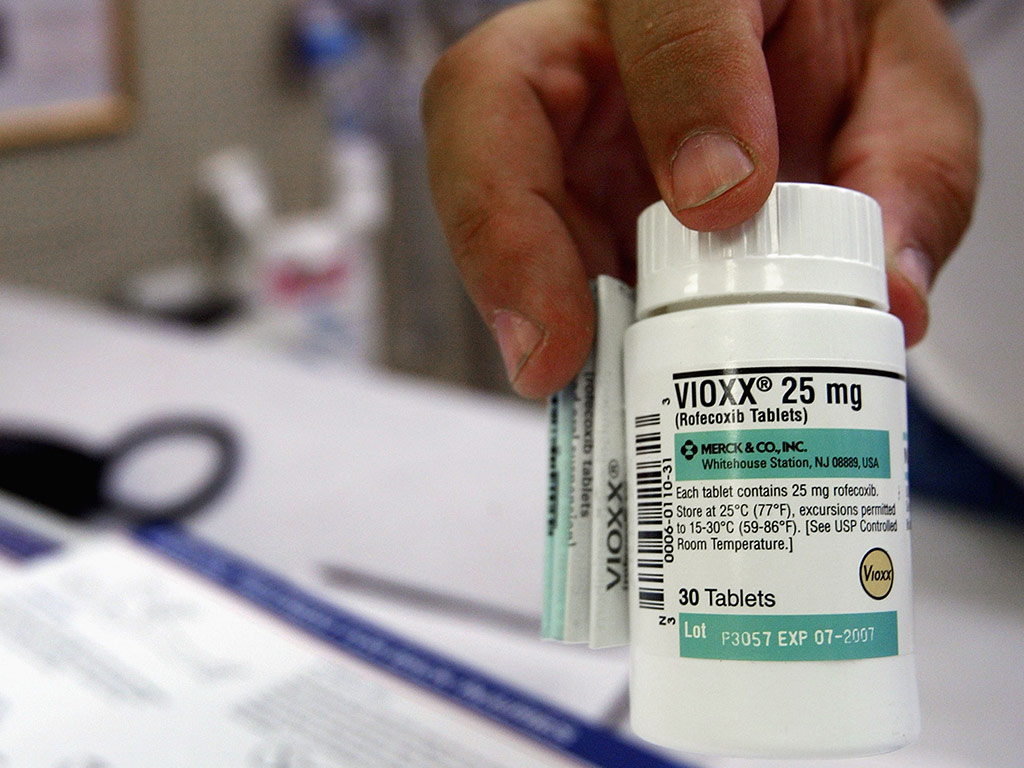
1. Merck’s Vioxx

Merck’s FDA-approved arthritis drug Vioxx was later discovered to carry with it “unacceptable cardiovascular risks,” and in 2004 was pulled from the shelves. The pharmaceuticals giant said shortly after that it expected some $725m in lost sales and later agreed to pay $4.85bn to settle 27,000 lawsuits in 2007.

Before being recalled from shelves, Vioxx was thought to be used by millions of arthritis sufferers around the world

2. Ford’s Firestone tyres

The American automaker recalled millions of Firestone tyres in 2000 after widespread reports of unusually high incidence of failure, hundreds of deaths and thousands of major injuries. Ford’s decision to pull 6.5 million tyres cost the company $3bn, alongside approximately $600m in lawsuits relating to the issues at hand.

Many of the Firestone tyres recalled in 2000 were used on sports vehicles

3. Toyota’s pedals

The Japanese car manufacturer initiated a string of pedal-related recalls towards the end of 2009 and beginning of 2010, pulling approximately nine million vehicles over the course of three months. The recalls combined cost Toyota $2bn, alongside a further $1bn used to settle lawsuits with previous car owners.

toyota
This picture shows a brake pedal and an accelerator of the latest Toyota Prius hybrid vehicle on display at the company’s showroom in Tokyo on February 5, 2010

4. The Peanut Corporation of America’s bankruptcy

An outbreak of salmonella prompted the Peanut Corporation of America to instigate one of the largest food recalls in US history and led to the loss of some $1bn in lost sales. The ramifications were so huge that on February 14 2009, the company was forced to file for Chapter 7 bankruptcy and to liquidate its assets.

Peanut-Corporation-of-America
Rep. Greg Walden holds a jar of candy peanut products while questioning Stewart Parnell, owner and president of the Peanut Corporation of America

5. Westland/Hallmark’s unfit meat

After an USDA-led investigation discovered Hallmark/Westland Meat Packing Company products to be “unfit for human consumption”, the company was left with no option but to recall in excess of 143 million pounds of beef. America’s then second largest meat processing plant was shortly afterwards forced into bankruptcy.

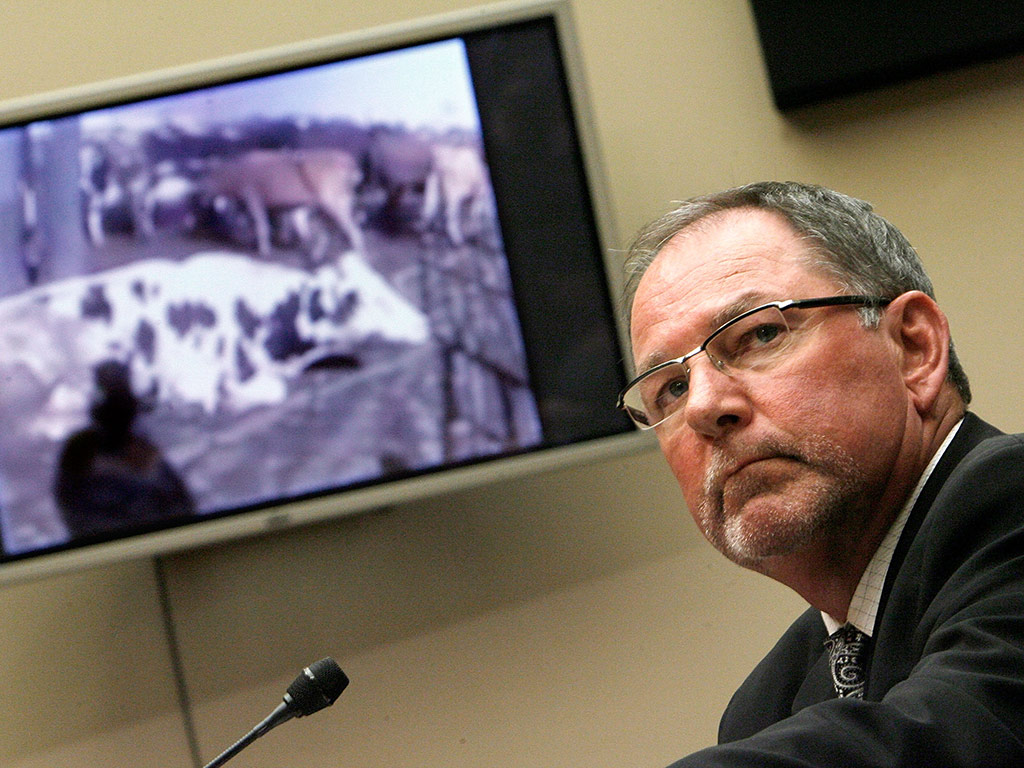
Westland/Hallmark Meat Co. CEO Steven Mendell watches a video of 'downer' cattle at his slaughterhouse while he testifies before the House Energy and Commerce Committee on Capitol Hill March 12, 2008 in Washington, DC
Westland/Hallmark Meat Co. CEO Steven Mendell watches a video of ‘downer’ cattle at his slaughterhouse while he testifies before the House Energy and Commerce Committee on Capitol Hill March 12, 2008 in Washington, DC

Augmented reality applications will erase space and time, says AR&Co

The team at AR&Co are working hard to reach a "new milestone in augmented reality applications" and believe this technology will become more prevalent over the coming years
The team at AR&Co are working hard to reach a “new milestone in augmented reality applications” and believe this technology will become more prevalent over the coming years

In the future, information will float around us – so says Michael Budi, CEO of augmented reality firm AR&Co: “From the establishment of AR&Co, we have seen the future as lying in this direction, and someone needs to start breaking the norm. We have to make people ready to adapt to this technology as it becomes a part of their lifestyle. It is our vision, as a company, to not only become the biggest, most notable player in Asia, but also the key figure in transforming humanity.”

AR&Co in numbers

300+

Augmented reality projects since 2009

250+

Number of brands. Clients include Caltex, Cartoon Network, Disney, Nestlé and Garuda Indonesia

AR&Co entered the marketplace in 2009, with augmented reality as part of its initial specialisation. “In Indonesia, we can be considered a pioneer in the industry,” says Budi, “and it took some time to educate the market before consumers started to understand its potential. Although many use augmented reality as part of their brand marketing campaigns, they have started to see other possibilities of utilising this technology.”

WIR Group is the holding company of AR&Co and, according to Budi, has always believed in innovation: “We always explore new ways, new channels, new platforms that will help establish our clients’ brands as strong living entities. At the same time, the top management always challenge themselves on how they can further advance humanity.”

Daniel Surya, Group CEO of WIR, says: “We have the vision to become Asia’s most out-of-the-box, brand-led innovative media, technology and entertainment group. Therefore, we have to be courageously creative and innovative for both the B2B and B2C markets.”

The effect on businesses
Peter Shearer Setiawan, the Managing Director of AR&Co, explains how “augmenting the real world with virtual objects in real time” can reinforce branding initiatives and increase marketability: “The way [augmented reality] works in general is by recognising a design or shape, such as a print ad, in order to trigger a virtual object that appears on top of it – we can even use our facial features to trigger virtual objects. You will see the virtual object in real time through the screen, and from various angles, as if the object is really there.

“We can distribute the application from smartphones and tablets up to broadcasting usage. Through highly creative content, one impactful augmented reality implementation will change the way you interact with brands. Not only will awareness be increased, but, at the same time, the interaction will be at a personal level – thus increasing brand loyalty and retention.”

Setiawan says the potential for the business to expand is tremendous: “Today, a study may say that only 0.1 percent of the population are using augmented reality, but that share is forecast to grow to one percent in the coming five years… More categories of application will incorporate this technology, such as retail, travel, gaming and many others. The growth will be exponential. A study mentioned the revenue will grow from $181.25m in 2011 to $5.16bn by 2016, at a CAGR of 95.35 percent from 2011 to 2016.”

Beyond augmented reality
Senja Lazuardy, AR&Co’s Head of IT, says: “We don’t want to be seen simply as a developer, but also a content creator. This differentiates us from some of the competitors. Each client has a specific set of objectives that we really need to consider. So each application has to be fully customised.”

R&D is about questioning everything around us, rejecting it and finding new directions through technology

AR&Co has therefore started to work with other technologies beyond augmented reality. Senja explains that his team of programmers and developers are not solely augmented reality specialists, but also experts in automation, robotics and neuro-control mechanics: “I see these as exercises and experimentations to reach a new milestone in augmented reality applications. Through all the creative ideas given to us to be solved, I have seen that this platform is indeed very flexible when it comes to implementing it… As technology advances in many areas, so does augmented reality.”

AR&Co’s creative augmented reality solutions include 4D effects and controlling game applications through neuro-sensing devices. The team equip themselves by researching what is already out there and having regular brainstorming sessions to come up with new possibilities.

AR&Co has been involved with a number of Asia’s upcoming theme parks – including the Cartoon Network Amazone waterpark in Thailand – and recently launched an e-cash system with integrated augmented-reality application.

The application, named Wildlife Care, is produced in partnership with the RedSpace creative agency and WWF Indonesia. It allows the user to pet a digital version of an endangered animal by purchasing food and tools with e-cash. Through augmented reality technology, the user can see their animal come alive on top of their ATM cards in real time.

Preparing for and shaping the future
Nobody can imagine what will be next for augmented reality. The rise of wearable technology – such as Google Glass, smart watches and Oculus Rift – is giving us new ways to access information and interact with our surroundings.

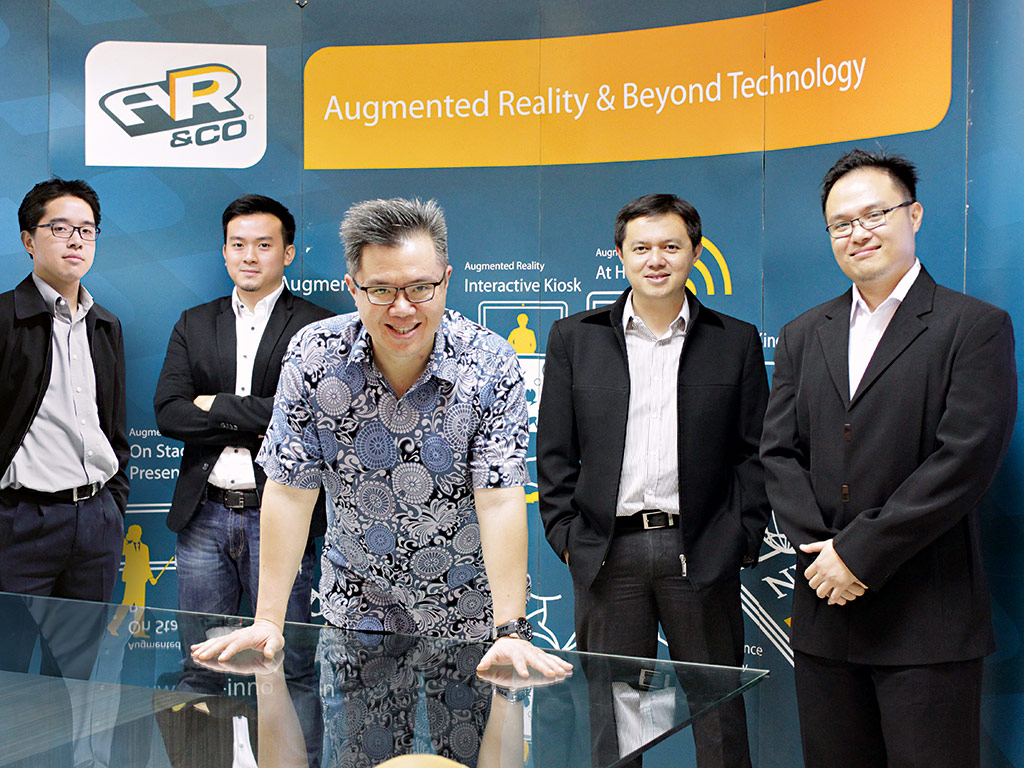
The directors: (L to R) Jeffrey Budiman, Peter Shearer Setiawan, Daniel Surya, Michael Budi and Philip Cahyono
The directors: (L to R) Jeffrey Budiman, Peter Shearer Setiawan, Daniel Surya, Michael Budi and Philip Cahyono

Chief Innovation Officer of AR&Co, Jeffrey Budiman gave his perspective on why the R&D division plays a vital role in preparing the company for the future: “Like Albert Einstein said, ‘Imagination is more important than knowledge’. R&D is about questioning everything around us, rejecting it and finding new directions through technology. Some of the initiatives we have in the pipeline may look like science-fiction at first. The vision is big: that is, to advance humanity and give smiles to many.”

Currently, the R&D division has to fulfil a certain number of patent registrations every month. Budiman says: “We have set milestones for each of the R&D initiatives and ensure all of them are commercially feasible. By utilising these correctly through our various commercial projects, people will slowly adapt to the transformation of the world around them.

“For AR&Co, innovation does not stop at augmented reality – it will be one of many elements that will shape a bigger platform. This new media channel will enrich the world we live in, erase the concept of space, time and distance – a new platform that will delete the notion of there being a ‘virtual’ and a ‘reality’.”

The global marketplace
AR&Co has, through its various projects, proven itself in the marketplace. Setiawan says: “Our clients have come from various parts of the world. We have sent our team to key cities such as Hanoi, Yangon, Singapore, Kuala Lumpur and Hong Kong, among many others. We have an office in Barcelona to serve the surrounding market. Recently, our portfolio has been exhibited at numerous events, including the Frankfurt International Book Fair and IAAPA Attraction Expo.”

The company has been recognised with a number of awards, including at video game shows, marketing events and augmented reality awards. Budi says: “Not only that, we are very happy that we can make our country proud. It is all about preparing a future platform for humanity through technology.”

Tesla faces tough choices as lawmakers ban direct sales

“A backroom deal”, claimed Elon Musk, CEO of Tesla Motors, was the reason for the state ban prohibiting direct sales from car manufacturer to potential customer. In a blog posted on Tesla’s website, the business magnate slammed New Jersey’s Governor Christie and the New Jersey Motor Vehicle Commission for what he called “a regulation that is fundamentally contrary to the intent of the law”.

It is not the first time that the company has tussled with dealers – in May last year Texas banned direct sales

Although lawmakers claim the legislation was enacted to protect dealers, Jonathan Chang, a lawyer for Tesla, said that “there’s no question that this rule was aimed directly at Tesla”.

The new measure, in effect, shuts Tesla out of New Jersey. From April, all cars must be bought through independent dealerships. Tesla, who do not have a franchise model, therefore plan to turn their current dealerships in the state into “galleries” where members of the public can come to ask questions about the cars but not conduct a purchase.

Currently customers in New Jersey will still be able to purchase Tesla’s cars from their website, but a third party has to complete the delivery.  It is not the first time that the company has tussled with dealers – in May last year Texas banned direct sales.

In an interview with the New York Post, Mark Scheinberg, president of the Greater New York Automobile Dealers Association, said he was “confident” that New York State would soon follow suit in putting into law a similar ban.

After posting their first profit in the first quarter of 2013, Tesla’s annual sales exceeded expectations and its share value increased fourfold. Global sales of the company’s Model S are now believed to have passed 25,000 – a significant milestone for the company.

In early March the carmaker also unveiled plans for a $5bn ‘gigafactory’ somewhere in North America. The factory will employ 6,500 people and allow the company to manufacture batteries for 500,000 vehicles every year. Tesla is raising the funds to construct the new factory by issuing bonds and also by seeking other companies who are willing share some of the financial burden.

Demand for FLIR thermal imaging technology sees prices drop

New technologies are brought to market faster than ever before. Sometimes new products are quite expensive in the introduction stage, but, once the early adopters have embraced them and once they can go into mass production, prices go down rapidly. One example is the mobile phone: bulky and expensive in the beginning, it has rapidly become a product that fits in the palm of the hand and is used daily by millions of people.

A lot of common technologies have their origins in military applications. GPS, for example, was developed in the early 1970s by the US Department of Defence to guide missiles. When first integrated with cars for civilian applications, GPS was still a very expensive system. Today, a GPS system is installed in practically every new car. Another technology that has found its way into useful civilian applications from military applications is thermal imaging.

The origins of thermal imaging
Whereas a normal camera is dependent on light to produce an image, a thermal imaging camera – sometimes also called an ‘infrared’ camera – is able to pick up minimal temperature differences and convert them into a crisp thermal image. In contrast to other technologies, thermal imaging can see in total darkness, needing no light at all.

Thermal imaging timeline

1958

Thermal imaging camera invented

1965

Commercial thermal imaging camera introduced

1973

Portable thermal imaging camera introduced

1997

‘Uncooled’ thermal imaging camera introduced

2014

First thermal imaging device for a smartphone introduced

Swedish company AGA, today known as FLIR Systems, developed the first thermal imaging camera for the military in 1958. The first commercial infrared camera was developed in 1965 and was used for power line inspections. It took until 1973 for the first ‘portable’ battery operated infrared camera to be introduced. The technology at that point in time required the camera be filled with liquid nitrogen to cool down the infrared detector integrated in the system.

In 1997, the uncooled thermal detector, also called the ‘microbolometer’, arrived. This detector has no moving parts and is therefore less susceptible to breakdowns. It is also less expensive to produce, which allowed thermal imaging camera manufacturers to bring the price of their products down.

The microbolometer enabled the technology to make its way into commercial industrial applications. The first to discover the benefits of thermal imaging were big production companies, which quickly learnt thermal imaging could give valuable information about electrical equipment.

Fuses, connections, cables and high voltage equipment such as transformers and power lines can all easily be inspected with a thermal imaging camera. The advantage is thermal imaging can help maintenance managers see an anomaly before a real problem occurs, and, as a result, avoid costly breakdowns.

Within the same companies, R&D departments became enthusiastic about thermal imaging technology. The cameras can be used early in a product design cycle. In the development phase, before going into mass production, appliances are thoroughly tested. Thanks to infrared, companies can shorten the development phase and start getting a rapid return on their development investments.

High volume production
Thanks to an increased use of thermal imaging technology by industrial companies, the first careful steps to so-called volume production could be taken. A few years ago, BMW – one of the major automobile manufacturers in the world – decided it would implement a thermal imaging camera for driver vision enhancement into its top-of-the-line Seven series. Since a lot of accidents happen during nocturnal driving, BMW was looking for a solution to reduce the number.

Later on, the same BMW Night Vision module became available as an option on BMW Five and Six series models. The high demand for this safety option allowed FLIR Systems to increase production significantly. Today, for driver vision enhancement alone, thousands of thermal imaging cameras are being produced by FLIR Systems. This increased production volume led to a significant price reduction.

Volume production, however, was not solely driven by consumer goods. Unmanned Aerial Vehicles are becoming more and more common in military and civilian operations. These radio-controlled planes can be equipped with video cameras that are downlinked to a ground station. The military was the first to realise thermal imaging, allowing the aircraft to fly in total darkness and detect targets through smoke and clouds. Civilian applications quickly followed, and today the same aircraft is also to detect such areas of concern as forest fires.

Increased applications
Now volumes are going up and prices are coming down, more and more applications for thermal imaging cameras have started to emerge.

Ship captains need to navigate during the night. The costly vessel, its passengers, cargo and crew need to be protected. With thermal imaging cameras, captains can clearly see channel markers, shipping lane traffic, outcroppings of land, bridge pilings, exposed rocks, other vessels and any other object that might damage a ship when undetected in total darkness.

Installed on a ship, a thermal imager can save lives as well. Finding a person who has fallen overboard within the shortest possible time frame is of the utmost importance. Thanks to thermal imaging, the drowning person can quickly be located and helped out of the water.

Firefighters have been using thermal imaging cameras for years in order to see in absolute darkness through smoke, as well as to detect hot spots in floors, walls and ceilings. The ability of thermal imaging cameras to see through smoke helps save lives.

People can easily be located in a smoke-filled room. The ability to detect temperature differences of objects is vitally important to firefighters, who must often open doors that lead to fires, or who identify the seat and extension of a fire quickly and reliably. FLIR’s handheld thermal imaging cameras have proven an excellent tool when used by experienced and well-trained firefighters.

The FLIR ONE is the first personal thermal imaging device for a smartphone. Applications such as this help to make thermal imaging technology available to the everyday user

Thermal imaging is also making its way into more and more security and surveillance applications. Whereas it used to be the privilege of border patrols and other government-related agencies to use a thermal imaging camera, today more and more industrial facilities – as well as residential owners – are using the power of thermal imaging to protect their valuable assets against theft, vandalism or – even worse – terrorist attacks.

The police and other law enforcement agencies use thermal imaging to find and follow suspects in total darkness. The main task of Search and Rescue professionals is to find people who are in distress, lost, sick or injured.

Either in a remote or difficult to access area, such as mountains, desert or forest, or at sea – whether close to shore or not – thermal imaging is essential. The cameras are sometimes mounted on helicopters flying over the scene. A thermal imager detects human activity in otherwise remote areas so the victim can be found before it is too late. A thermal imaging camera can do this on the darkest of nights, on land, in the air or at sea.

Daily use of thermal imaging
We have become increasingly conscious of energy consumption. Global warming is caused largely by pollution related to burning fossil fuels to heat buildings. Therefore, more and more countries are setting up legislation to inspect buildings on a regular basis for heat loss. A thermal imaging camera is an easy-to-use tool for making insulation defects and other building anomalies visible. It is probably just a matter of time before every building will be inspected with a thermal imaging camera.

Many companies specialise in transporting and transforming industrial gases and chemical compounds. Yet most of these ingredients are invisible to the naked eye: this is not the case for thermal gas imaging cameras.

They offer a number of benefits compared to traditional ‘sniffers’: they scan a broader area much more rapidly and in areas that are difficult to reach with contact measurement tools. Infrared displays a leak as a plume of vapour in the infrared image. Thanks to early leak detection, severe damage or even the loss of human lives can be avoided.

A recent evolution is the use of thermal imaging for traffic monitoring. Traffic managers all over the world are starting to use thermal imaging cameras to monitor and manage traffic streams. Be it for monitoring motorists and pedestrians in urban areas, for detecting incidents on highways and in tunnels, or for traffic data collection purposes, thermal traffic camera systems can enhance traffic safety and mobility.

One of the latest innovations is the FLIR ONE, a case for the iPhone 5 that gives smartphone users a thermal view. This will allow users, for example, to see at night or spot insulation leaks with their smartphone. As thermal imaging cameras are finding their way in more and more consumer-orientated applications, the interest for the product will rise, production volumes will go up and prices will come down.

Where this will lead, nobody knows. But chances are high that, within a very short time frame, every police officer, firefighter, security guard, and car, truck, train or other vehicle, will have their own thermal-imaging camera.

WhatsApp CEO calls data privacy reports ‘careless’ and ‘inaccurate’

In response to widespread speculation, and even official complaints lodged with US regulators, WhatsApp founder Jan Koum has taken to the blogosphere to set the record straight on the company’s data privacy policy. The complaints have come in the wake of Facebook’s landmark $19bn acquisition of the messaging giant, which has led many to believe that WhatsApp’s approach to privacy will be compromised.

Koum, who reportedly owns 45 percent of the company and is now worth somewhere in the region of $6.8bn, was keen to settle any user concerns and attempted to do so in a blog entitled ‘Setting the record straight’. “Unfortunately, there has also been a lot of inaccurate and careless information circulating about what our future partnership would mean for WhatsApp users’ data and privacy,” he wrote.

We don’t know your birthday. We don’t know your home address. We don’t know where
you work

“Respect for your privacy is coded into our DNA, and we built WhatsApp around the goal of knowing as little about you as possible: You don’t have to give us your name and we don’t ask for your email address. We don’t know your birthday. We don’t know your home address. We don’t know where you work. We don’t know your likes, what you search for on the internet or collect your GPS location. None of that data has ever been collected and stored by WhatsApp, and we really have no plans to change that.”

The company’s earnings come by way of subscription fees, which cost $0.99 per year, in opposition to Facebook, whose fourth quarter advertising revenue increased 76 percent on the year previous and was largely responsible for its $1.5bn full year profits.

Koum has previously outlined his aversion to advertising in a previous blog post. “Remember, when advertising is involved you the user are the product,” he wrote in mid-2012.

Suspicions of Facebook’s intentions to change WhatsApp’s privacy stance are understandable, given the company’s short history of hoarding user data for use in advertising. Privacy groups have even gone so far as to ask that the Federal Trade Commission block the acquisition, for fear of Facebook exploiting huge sums of user data stemming from WhatsApp’s 450 million strong user base.

“Users provided detailed personal information to the company including private text to close friends. Facebook routinely makes use of user information for advertising purposes and has made clear that it intends to incorporate the data of WhatsApp users into the user profiling business model,” wrote the Electronic Privacy Information Center and Center for Digital Democracy.

Airports Authority of Trinidad and Tobago to launch business park

Visitors to Trinidad and Tobago will soon be able to visit an exciting new urban centre for shopping and entertainment. At the same time, companies seeking to expand their operations in Latin America and the Caribbean will be able to access prime real estate in one of the region’s most dynamic economies.

The Airports Authority of Trinidad and Tobago – the organisation responsible for managing international airports in Trinidad and Tobago – is poised to announce the launch of a mixed-use business park along the model of an airport city. Phase one of this development, the Piarco Aeropark, occupies 168 acres of prime real estate just metres from the Piarco International Airport in Trinidad.

Business and pleasure
Trinidad and Tobago has one of the strongest economies in the Caribbean. Its economic resilience explains why the country has been attracting investment from across the world, in sectors as varied as oil and gas, financial services, retail, and manufacturing.

The Piarco Aeropark will help bolster Trinidad and Tobago’s reputation as the business and entertainment capital of the Caribbean

The Piarco Aeropark will help bolster Trinidad and Tobago’s reputation as the business and entertainment capital of the Caribbean. The country is renowned for its rich blend of cultures, cuisines and festivals: each year, visitors flock to the islands to take part in their carnival – one of the largest street parties in the world – and to enjoy the country’s world-class diving, game fishing, surfing and birdwatching opportunities.

Access to the Southern Caribbean
The Piarco Aeropark has zones earmarked for free trade, a four star airport hotel and conference centre, retail shopping, entertainment, offices, warehousing, manufacturing, and a maintenance repair and overhaul facility.

The park is ideally located for companies seeking to access South America and the Caribbean. As Trinidad and Tobago is a major producer of natural gas, energy costs are relatively low and give manufacturers located there a competitive edge.

Businesses will also benefit from a highly trained labour force: the product, in part, of successive governments making it a policy priority to offer citizens free tertiary education.

Companies based at the park will be in an excellent position to reach potential clients from other Caribbean countries, as well as Venezuela. Historically, a significant number of people from the Southern Caribbean have come to Trinidad and Tobago to shop for gifts and parts, as well as to make wholesale purchases of foodstuffs and hardware items. The air cargo links between the islands and the Southern Caribbean support this retail economy.

A worldwide call for Requests for Proposals for the leasing of space at the Piarco Aeropark is expected shortly.

For further information visit tntairports.com/aatt/nabpark.html or email marketing@tntairports.com

China stops mobile payments amid security concerns

China’s central bank has demanded that mobile payments and the use of virtual credit cards be halted immediately, amid concerns over the security in verification procedures by major internet firms Tencent, Baidu and Alibaba Group.

The move comes just a day after Alibaba and Tencent launched virtual credit cards, which the central bank ruled too risky, state media said.

It is the latest in a series of clashes between China’s finance sector and IT companies, which have pushed into the banks’ territory by offering financial services such as online payments and wealth management products.

It is the latest in a series of clashes between China’s finance sector and IT companies

Chinese officials have so far permitted the firms’ growing roles in the finance sector, viewing online and mobile payments as beneficial to ordinary consumers and as a potential booster for the economy. However, the incursion into traditional banking turf has caused banks to call for stricter regulations as opposition towards tech firms continues to mount.

As such, the People’s Bank of China said in a statement that it has ordered the temporary halt of virtual credit cards and QR payment systems.

“The level of risk control directly impacts the users’ information security and financial security,” the central bank said, adding that further research was needed to assess whether the virtual payment services could handle such risks. In addition, the companies have to submit detailed reports on their procedures.

This follows recent tension between state-owned China UnionPay, the country’s monopolistic credit card provider, and the internet firms, which were set to launch virtual credit cards that could potentially hurt UnionPay’s revenues significantly. In February, Chinese and international media reported that UnionPay had put pressure on Alipay to route its new virtual card service through UnionPay’s system so it could increase its commission earnings on transactions.

However, Tencent and Alibaba announced just this week that they would partner with Citic Bank to launch the virtual credit cards, thereby eliminating UnionPay from being able to charge fees on the online card transactions.

Tencent, Alibaba and Citic have all confirmed to Reuters that they’ve received notice of the restriction, which has caused shares in all three firms to drop significantly. Spokespeople from both Alibaba and Citic said they had adhered to the correct application procedures before launching the virtual credit cards and that they would await further information from the PBOC.

Panasonic offers Chinese workers pollution compensation

The severity of China’s pollution problem has prompted Japanese electronics giant Panasonic to offer its Chinese workforce a pollution-related premium on top of their base salary. The deal is thought to be the first of its kind and comes shortly after an associate professor at China Agricultural University College of Water Resources and Civil Engineering likened the country’s smog to a “nuclear winter”.

Earlier this month, China’s vice-minister of environmental protection Wu Xiaoqing revealed the true extent of the damage when he revealed that 71 of 74 Chinese cities surveyed by his department had failed to meet state pollution standards through 2013 – amounting to 96 percent. Many of China’s major cities to this day remain cloaked in a thick smog, and require that residents and workers wear masks to protect against health hazards.

71 of 74 Chinese cities surveyed by his department had failed to meet state
pollution standards

The pollution premium will come into being as soon as April and is reportedly set to increase base pay by 2,000 yen ($19.50) a month for every worker.

Although Panasonic employs some 70,000 workers in China, the pollution-related pay rise – otherwise termed ‘hardship pay’ – will only apply to expatriates, and comes as a number of major Japanese companies have promised to bump up their wages ahead of April’s sales tax hike.

The move should be seen as an instant response to Abe’s so-called ‘war on pollution’ and on-going pressure put on major Japanese firms to raise wages.

A number of Japanese firms, amongst them Toyota, Toshiba, Panasonic and Hitachi, promised to boost employee salaries come April to protect against the economic slowdown that could ensue as a result of the sales tax rise – up from five to eight percent.

Toyota has promised to raise employee wages by an average of 2,700 yen ($26) a month along with a bonus worth 6.8 months of pay, whereas Nissan promised a larger 3,500 yen ($34) hike and a lesser bonus worth 5.6 months of pay. Although the amounts in themselves appear minimal, it signals an important step for Japanese consumers, many of whom, have worked for years without the slightest sniff of a rise to speak of.

Japan’s consumer confidence dropped sharply in February – 38.3 as opposed to 40.5 a month previous – and higher wages are believed to be the single most important influencer in spurring consumer spending and protecting against deflation.

Can it beat Blu-ray? Sony and Panasonic unveil Archival Disc

Japanese tech giants Sony and Panasonic have unveiled the upcoming new optical media standard, called the Archival Disc. The companies say the new storage medium, designed for professional use and slated for a Q2 2015 release, will be able to store up to 300GB of data. Further iterations of the disks will be able to store 500GB and then up to terabyte of data. The announcement follows a joint agreement made between the companies in July 2013 to develop the next generation of media storage.

Sony and Panasonic say the disks are intended to be durable and more secure. Optical disks are more readily able to withstand humidity and temperature changes. They also have excellent dust-resistant and water-resistant properties. The companies say the disks will have inter-generational capabilities between different formats, making them a “robust medium for long-term storage of content.” The companies have agreed on a roadmap, logo and specifications for the initial iteration of the format.

The Archival Disc

300GB
Storage capability upon 2015 release

The initial Archival Discs will have six times the storage of a Blu-ray. In a joint statement the companies said this was to address “demand for archival capabilities…in the film industry, as well as in cloud data centres that handle big data, where advances in network services have caused data volumes to soar.”

The companies have not yet stated whether the disks will eventually be released for consumers, but developments in cloud storage, online streaming and video codecs may remove most of the need for physical storage mediums for the average user.

The two companies agreed to co-develop the new format “to improve their development efficiency based on the technologies held by each respective company”. Both Sony and Panasonic already developed Blu-ray format technology separately.

They are also confident that the disks will quickly be adopted, saying that “by actively promoting the adoption of a new standard for next-generation high-capacity optical discs, [we] intend to offer solutions that preserve valuable data for future generations.”