




IBM guides businesses through the transition to cloud computing

When Eric Schmidt popularised the term ‘cloud computing’ at a conference in 2006, few could have known the extensive impact the “emergent new model” would have. Not only has it transformed the way in which data services are conducted, it’s now reshaping the very fabric of business across manifold industries.

Over a decade later, and the tech powerhouses of this world – Google, Amazon, IBM – have taken the concept and run with it. By harnessing the potential of the public cloud, they supply companies with infinite compute and data resources – a genuine pay-as-you-go model that requires no physical infrastructure, provides cutting-edge technology on demand, and offers a system that is both robust and secure.

Over the past year or so, we’ve witnessed an expansion in the definition of the cloud. Previously, cloud technology was concentrated in the public sphere, offering computing services over the internet on either a free or pay-per-use basis. Today, however, the cloud encompasses a whole spectrum of services – from private infrastructures for individual enterprises to edge devices and the very far reaches of the Internet of Things (IoT).

It’s no longer a case of whether or not a company should adopt cloud: it’s a question of when, how and with whom

“I think enterprises are starting to look at a much wider landscape with regards to compute options, and whether we can maintain a common architecture across them,” said Steve Robinson, General Manager of Cloud Technical Engagement at IBM. “They’re also considering more fluidity in terms of where their applications and workloads run, and a much richer set of considerations than just simply, ‘how quickly can I get on a public cloud provider?’”

Flexible solutions
Enterprises are now exploring the ways in which they can take advantage of the cloud’s key benefits – whether that’s elasticity, flexibility, portability or simply being able to consume services within a certain ecosystem. “I think that leads to a whole load of interesting possibilities, especially in the sense of what workloads can be brought to cloud and what kind of transformation is needed – from designer architecture all the way to management and security,” said Bala Rajaraman, CTO and Fellow at IBM. “So we’re getting a much more varied conversation.”

Robinson drew parallels with the early days of the internet: “If you look back, we had intranet, extranet, public internet and then, all of a sudden, there was a rally around a set number of standards and it just became the internet. I think we’re seeing the same thing with the cloud as well, with rally points such as Linux, Docker and Kubernetes, which are now supported by most of the major vendors for the orchestration and management of containers. It is simply becoming one cloud.”

Aside from ‘born-on-the-cloud companies’, most organisations are faced with a choice. But it’s no longer a case of whether or not a company should adopt cloud: it’s a question of when, how and with whom. This transition – which inevitably requires enterprises to transform their business processes – doesn’t simply happen overnight. This is where hybrid cloud comes in.

North Star
A hybrid-cloud computing environment combines public and private cloud services with on-premise infrastructure, offering organisations an invaluable degree of flexibility. As a result, enterprises can benefit from the scalability and economies of scale of public cloud, as well as the security and customisation of private cloud, all the while preserving pre-existing IT infrastructures. Put simply, it allows users to get the best of both spheres, while ensuring workloads are treated as effectively
and economically as possible.
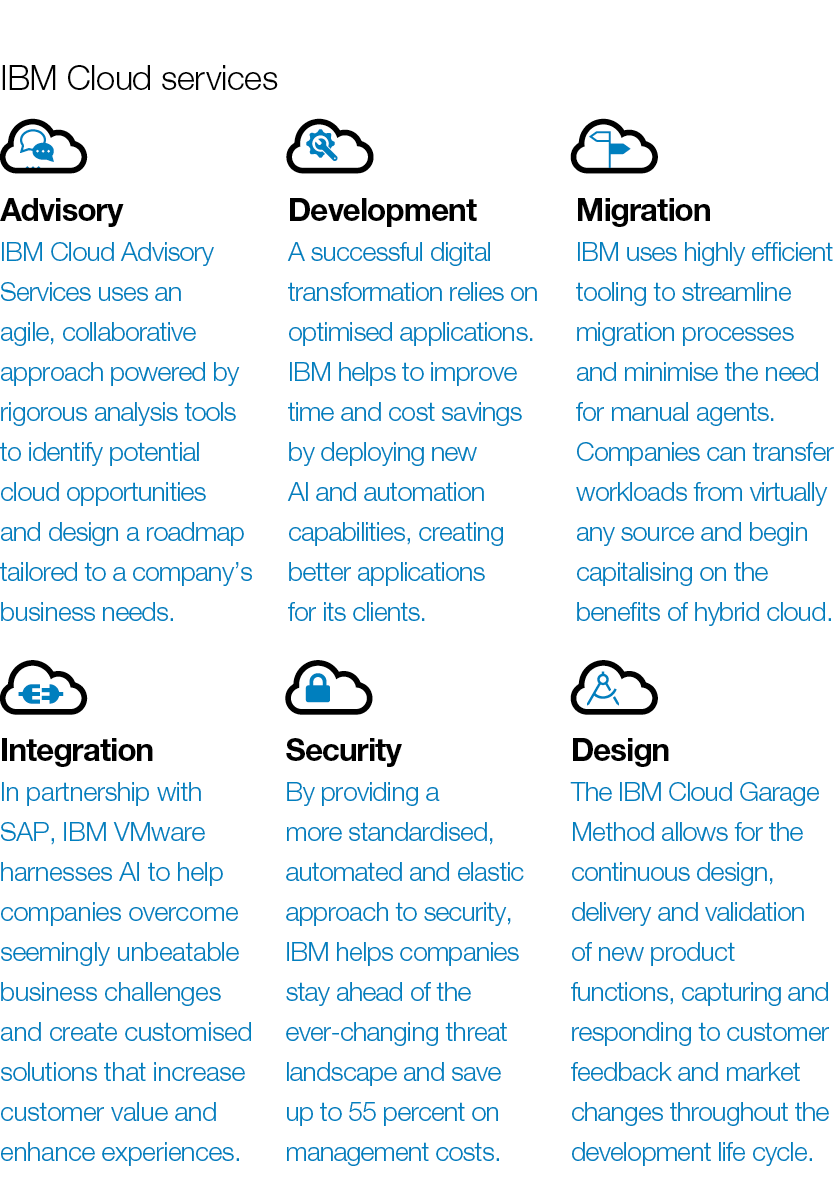
But despite these myriad benefits, challenges still exist. Robinson told The New Economy: “Most of the enterprises that we’re talking to view cloud as their North Star, but they’re starting to look at the transformational impact that it may have and it’s fairly broad – in fact, we have several firms calling it a ‘core transformation’.”

Rajaraman agreed: “These challenges touch on everything, including how you actually organise the process of transformation in terms of centres of competency, skills and architecture, so that you can converge the organisation around good patterns with building for the cloud.

“It also involves questions such as, how do I transform my existing estate? How do I manage and govern my data? And how do I build my new generation of service management? The moment you get into a hybrid world, you have a whole cluster of providers. Essentially, it takes a problem that is contained within a data centre and expands to a whole host of different players.” Organisations must then consider how best to deliver their service within such an environment, how to ensure it’s secure and how to manage the prospect of a variety of people owning different aspects of it.

When considering these challenges – and the plethora of questions that must be answered – the need to identify the right partner becomes clear for all to see. “This is where we get a tremendous resonance with our enterprise customers,” Rajaraman said. “We’re one of the few companies that understands what it takes to deliver all of the changes that need to happen to transition to hybrid cloud. And we have the assets to do it, too – be it transformation assets, management assets, security, data or the governance of data. That’s a big deal.”

The IBM approach
Although it does spend time with start-up communities that were born on the web, IBM’s methodology is finely tuned to deal with the level of complexity that can be found in global enterprises. “A lot of our cloud definition, as well as the features and functions of our portfolio, is shaped around supporting the enterprise client,” Robinson said. “We’ve typically observed that only around 15 to 20 percent of enterprise workloads have landed on the cloud.

As firms begin their cloud journey, they are met with the exciting prospects proffered by new technological advances, such as AI

“Now, these are very different to a born-on-the-cloud company that probably has all of its business functions residing on the public cloud; for an enterprise, there are limitations with regards to security, latency and performance, predictability of workload needs, and more. So we still think there’s 80 percent or more of workloads that have yet to begin on the cloud journey – that’s IBM’s sweet spot.”

While there are a few vendors in the market currently setting their sights on enterprise clients, many of them are simply trying to either replicate portions of their public cloud in the private space or develop applications to ease the movement of data towards their public model. “At IBM, even since the early days of our cloud, we’ve always envisioned it to resemble three islands closely bound together,” Robinson added. “These islands are private cloud, dedicated public cloud and multi-tenant public cloud.”

To ensure its architecture continues to function effectively, IBM takes a more holistic approach than most. “We’ve been very aggressive in modernising our middleware, containerising it and bringing it to all of those environments,” Rajaraman said. “And we’ve put a lot of focus in a common backplane across those three environments for management, integration and [application programming interface] connectivity, which again speeds up workloads moving in that direction.”

IBM has also started adapting its public cloud to this end. Aspects such as where it stores its data centres, how data is moved between those centres and the security around them are now more closely adapted to enterprises and how they move their workloads forward. “We’re beginning to see a common platform across private and public cloud, which has common architecture around it,” Robinson said. “There really is a focus on the full enterprise cloud journey.”

“I think we’re in a very unique position to ease that transition, meet them where they are, enhance what they’re doing and allow them to make some very logical and cohesive steps as they move out.”

Strategic partnerships
As firms begin their cloud journey, they are met with the exciting prospects proffered by new technological advances, such as AI, blockchain and IoT. Rajaraman highlighted the ability of these services to further refine a business’ processes: “If you look at the healthcare or financial services industries, for example, these technologies complement their existing capabilities; they can change the user experience while also allowing more insights to be gleaned from various parts of the operation. Again, integration plays an important role.

“If you look at the continuum of cloud, it’s a lot more about how you change your business, how you change your processes and how you exploit your data, rather than just pure infrastructure or the choices of infrastructure. Infrastructure becomes a means to an end.”

It’s a case of taking an enterprise’s existing business processes and infusing higher-level services – and doing so securely. “You also need to ensure the insights and algorithms that you build belong to you as an enterprise, and that they are not shared with everybody else, including your competitors,” Rajaraman added. “All these elements of security, integration, connection and performance come together in terms of how we deliver solutions in this space.”

To this end, IBM has recently formed a series of key partnerships. In January 2018, for example, the firm revealed that it had started working with shipping giant Maersk to improve its business processes through the use of blockchain technology. In March, IBM established a joint venture with Mastercard: known as Truata, this Europe-based data trust allows firms to analyse their financial client information within the constructs of the General Data Protection Regulation.

“In this situation, we set up an independent trust, had it listed on the IBM Cloud and applied our research elements to help anonymise and pseudo-anonymise the data, so that we could quickly mask all the personal information associated with it,” Robinson told The New Economy. “Then, we brought in our data tools to allow you to continue to derive correlations as well.”

IBM is making headway in other markets, too: Watson, for example, has been integrated into Salesforce systems to deliver improved CRM solutions using the power of AI. Meanwhile, the Weather Company, which runs on IBM Cloud and handles billions of data feeds, is having a profound impact on a variety of industries.

Following recent hurricane activity in the US, the service received a record number of queries. And it’s not just individuals checking for rain, either: enterprises are now using this service against their insurance models. Elsewhere, it’s impacting aeroplane activity on runways and being usedto create predictive models.

On cloud nine
As these higher-value services continue to open up new opportunities, enterprises are turning to numerous vendors for their cloud needs. Multicloud – the use of computing and storage services across several cloud-hosting environments – provides an array of benefits for organisations in a wide range of industries.

For instance, it adds a measure of redundancy, ensuring that, even if downtime occurs from one provider, outages are avoided. Further, cloud diversification enables firms to position their providers closer to their users – a boon for global enterprises hoping to improve performance and reduce latency issues. The multicloud approach also prevents customer lock-in.

According to a study by the International Data Corporation, 86 percent of enterprises expect they will require a multicloud strategy to support their business goals within the next two years.

Given this expected rise in activity, Rajaraman was quick to outline three key dimensions that enterprises should consider before making the move to a multicloud system: “The first is, how are your applications built and how do they integrate across different clouds? Once that is established, you must consider how you intend to manage your data, move it, govern it and encrypt it. Finally, given that you have multiple clouds, you need to discern how you’re going to manage everything, from monitoring to picking the right cloud with the right cost points and the right capabilities.”

IBM is advantageously positioned in this respect. In terms of its product portfolio, it boasts a plethora of applications – from Java and WebSphere to databases – that can be made available across multiple clouds. What’s more, IBM’s data governance and security products can be supported on various clouds.

IBM has also recently announced a new cloud management platform. “[Our new platform] manages containers and clusters of containers wherever clients are, whether they’re on premise, on IBM Cloud or on other clouds,” Rajaraman explained.

“From a governance perspective, this ensures we have a view of all of the outlets across different clouds. It can also ensure that the configurations across these clouds are consistent, so that they can be governed, they can be used for [high availability and disaster recovery], and so on and so forth.”

Robinson added: “One of the things we continue to hear with multicloud is that many firms are a little fearful that it may amplify the complexity of the environment that they’re dealing with. We feel, however, that there’s a handful of very key emerging standards that we’re not only supporting with our products, but [we’re] also really helping to shape the open source communities around them. For almost every enterprise that we talk to, one of their primary concerns is vendor lock-in, so many of them want to have the flexibility of moving betweenone vendor [and] the next.”

Robinson has also encountered many enterprises that try to go down the open source route on their own, only to find they are quickly faced with a number of challenges. “Many times that’s when they come back to IBM to say, ‘Look, you’ve got officers on the board, you can sponsor projects yourself, you understand what we’re dealing with in terms of the complexities – can you help us drive this through as well?’ So this is maybe the reason that even though clients definitely want to be open and flexible, theyview IBM as a very safe haven.”

Transformation of any kind is tough. But with the right partner, the adoption of multicloud and hybrid cloud isn’t an arduous task: it’s an exciting step towards business processes that are more effective than previously imagined possible.

US accuses Chinese spy of stealing aviation trade secrets

A Chinese intelligence officer has been charged with economic espionage and stealing trade secrets from a number of high profile US aviation firms, according to indictment documents from the US Department of Justice.

Xu Yanjun, who also uses the aliases Qu Hui and Zhang Hui, was extradited from Belgium on October 10 to face trial on US soil, according to the Department of Justice.

Xu is accused of attempting to obtain trade secrets and economic data from GE Aviation and other American aerospace firms

The US authorities are claiming that Xu’s plot was orchestrated by the Chinese Government. FBI Assistant Director Bill Priestap said: “This unprecedented extradition of a Chinese intelligence officer exposes the Chinese Government’s direct oversight of economic espionage against the United States.”

Xu is accused of attempting to obtain trade secrets and economic data from GE Aviation and other American aerospace firms, including a leader in unmanned aerial vehicle technology, beginning in 2013.

Xu is a deputy division director within the Chinese Ministry of State Security, which conducts domestic and overseas espionage. US Attorney General For National Security John Demers stated in a press release: “This case is not an isolated incident. It is part of an overall economic policy of developing China at American expense. We cannot tolerate a nation’s stealing our firepower and the fruits of our brainpower.”

Xu is charged with economic espionage and stealing trade secrets, accusations that carry a maximum combined penalty of 25 years in prison.

The charges form part of a larger espionage battle raging between China and the US. Earlier this month, an investigation by Bloomberg revealed that Chinese firms had placed microchips inside hardware destined for US technology companies, an action it alleges would facilitate spying by the Chinese Government.

The indictment of Xu marks a new development in the conflict; it is the first time an intelligence official has been arrested and faced charges for specific crimes on US soil.

Amazon and Apple victims of alleged microchip spy attack

Amazon and Apple are among 30 US companies that have experienced a hardware spy attack, according to an investigation by Bloomberg.

The attack, Bloomberg claims, was made possible by the surreptitious placement of tiny microchips on the server circuit boards that power computers and mobile devices. The boards were manufactured by California-based firm Super Micro, which makes hardware for the two tech giants and a range of other private and governmental organisations.

According to the investigation, the chips were first discovered in 2015 by AWS Elemental – formerly Elemental Technologies – a start-up that Amazon was in the process of acquiring through its cloud computing arm Amazon Web Services (AWS). As part of due diligence relating to the acquisition, Elemental’s servers, which were manufactured by Super Micro, were sent for security analysis. Testers discovered the microchips implanted in server motherboards.

The attack was made possible by the surreptitious placement of tiny microchips on the server circuit boards

Amazon allegedly reported their findings to the US authorities and a top-secret probe was launched. The investigation has so far identified 30 companies affected by the hardware attack, which include a major bank and a number of government contractors, as well as Amazon and Apple. All of the firms were using technology manufactured by Super Micro.

Super Micro is one of the world’s biggest suppliers of circuit board technology. The vast majority of its hardware is made in China, which is where Bloomberg alleges these chips were implanted. According to the report, the chips provide “long-term, stealth access” to servers and confidential information. China was well-placed to carry out the attack, said Bloomberg, as 90 percent of personal computers and 72 percent of mobile phones worldwide are manufactured there.

US officials are purportedly describing the hack as “the most significant supply chain attack known to have been carried out against American companies”.

Amazon, Apple and Super Micro have vehemently denied all knowledge of the claims set out by Bloomberg. Amazon said in a statement: “It’s untrue that AWS knew about a supply chain compromise, an issue with malicious chips, or hardware modifications when acquiring Elemental. It’s also untrue that AWS knew about servers containing malicious chips or modifications in data centres based in China, or that AWS worked with the FBI to investigate or provide data about malicious hardware.”

Apple’s denial was even more forceful: “On this, we can be very clear: Apple has never found malicious chips, ‘hardware manipulations’ or vulnerabilities purposely planted in any server.”

A spokesperson for the company also criticised Bloomberg’s investigation, stating: “We are deeply disappointed that in their dealings with us, Bloomberg’s reporters have not been open to the possibility that they or their sources might be wrong or misinformed… we want users to know that what Bloomberg is reporting about Apple is inaccurate.”

The FBI, CIA and National Security Agency have declined to comment on the report. Bloomberg claims to have 17 sources that have corroborated the hardware attack allegations. These include insiders at Apple and Amazon, as well as senior national security officials.

The Chinese Government did not directly address the allegations in its statement, saying: “Supply chain safety in cyberspace is an issue of common concern, and China is also a victim.”

The investigation represents a significant undertaking by Bloomberg, and the legitimacy of the claims is likely to be investigated further following the release of the report. The findings also feed into a global sense of malaise concerning data security and international espionage, topics that have occupied a significant proportion of headlines in recent months.

Many of the previous allegations, however, have concerned software hacking. A hardware attack such as this represents a far more comprehensive, organised and costly undertaking and, as such, could signal involvement at the highest levels of private enterprise or government.

Closing the digital skills gap

Businesses are in the midst of a technology skills drought. As more companies embrace new technology and undertake a digital transformation, demand for capable, skilled IT personnel is soaring, yet supply remains low. For companies to remain competitive, they must find a way to fill this skills gap.

One means of closing the digital skills gap is to focus on building diversity within the tech sector. Only 15 percent of those working in STEM roles in the UK are women, according to research by PwC. Women represent an untapped resource of technology talent.

Although the gender imbalance – and resulting skills gap – within technology cannot be changed overnight, there are a few critical steps business leaders can take to start making a difference. These changes will help to future-proof the business in the long run.

Train the workforce
Although organisations should always keep an eye out for new talent, they should not underestimate the employees they already have. With an awareness of the skills gap, organisations should train employees so they are able to take on STEM roles.

While training programmes must be offered to all employees, business leaders should make a particular effort to encourage participation from their female employees who may feel excluded from a career in technology.

Executives must work with HR to ensure that the recruitment process focuses on diversity and that employees are given equal opportunities

Once participation has been established, decision-makers can identify the mode of training they will provide. For ongoing training of this intensity, online and on-demand learning tends to be the best way forward. In the digital world, modern workers can be short on time, distracted and often mobile.

They need learning and development tools that meet the demands of the modern workplace, as well as the instant, curated content delivery expectations set by social media and entertainment platforms like Netflix. Forward-thinking organisations are turning to intelligent e-learning solutions that provide employees with engaging, multimodal content and tailored learning paths.

This approach can meet each individual’s learning requirements and encourages people to fit learning into their working day where they can. Employees can decide when they learn, where they learn and how they learn.

Boardroom level executives have a huge role to play in driving cultural change and that is exactly what is needed to increase diversity within technology. Executives must work with HR to ensure the recruitment process focuses on diversity and employees are given equal opportunities. Organisations that create a culture of diversity and inclusion and rally behind female talent will see the skills gap narrow faster than those that do not.

Filling the gaps
A recent study by Emolument found that within the tech sector women earn up to 28 percent less than men. The study also found that women consistently earn less than men even if they have the same job role. Statistics like this can be off-putting for women entering the industry. Why would they want to pursue a career technology if the opportunities and rewards are not equal to their male counterparts?

Organisations have an important role to play in ensuring women in technology are treated fairly. By taking part in gender pay gap reporting and being transparent about the efforts they are making to close the pay gap, organisations are more likely to create a diverse tech talent pipeline.

The technology skills gap will take time to close, but organisations can make headway in plugging their internal skills gap by using the talent they already have, particularly encouraging their female workforce to consider technology roles and ensuring they will be treated equally if they do.

Space race: maximising the potential of urban real estate

“Cities offer unparalleled opportunities from an occupational, social and cultural point of view,” said Francesca Pintus, a senior urban designer at global architecture firm HOK. “People are enticed to renounce an arguably higher quality of life – typical of smaller urban centres and rural areas – to access more stable jobs, better cultural experiences and a diverse social circle.”

According to a report by the UN, 55 percent of the world’s population currently lives in an urban or peri-urban space, and that figure is predicted to rise to 66 percent by 2050. However, rising urban populations have a significant impact on the amount of physical space available within cities, but space that is used for residential and commercial buildings, transport infrastructure and green areas.

The more people in the city, the less space for infrastructure to support those people

It boils down to a simple equation: the more people in the city, the less space for infrastructure to support those people. Pintus told The New Economy: “Space is now a luxury, and city agencies are constantly torn between the necessity of providing more room for living areas and related services versus preserving and providing a high-quality public realm.”

Implications of growth
Population growth and lack of space is an especially prominent issue in developing nations, as cities do not have the bureaucratic capacity or the funding to expand at the necessary rate. By 2030, the world is projected to have 43 megacities with more than 10 million inhabitants, most of them in developing regions.

Delhi is forecast to become the world’s largest city by 2028, however, the city currently faces a number of problems such as lack of clean drinking water, the absence of green spaces and inadequate sewage systems. These problems will only be exacerbated by a spike in urban population.

Cities in first world nations aren’t without their problems either. Space, be that residential or commercial, is at an absolute premium in cities such as New York and Paris. Rising housing costs often surpass average wage growth, making these cities unaffordable places to live.

This presents a multi-faceted problem, both for governmental organisations that oversee city growth and current or prospective residents. The demand for urban space persists but the infrastructure is not developing in a rapid or affordable enough way to support an influx of city-dwellers.

Solutions not problems
Enterprising firms across the globe are developing solutions to tackle conundrum facing cities. One that has been trialled in cities across the globe is the building of micro-units. The trend for these miniature homes can be directly linked to accelerating urban populations across the globe; as the number of city residents has increased, so has the construction of micro-apartments.

In 2012, then New York City Mayor Michael Bloomberg announced the city’s first pilot project of micro-units, located in the Kips Bay area of Manhattan. Each unit offers around 275sq ft of floor space, well below the minimum 400sq ft requirement set by the New York housing regulator. Bloomberg told Reuters at the time: “People from all over the world want to live in New York City, and we must develop a new, scalable housing model that is safe, affordable and innovative to meet their needs.”

Micro-apartments have subsequently become more widespread, appearing in cities across the globe, including Hong Kong, London and Shanghai. The trend has proven particularly popular in Germany, where there are more than 25,000 micro-homes across the country, as the federal government has agreed to allocate €120m ($139m) to facilitate market expansion. These types of homes have myriad benefits: not only do they maximise the availability of reasonably priced residential urban space, but they also cater to the growing numbers of people who want to live alone.

The rise of micro-apartments has also opened up a new sector for developers: co-living spaces. The idea is partly an offshoot of the co-working space phenomenon, which allows companies to rent a desk or small office with access to certain facilities, for less than it would cost to rent an independent office space. Co-living spaces are now popping up all over European cities, such as LifeX in Copenhagen and Vonder in Berlin, offering reasonably priced apartments with perks such as weekly communal dinners and unlimited streaming service subscriptions.

There is a growing movement against individualism and a renewed romanticism of community, which is feeding into space-sharing norms

Tim White works on the London School of Economics Cities programme, which conducts research into the changing nature of cities around the world. He said: “People’s conceptions of home are certainly changing, but it can be debated whether this is out of choice or necessity. Advocates of co-living, for example, suggest that the rising popularity of these spaces is about shifting attitudes: a growing movement against individualism and a renewed romanticism of community. But this could also be seen as people normalising and adapting to the increasing cost and precarity of housing in cities.”

Commercial reinvention
Aside from housing and office facilities, urban space comprises five features: transport infrastructure, cultural institutions, educational establishments, green spaces and amenities such as hotels, cafes and retail stores. The majority of these features are fixed in terms of the space they occupy. However, certain amenities are ripe for spatial economisation. Space10, IKEA’s ‘future-living lab’, recently unveiled a project that was designed with that exact goal in mind. Working in partnership with foam Studio, the company has designed autonomous vehicles that could replace our local institutions.

The project, called Space on Wheels, features seven self-driving cars that can house shops, farmers’ markets or hotels, freeing up static space for housing or green spaces. The vehicles could also save on space currently used for transport infrastructure. Simon Casperson, Communications Director for Space10, explained: “These vehicles could potentially free up a lot of the space we use for car parks. Traffic lights and stop signs could disappear too: these vehicles could instead navigate the streets by communicating with each other rather than obeying traffic signs, which means we would need a lot less space for lanes on the roads too.”

Necessity breeds innovation
One only needs to inspect any world-leading modern city to ascertain that innovation, creativity and success are found at the very centre of that urban space. Areas such as Shanghai’s Pudong City, New York’s Manhattan or London in the UK will continue to be sought-after as long as urban spaces exist in their current incarnation, principally because they represent a concentration of opportunities for work and pleasure.

However, space in such areas is limited by geographical or regulatory factors and businesses are forced to come up with ways to maximise the finite amount of space available to them. Fortunately, necessity breeds innovation, and as technology becomes more advanced, enterprising firms such as Space10 are better equipped to create cutting-edge solutions to combat the fact that urban space is becoming an ever more rare and valuable commodity.

The development of space-saving solutions such as autonomous driving amenities and micro-units ensures that as many people as possible can enjoy the benefits of these thriving urban spaces for years to come.

Elon Musk fined $20m in SEC fraud case

Elon Musk will step down as chairman of car manufacturer Tesla and will pay a $20m fine in a settlement with the US Securities and Exchange Commission (SEC), according to a statement released on September 30.

The SEC announced on September 28 that it was suing Musk for securities fraud in relation to a tweet he posted on August 7, claiming he would be taking Tesla private at $420 a share. The tweet was later revealed to be entirely baseless.


Under the terms of the settlement, Musk has 45 days to step down as chair of Tesla, a position he is forbidden to hold for the next three years. However, he will remain in his post as CEO of the company.

Musk has 45 days to step down as chair of Tesla, a position he is forbidden to hold for the next three years

Tesla will also pay a $20m fine, which, along with Musk’s personal $20m fee, will create a fund to reimburse investors who were financially disadvantaged by the false claims.

Tesla shares have lost 30 percent of their value since the tweet was posted, falling from $379.57 to $264.77 when markets closed on September 28.

SEC chairman Jay Clayton said in a statement: “This matter reaffirms an important principle embodied in our disclosure-based federal securities laws.

“Specifically, when companies and corporate insiders make statements, they must act responsibly, including endeavouring to ensure the statements are not false or misleading and do not omit information a reasonable investor would consider important in making an investment decision.”

Two new independent directors will be appointed to preside over Tesla’s board. As chairman, CEO and majority shareholder at Tesla, Musk wields a great deal of power within the firm. His resignation as chairman allows for an important separation of the CEO and directorial roles, which will serve to limit Musk’s individual authority within Tesla.

In an effort to prevent any future incidents of fraudulent claims, Musk will be obliged to adhere to a strengthened communications policy set by company board members. This will dictate that a board member must be present in meetings with investors and will prevent Musk from sharing any financial information about Tesla on Twitter without prior consent from the board.

Musk has emerged from the investigation relatively unscathed as he is able to continue in his role as CEO. Under the original terms of the settlement, the SEC sought to ban him from participating on the board of directors of any publicly traded company.

Moreover, the $20m fine he has been handed will not make much of a dent in his $20bn personal fortune, which currently makes him the 40th richest person in the world, according to Bloomberg’s Billionaire Index. The financial implications of this case will be far more heavily felt by Tesla’s investors and may inspire some to reconsider their investment in a company with a volatile CEO at the helm.

Top 5 steps to maximise return on rebranding investment

A company’s brand is its most valuable asset and one of the soundest investments it can make. As the crux of an organisation’s reputation with customers and employees, shaping brand image is vital for growth.

Brand investment might be triggered by a number of factors: a merger or acquisition, international expansion or a disruptive new competitor. Investment could take the form of an updated content marketing strategy or a multinational rebrand that impacts everything from digital assets to office stationery.

Brand investment is vital for any organisation to remain competitive. Whether it’s a one-off rebrand or a scheme of continuous development, here are five steps to help organisations maximise return on investment.

Assess brand perception
Up-to-date quantitative and qualitative data is invaluable and should be collected across all company departments via desk research, online questionnaires and stakeholder interviews.

Strong brands make credible and consistent promises to their stakeholders; changes to this identity can be jarring for consumers

Internal research should look at brand perception among stakeholders and assess whether those perceptions are consistent with the company’s mission. It’s also useful to understand which brand experiences have influenced consumers’ perceptions and whether they have done so positively or negatively.

This data should be used alongside market research about brand perception. It’s important to gain an understanding of how consumers prioritise brand touchpoints – the interactions brands have with their customers – and the extent to which those touchpoints convey the business’s identity and pave the way for a consistent and positive brand experience.

When combined, internal and external data will help to paint a picture of how the organisation is perceived.

Evolution or revolution
It’s essential to strike the right balance between spending and impact; more ambitious and rapid changes will cost more, so financial risks and rewards must be considered.

A long-term ‘evolution’ approach to brand investment can bring real financial benefits. For example, longer lead times will help teams deliver their work with minimal disruption. If changes to branded materials are implemented as part of regular replacement cycles, the change will be even more cost-effective and less disruptive.

A ‘revolution’ style of rebranding can be more disruptive, though this may be an unavoidable but necessary inconvenience for a business that urgently needs to address stagnation. A revolutionary rebrand can have a greater impact as customers and employees are immersed in the change from day one.

Define improvement areas
Small changes to the brand can affect multiple parts of the organisation. If these butterfly effects aren’t planned for, the costs, both in terms of time and money, can be significant. To reduce costs, businesses should rationalise the number of brand touchpoints in use so there is less to build, print or develop. They can also streamline their supplier base and negotiate on purchase prices.

Implementing change
Throughout the implementation phase, the brand’s mission should be clearly defined and kept in focus. Strong brands make credible and consistent promises to their stakeholders; changes to this identity can be jarring for consumers, particularly when internal challenges become visible externally. Companies should place equal importance on internal and external changes to their brand.

Implementing a brand promise is much harder and more complex than defining it. Simply reiterating a brand position is not enough; the strongest brands live and breathe their values. Smart planning and preparation will ensure brand investment is implemented in a way that remains true to the organisation’s mission.

Monitor success
Setting targets and monitoring performance will help to ensure the long-term success of the investment. Inversely, a lack of measurement and vague objectives are likely to lead to badly spent budgets and missed opportunities.

By carefully monitoring performance, small adjustments can be made to optimise the experience for customers and colleagues alike. The process of investment, monitoring and refinement is the bedrock of a strong brand and a successful organisation. This will also help an organisation prepare for more revolutionary changes if the time comes.

The implementation of investment is not a snapshot moment but a continuous process of adaptation and improvement. This requires continued monitoring, flexibility and determination.

Uber to pay $148m in settlement fees for 2016 data breach cover-up

Ride-hailing firm Uber has been ordered to pay $148m to 50 US states and Washington DC for failing to disclose a mass data breach in 2016.

The settlement, announced on September 26 by California Attorney General Xavier Becerra, marks the end of a 10-month investigation into the breach that exposed personal data from 57 million Uber accounts. The data revealed included the licence plates of 600,000 drivers across the globe.

The breach was discovered by Uber in October 2016, when Joe Sullivan, the company’s chief security officer at the time, received an email notifying him of “major vulnerability” in Uber’s system. Rather than report the incident to the authorities, the company opted to pay hackers $100,000 to destroy the stolen data. The payment was made possible by Uber’s ‘bug bounty’ program, which compensates hackers for reporting flaws in the company’s software.

Despite recent promises to improve security measures, Uber continues to pay the price for its previous actions

Current CEO Dara Khosrowshahi disclosed the hack to authorities in November 2017. The incident took place under previous CEO Travis Kalanick, who left the company in June 2017 amid a storm of legal challenges. Khosrowshahi apologised for the fact that the breach had not been disclosed sooner.

The $148m settlement fee will be divided across all 50 states and the District of Columbia. California, which led the settlement case, will receive $26m.

In a press release, Becerra declared that Uber “swept the breach under the rug in deliberate disregard of the law”. He also stated: “Uber’s decision to cover up this breach was a blatant violation of the public’s trust.”

The terms of the settlement include compulsory changes to Uber’s business practices, which are designed to protect its users from further breaches. One such change includes the appointment of an executive officer to create and implement a comprehensive information security programme. The company will also be required to report any data security incidents to individual states on a quarterly basis for the next two years.

In a statement posted to the Uber website, the company’s chief legal officer, Tony West, said: “We know that earning the trust of our customers and the regulators we work with globally is no easy feat.” He promised that the company would “continue to invest in protections to keep [its] customers and their data safe and secure”.

The case sends a powerful message to Uber that its secretive corporate culture, penchant for ignoring the law and bad business ethics will not be tolerated in the US. Despite recent promises to improve security measures, the company continues to pay the price for its previous actions.

Although the case has been settled, Uber still faces a number of further lawsuits pertaining to the 2016 breach. These include legal challenges from the individuals whose data was leaked, as well as from the cities of Chicago and Los Angeles.

Pandora acquired by SiriusXM for $3.5bn

Satellite broadcaster SiriusXM has bought out internet streaming service Pandora Music in an all-stock deal worth $3.6bn, the two companies revealed on September 24.

According to the joint announcement, the deal will create the “world’s largest audio entertainment company” by combining Pandora’s 70 million monthly listeners with SiriusXM’s 36 million subscribers. The new company is expected to generate more than $7bn in revenue in 2018.

Pandora has struggled in recent years due to competition from other streaming giants such as Spotify, Apple Music and Tidal and has been slow to introduce new features

SiriusXM operates 175 satellite radio stations across the US. In June 2017, the company invested $480m in Pandora in exchange for a 19 percent stake. Pandora’s quarterly revenues have been rising since the cash injection, which may have factored into SiriusXM’s decision to buy out the firm.

The deal has been unanimously approved by the directors of both companies and is expected to close in Q1 2019. Pandora stockholders must now approve the merger. As stated in the announcement, they will receive 1.44 shares of SiriusXM for each share of Pandora they currently hold. Pandora shares were worth $9.31 and SiriusXM’s were valued at $6.41 when New York markets opened on September 24.

SiriusXM CEO Jim Meyer described the deal as “a win-win for both companies”. He also stated: “The addition of Pandora diversifies SiriusXM’s revenue streams with the US’ largest ad-supported audio offering.” The deal represents a significant step into the streaming market for SiriusXM and its parent company, Liberty Media. The move will allow the company to expand its reach beyond its primary market of radio listeners.

Pandora has struggled in recent years due to competition from other streaming giants such as Spotify, Apple Music and Tidal, and has been slow to introduce new features such as on-demand streaming, leading to stagnant audience growth; in June 2015, Pandora had 79.4 million monthly listeners in comparison with Spotify’s 75 million. Today, however, Pandora’s monthly listener tally has fallen to 71.4 million, whereas Spotify’s has surged to 180 million. Much of this is down to the international scope of Spotify’s listener base, which extends across 65 countries, while Pandora continues to operate solely in the US.

To succeed in the highly competitive audio streaming sector, Pandora must diversify by expanding its global market reach, advertising business or subscription options. Its partnership with SiriusXM will allow Pandora to do so by drawing on the broadcaster’s expertise and financial resources, as well as giving it access to a new consumer base for streaming and subscription services.

Airbnb explores equity options for hosts

Airbnb has written to the US Securities and Exchange Commission (SEC) to ask whether it will consider reforming its policies with regards to stock ownership in private companies.

In the letter, sent on September 21 and subsequently published online by Axios, the San Francisco-based firm makes the case for a change to the SEC’s Rule 701, which governs ownership of equity in private companies.

The current regulation states that private companies can only offer stock to employees or accredited investors. Airbnb has requested that the SEC updates its regulations to accommodate companies within the sharing economy by introducing a new shareholder class: gig economy workers. The new category would comprise participants in the sharing economy that provide goods or services but are not direct employees of the company.

If the SEC agrees to the new shareholder class, it is likely to put some sort of reporting policy in place to keep tabs on companies’ activities

In its letter, Airbnb stated: “[E]nabling private companies to grant hosts and other sharing economy participants equity in the company from an earlier stage would further align incentives between such companies and their sharing economy participants to the benefit of both.”

The current regulation requires any company with more than 2,000 total shareholders or more than 500 that are not US accredited investors to register with the SEC. If it were to register, Airbnb would be required to publically report both its own financial data and that of individual shareholders.

Airbnb has more than five million listings from hosts in 191 countries on its platform, making complying with this condition logistically unviable.

While regulatory changes could prove positive for Airbnb employees and sharing economy participants more broadly, they could also bring about a number of complications. If the SEC agrees to the new shareholder class, it is likely to put some sort of reporting policy in place to keep tabs on companies’ activities. Some companies may not be willing to subscribe to these reporting procedures.

Furthermore, the global scope of Airbnb’s business could pose issues with regards to the attribution of US equity to non-US residents. The SEC may also be forced to make changes to tax regulations to ensure that sharing economy participants do not become liable for tax on the stock they own.

Despite these possible complications, the move is a positive one for Airbnb. It offers the company a new way to acknowledge the value that hosts bring to the business. Sharing economy companies frequently come under fire for their lack of employee benefits and job security. By petitioning the SEC to allow its hosts to gain equity in the company, Airbnb could not only improve the lot of its own hosts but that of all sharing economy participants.

Japanese cryptocurrency exchange falls victim to $60m hack

Unidentified hackers stole around JPY 6.7bn ($60m) of cryptocurrency from Japanese crypto exchange Zaif, according to a press release circulated on September 19.

The coins were reportedly stolen from the exchange over a two-hour period on September 14. Of the total sum taken, JPY 2.2bn ($20m) belonged to Zaif, while the remaining JPY 4.5bn ($40m) was stolen from clients. Hackers embezzled 5,966 bitcoins, in addition to an undisclosed amount of Monacoin and Bitcoin Cash.

Japanese start-up Tech Bureau, which owns the Zaif exchange, stated that it became aware of the hack on September 17 due to a server error. As a precautionary measure, the company suspended all deposits and withdrawals, at which point it identified that a considerable amount had been stolen. On September 18, Tech Bureau reported the hack to the Financial Service Agency, Japan’s financial regulator.

Japan’s crypto exchanges have suffered multiple hacks this year, and are now under close scrutiny from the financial regulator

The company has enlisted the help of investment support group Fisco to cover the cost of lost customer assets. Fisco will provide JPY 5bn ($45m) in exchange for a majority share in Tech Bureau.

Japan’s crypto exchanges have suffered multiple hacks this year, and are now under close scrutiny from the financial regulator. In January, hackers stole $530m from Tokyo-based exchange Coincheck, which constituted one of the largest currency hacks in history.

Zaif is the 85th largest crypto exchange globally in terms of market capitalisation. In March this year, the platform was slapped with a business improvement order and told to bolster its security systems after a glitch in February temporarily allowed uses to acquire bitcoin for free.

The latest hack is evidence that Japan’s crypto exchanges simply do not have the protective infrastructure to shield themselves from attacks. Until robust protective structures are put in place within these exchanges, hacks will continue to dissuade many from investing.

Top 5 uses of blockchain in gaming

Blockchain first rose to prominence as the decentralised platform behind bitcoin. Then it began to be used for other cryptocurrencies, from Ethereum to Litecoin. The opportunities provided by an open, inviolable distributed ledger quickly caught the eye of other industries. Telecoms, healthcare and retail are just a handful of the sectors that could stand to benefit.

In the world of video games, the technology has the potential to create new forms of monetisation, introduce more robust player authentication and modify gameplay in a variety of ways. The New Economy takes a look at some of the best uses of blockchain in gaming.

Ubisoft
Ubisoft may be best known as the publisher of hit franchises like Assassin’s Creed and Rayman, but the French company has also been exploring how to incorporate blockchain in its releases.

One area being explored is how the technology can provide greater protection for creative property. Another is the possibility of allowing individuals to play a role in creating their own games. For example, Ubisoft has experimented with a prototype game called HashCraft, where gamers can upload worlds of their own creation and be rewarded with digital currency.

Fuel Games
In-game purchases have become extremely lucrative for video game firms, particularly as the ‘freemium’ business model has become more popular. However, these purchases are heavily weighted in favour of video game publishers – gamers have no way of selling assets back and whether they even ‘own’ them at all is debatable.

In-game purchases have become extremely lucrative for video game firms, particularly as the ‘freemium’ business model has become more popular

Sydney-based Fuel Games is an e-sport start-up looking to leverage blockchain technology to ensure that developers no longer have centralised control over in-game economies.

With the company’s first release, Etherbots, participants can purchase parts, build robots and battle against each other. Crucially, these digital assets can subsequently be sold to other players. Some items have reached prices as high as $18,000.

Plair
Plair is a video-gamer-focused public blockchain platform that aims to foster community spirit, supply gaming content and deliver rewards that appeal to hardcore gamers and casual fans alike.

Based around the growing e-sport market, Plair rewards participants for their time, intellectual property and game playing with Plair tokens, which also hold real-world value. It is hoped that Plair will provide another route for gamers to monetise their activities. Unsurprisingly, the platform has already been described as “a gamer’s best friend”.

Etheroll
Etheroll is a pretty straightforward betting game where players gamble on the outcome of dice rolls. The main difference is that by using the Ethereum blockchain, players can be sure the game is fair.

The smart contracts involved are completely transparent, meaning players can examine the code behind the game and find out how the odds are stacked against them. In the case of Etheroll, the dealer only has a one percent advantage over the players.

By removing a centralised authority from the game, blockchain could be used to level the playing field in a host of other betting-based games.

Robot Cache
Steam may still be one of the most popular places to purchase PC games, but recently its competition has increased significantly. One such alternative, Robot Cache, is a blockchain-based marketplace that enables users to buy and sell games using a cryptocurrency called IRON.

Players can also mine the currency when they’re not playing, meaning they earn more tokens to buy games with. Developers are likely to be pleased with Robot Cache’s revenue model too.

When a user sells a game on the platform, they receive 25 percent of the sale, with the remaining 75 percent split between the platform and the developer. Normally, developers receive nothing for second-hand game sales.