Getting Engaged

With more than 100 studies illustrating the link between employee engagement and performance, it is increasingly evident that promoting worker engagement – a responsibility once considered the province of an organisation’s human resource and communications departments – is everybody’s business, particularly as employee satisfaction and engagement rates decline in the wake of the global economic crisis.

The fiscal consequences of worker disengagement cannot be overstated; it’s estimated disengaged employees cost organisations approximately 35 percent of their payrolls, with US organisations experiencing a cost of $370bn annually.

Creating a coaching culture
One strategic organisational change that can yield significant rewards in the arena of employee engagement is the implementation of a professional coaching programme. Roche Turkey, a subsidiary of Roche Group, a multi-national pharmaceutical company, has experienced first hand the positive impact of coaching on employee engagement.

In 2009, a highly regarded human resources consulting firm demonstrated the company’s employee engagement was “indifferent” or lacklustre – but that the employees also felt Roche Turkey had great potential to become an emerging market leader. So Roche Turkey decided to pursue an option that’s still considered new for corporate development in Turkey: professional coaching.

The process is completely driven by coachees and their development needs

Roche Turkey coached high-potential leaders to become “internal” coaches and then offered another 45 high-potential employees 12 coaching sessions with an internal or an external coach. Berrin Yılmaz, Head of Human Resources at Roche Turkey, said: “What makes our coaching initiative unique is twofold: the coaching process in Roche Turkey involves the total life of the coachee – it is for both personal and professional development. The process is completely driven by coachees and their development needs.”

The organisation has dramatically increased employee engagement from 55 to 66 percent, expanded its talent pool by 22 percent, developed its leadership talent, and enhanced internal promotions and international assignments. Roche Turkey employees report using coaching skills in daily business dealings, and the HR consulting firm initially charged with evaluating the organisation has found employees to be more open and trusting since the initiative went into effect. Employee turnover has also decreased.

As a result of the coaching initiative, Roche Turkey has been rated a “high-performing” company – rather than being in the “indifferent” zone – in terms of engagement, and other companies in Turkey have inquired about how they too can create a coaching culture. In 2012, the organisation was awarded an International Prism Award by the International Coach Federation (ICF) – an honour bestowed upon organisations that have achieved a standard of excellence in the implementation of coaching programmes for culture change, leadership development, performance improvement and productivity.

+22Talent pool expansion due to coaching

Running the numbers
Coaching also boosts many of the indicators associated with employee engagement. According to the 2009 ‘ICF Global Coaching Client Study’, 70 percent of clients reported a positive improvement in work performance. The same study showed coaching improved clients’ ability to achieve a work-life balance by 67 percent.

Improving a company’s overall culture can help positively impact employee engagement, and coaching plays a role here too: in the “ICF Global Coaching Client Study”, 72 percent of clients who identified a change in corporate culture as one of their goals for the coaching interaction experienced positive change, while 20 percent of respondents identified culture change as an unanticipated but positive side benefit.

Coaching is a worthwhile investment in your employees’ well-being and your organisation’s future, particularly in an era when executives, managers and workers are all trying to achieve greater productivity with fewer resources – human and otherwise. The numbers tell the story: According to the ‘ICF Global Coaching Client Study’, most companies (86 percent) say they at least made their investment in coaching back, with 19 percent reporting an ROI of 50 times their investment and a further 28 percent reporting an ROI of 10 to 49 times their investment.

Contact details: to learn more about coaching or to find a professional coach through ICF’s Coach Referral Service, visit www.coachfederation.org

Smart Opportunities

Eltel was a product of the intense wave of telecoms deregulation that swept through the Nordic countries at the beginning of the last decade. Its specialist business units cater to the needs of utilities, mobiles, and fixed telecommunications and transport companies. It is a true pioneer in the infrastructure business, managing healthy growth and over 50 acquisitions. But recently Eltel has turned its considerable experience to a new enterprise: smart grid infrastructure. Eltel works with some of the biggest utility companies in northern Europe, providing intelligent solutions to their network needs.

“In general, we have all the biggest utilities in northern Europe as our customers, and the hiring of our services is a big spend for them,” explains Axel Hjärne, President and CEO of the Eltel Group Corporation. “We typically deliver the seed services, both in build and maintenance. We have many long-term contracts, where we work in an extremely integrated fashion with our clients.

“What is happening now is our utilities clients are requesting new solutions in new areas in order to develop their scope of work. Having extensive maintenance contracts means we are present in the networks everyday, and know very well what is happening out there. This gives us an edge over many other companies and developers.

“We are in a good place here at Eltel because we have telecom knowledge, experience and capabilities – as well as vast experience in the electricity sector. We combine all our experience in the infranet market. It is a very strong position indeed. We are delivering our services in 10 countries in northern Europe, Germany, the UK and around the Baltic Sea region, both in electricity and telecom.”

With the fast development of the smart grid industry, Eltel is making the most of its privileged position in the infrastructure and electricity industries. In the 12 years since its inception, the company has garnered unique experience and know-how in IT, telecoms and electricity provision. Hjärne says: “The development of this smart grid technology to meet the needs and demands of the utilities companies we service is a very good opportunity for us. We are also looking to explore the opportunities offered by the emerging smart grid industry in order to widen our service a bit. There are opportunities emerging like electric vehicles, sensors and smart meters.”

Growing consumption
The opportunities are there. As Juha Luusua, President of Eltel’s Power Distribution division succinctly puts it: “The more energy you want to save, the more electricity will be consumed.” It might sound contradictory, but Eltel is onto something: efficient electricity. “Electric vehicles are a great example, because, as we want to save energy – or fossil fuels – we need more electricity.”

According to Luusua, when the company first spotted an emerging trend in smart grids, it moved fast. “We started our activity with smart metering: providing house-meter management services,” he says. “We have converted over three million meters in northern Europe to date. We are active players in developing charging networks for electric vehicles. We also have a project and service solution for wind power generation and we have a range of services for network management for the medium- and low-voltage network.”

The more energy you want to save, the more electricity will be consumed

The smart grid market is developing, with demand skyrocketing. Companies like Eltel will have a number of challenges ahead of them. The current system is built around an outdated model in which electricity is produced centrally and then distributed by the grid. Luusua explains: “The world is changing and a centralised power generation model will not be dominant. Germany is a good example, where the nuclear plants will be shut down.

“The trend will be for more and more distributed, local generation, with a focus on green energy. That is a big challenge for the electricity networks, as they are more or less designed to serve the antiquated centralised generation, and then to transmit
and distribute the power. Decentralised generation means there needs to be a technical and business solution by the providers to feed locally produced electricity to the grid and other consumers.

“Two-way energy management demands more intelligence in the electricity network. Also, the instability of grids is increased due to the nature of green energy like wind and solar power. This need for intelligence is the main drive behind our smart grid solutions; to increase network reliability.”

A big concern when it comes to grid conversion and the installation of intelligent systems is the cost of implementation. But Luusua dismisses the issue: “Conversion into smart grids is not as expensive as one expects. It must be done step-by-step; starting with smart metering, where the utility network company will change all the meters to the new generation two-way communication meters. This is, of course, a big investment, but quite often it is the biggest investment companies have to make when converting their grids.

“It takes several years, but while network companies are preparing their business plans, it is easy for them to see how they will get profit out of it. The interesting thing is that, with smart grid solutions, you don’t need to invest so much money to strengthen the networks; so the smarter the network, the lighter it can be. Smart grids open an analytical way of seeing, online, how the network is doing. The network can be run at its optimum and it will become more predictable.

“All this means more efficient asset management. Smart grids will do the same for the power sector as IP did for telecoms in the 90s: new capacity and services at practically no higher cost. As a partner to utilities, we recognise that today we can only see the peak of the iceberg in the overall business and its potential.”

Great cost-benefit
For Luusua, the benefits to end-consumers are clear. Smart-metering in particular – which is already being rolled out in parts of Europe – means households can get more information from the utility to optimise their consumption. It also enables utility companies to monitor and control peak loads in the network more efficiently and with less waste. Another emerging trend is end-consumers producing some of their own energy with solar panels and wind turbines. They can sell that energy back to the grid and reap great financial rewards. A smart grid would be able to quantify this addition and make efficient use of it.

“When the intelligent aspect is added, the network will be more easily remotely controlled; there will be more sensors that will monitor the network as it will be online all the time,” explains Luusua. “It has been exciting to notice that some key elements to control the networks have been missing. Eltel is now introducing them after successful proof-of-concept installations. The network will be able to give out more information about the difference between the low and medium volt networks, and that means utilities will be able to manage and operate the network in a more efficient way.” The company’s clever way of doing business – by combining their expertise in different fields into one big service – has been tremendously successful so far. It is divided into different business lines.

“We are a very specialised company,” explains Hjärne. “We have a unique way of running the company that we call ‘the Eltel Way’, and that affects the way we organise the company, and the very defined ways that we report and follow up the business. We have collected best practice information from all the different countries and departments where we operate, and we have implemented this best practice guide all over. All the time, we know we are offering the best services we possibly can to our customers.”

Eltel is already the number one player in its field in Poland, and the Baltic and Nordic countries, and is hoping to grow its business in Germany and the UK. “In five years time, I expect Eltel to be the most reliable intranet company in Europe,” says Hjärne, “and expect we will be known for quality, innovation and proactivity, and will employ a lot of empowered people all over Europe.”

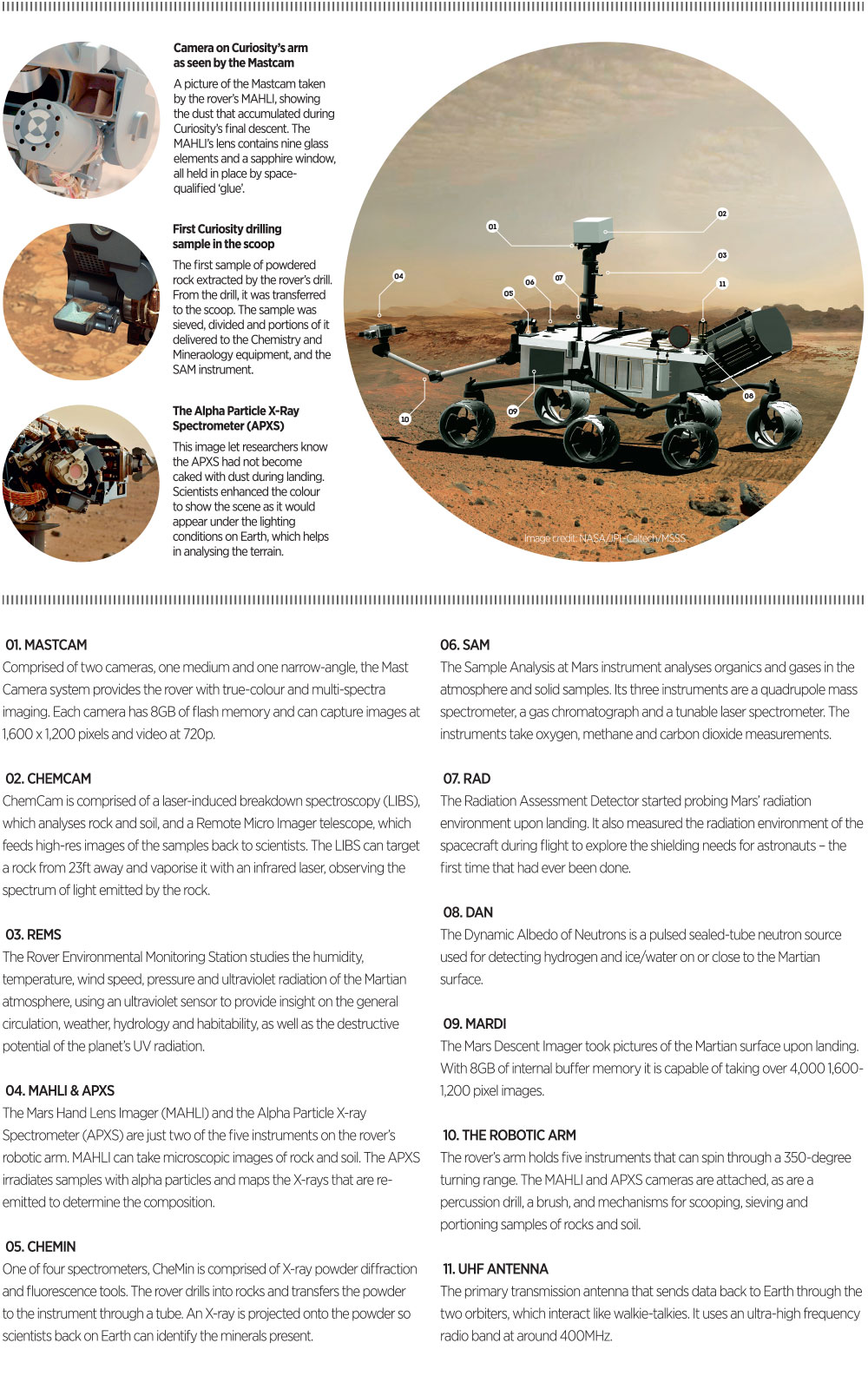
Curiosity uncovered

Curiosity was sent to the Red Planet as part of NASA’s Mars Science Laboratory mission (MSL). The robot landed 1.5 miles from its target site – in a location called Aeolis Palus in the Gale Crater – on August 6, 2012. Sent to reconnoiter the Martian climate and geology, the project has been an umblemished success thanks to co-operation between the international scientific community and its careful design.

Objective:
To investigate the Martian climate and geology; to decipher whether the Gale crater has ever harnessed microbial life; to determine whether the Gale crater has harboured water; and to analyse whether humans could one day inhabit the planet.

Mass:
Curiosity has a mass of 899kg, which accounted for 23 percent of the mass of the MSL spacecraft – the rest was disregarded during the landing process. Scientific instruments account for 80kg of its overall weight. The rover is 9.5ft long by 8.9ft wide and is 7.2ft high.

Power:
Curiosity is powered by a radioisotope thermoelectric generator (RTG), which produces electricity from the decay of radioactive isotope plutonium-238 dioxide. The isotope is packaged into 32 cubes inside the robot. This generates 9MJ of energy each day. The RTG energises two rechargeable lithium-ion batteries to boost energy needs if the regular supply is not enough for the rover’s demands.

Heating System:
The temperature at the landing site ranges from -127 to 40˚C, so thermal monitoring of the robot is imperative. Its system warms the robot through electrical heaters placed on key components, passively through the dissipation to internal components, and by pumping fluid through 200ft of tubing. This fluid can also cool the robot if it becomes too warm.

Computers:
Curiosity has two identical onboard computers called the ‘Rover Computer Element’. Each contains radiation-hardened memory to tolerate the extreme radiation from space and contains 256KB of EEPROM, 265MB of DRAM and 2GB of flash memory. The computers use RAD750 CPU, capable of up to 400 MIPS. One of the two computers is a back-up, designed to kick in if the other falters. So far in Curiosity’s mission, the back-up system has been used only once.

Communications:
Curiosity has an X band transmitter and receiver that communicates directly with Earth. It has a UHF Electra-Lite software-defined radio for communicating with the Mars orbiters (Mars Reconnaissance Orbiter and Odyssey Orbitor), which is the main path for data back to Earth. Each orbiter can only communicate with Curioisty for 8 minutes per day. The rover has two UHF radios – signals to Earth take on average 14 minutes and 6 seconds.

Mobility:
Curiosity is equipped with six 50cm diameter wheels in a rocker-bogie system, which also served as its landing gear. The wheels have cleats and are actuated and geared independently so it can climb soft sand and hard rock. Each front and rear wheel can be independently steered allowing the robot to turn. Each wheel has its own pattern so its tracks can be monitored. The rover is capable of climbing sand dunes with slopes up to 12.5 degrees and can withstand a tilt of 50 degrees without overturning. It can travel 30 metres per hour at maximum speed.

rover-details

Japan’s return to nuclear energy

More than two years after the decimation of Fukushima, the enduring inhabitants of the prefecture – nuclear refugees – are yet to see out the invisible contagion that razed their livelihoods. The notorious Fukushima Daiichi disaster made for a paradigmatic case of human hubris meeting natural disaster – an event that vomited deathly waste onto ordinary people and subsequently made for a horrifying lesson on nuclear hazards.

Fukushima Daiichi was a small, humble region characterised by agriculture and the creation of traditional Japanese wares, and the few thousand who lived there were subjected to the abominable repercussions of Japan’s nuclear dependence. Apart from the rally of death popularly depicted by the international media, an array of ongoing problems in the aftermath of the disaster illustrated the consequences of Japan’s reliance on nuclear power, eliciting a – perhaps too eager – departure from this form of energy.

Prior to the earthquake and ensuing tsunami, the nation had intended nuclear power to comprise 50 percent of its electricity generation: 70 percent of the Japanese populace are now anti-nuclear. The Fukushima disaster – perhaps above all else – led to this marked reduction in support for the formidable power source. Shortly after the incident, officials expressed their intention to phase out nuclear power altogether by the 2030s.

The reality is that it may be quite difficult to shut down all power plants across Japan

Perhaps the enduring legacy of Fukushima is the region’s role in spurring a growing nationwide appetite for renewable energy. It sparked Japan’s fruition as a leader in pioneering sustainable means of electricity, and signalled a departure from contaminative energy sources. The project originally showed a great deal of promise, but has since been hindered by growing economic pressures.

Kick start initiatives
Not long after the tsunami struck in March 2011, the ruling Democratic Party of Japan (DPJ) was persuaded to instigate a fundamental shakeup of the country’s energy market. The government, in this instance, recognised an important opportunity to advance renewables and depart from a comprehensive nuclear programme that had been stifled partway through.

The DPJ introduced a series of clean energy feed-in tariffs (FiT) to incite a nationwide investment drive in the renewable energy sector. The FiT programme implemented attractive rates to effectively offset the higher costs of renewable energy and thus diversify Japan’s energy market. The proposed tariffs generated equity returns as high as 44 percent for solar and 51 percent for wind projects, and have since proved highly effective in initiating investment in renewables.

“The FiT did really kick-start the industry,” says Phil Dominy, London-based Assistant Director of Ernst & Young’s Energy and Environmental Finance team. “Until the FiT was introduced there had been little investment, even given Japan’s commitment to a shift away from nuclear power. Since its introduction in July 2012, there has been a significant increase in activity, with investment up 75 percent in 2012 – on the 2011 figure – to $16.3bn.”

In the six-month period following the FiT introduction, applications for renewable capacity amounted to 3.6GW, of which solar comprised 3.3GW. Whereas prior to the introduction of the FiT, residential-scale applications amounted to the majority of the market, 2.5GW of the 3.3GW produced afterwards was either commercial or industrial in scale.

Though they previously made up an extremely slim portion of the sector, renewable investment funds stemming from both public and private sources increased by similar degrees. Perhaps most notable was the Japanese asset manager Sparx, which won a contract from Tokyo’s metropolitan government in 2012.

An initial investment of ¥1bn (approximately $10.2m) in February this year – along with a further 30 potential investments – suggests advancement for the foreseeable future. The investment drive, however, is not just comprised of Sparx – private sector funds have, since then, been established by both Tokio Marine Asset Management and Mizuho Corp Bank, valued at ¥9bn ($91.8m) and ¥5bn ($50.9m) respectively.

Central vs local government
Though the current intention is to pursue developments in renewable energy, the central Japanese government is said to have hampered this by producing an energy policy mired in regulatory uncertainties and plagued by vague incentive schemes.

Local governments, conversely, have adopted a decidedly aggressive stance in their responses to the crises exacerbated by Fukushima, by-and-large seeking to overturn and offset the inadequacies of the central government. The Fukushima crisis was instrumental in highlighting central government’s deficient crisis-management capabilities and in alerting many to the dangers of having highly a centralised power generation and transmission supply.

The nation’s relative abandonment of nuclear determinedness has given greater scope to the reconfiguration of energy policy; it has allowed local governments to formulate progressive substitute strategies for growth and to reconsolidate intergovernmental relations in extending their powers.

Japan has shown a near-unparalleled investment in renewables, having doubled solar spending year-on-year to $6.7bn in the first quarter of 2013. Nevertheless, the shortfalls of central government since the 2011 earthquake have somewhat stifled advancements in what could have been a far more promising sector.

Mika Ohbayashi, Director of the Japan Renewable Energy Foundation, describes the unbundling of transmission and distribution as “the most important and urgent issue in the Japanese energy market”. He describes this separation process as critical to ensuring the successful market liberalisation of electricity.

This will allow renewable entrants access to the grid and loosen the grip of mainstream utility companies such as Tepco and Tokyo Electric Power – those responsible for the heavily subsidised selling of nuclear power in the past and for the often-closed nature of Japan’s national grid.

Canadian environmentalist and geneticist David Suzuki says: “There’s a huge opportunity that the government, because it is so tightly tied to the private energy sector, has refused to acknowledge.” Local governments are seen as the surest means of progression as they have fewer ties to leading utilities and have demonstrated a greater degree of mobility than central government.

The governments of Osaka, Kobe and Kyoto have recently banded together to launch an energy commission, established with the intention of spurring discourse regarding renewables and permitting new entrants access to the national grid.

Renewable shortfalls
The climate of Japan’s renewable energy sector, however, is one of unerring complexity, with a population both opposed to nuclear power and – often conversely – seeking economic stability. Having failed in its blinkered pursuit of nuclear power, the Japanese government has now diverted its attention to employing robust policies to diffuse renewable alternatives. However, despite having pioneered a series of developments – particularly in residential solar power – clean energy has fallen short of its potential. This appears to be a result of Japan’s changing government and the lessening potency of anti-nuclear rhetoric as the Fukushima disaster fades into the past.

It seems the American Nuclear Society was right when it sent a message of support in the wake of the Fukushima Daiichi disaster. “This is not the end,” their message read. “This is the beginning of a new nuclear age.” But it is with far greater reluctance that Japanese scientists recognise the truth of those words.

The potential contradiction between renewable energy and economic growth was illustrated recently, mere miles from Fukushima, when a nearby town offered a platform for locals to speak about how nuclear energy had impacted their businesses and quality of life. Toshiyuku Azaki, whose farming of apples and peaches was compromised by the radiation from Fukushima, was only able to present peach juice – his apples having been deemed by government officials too radioactive for sale. Though stripped of his livelihood, Azaki maintained nuclear energy was necessary to the Japanese economy.

“It would be good to not rely on nuclear energy,” he said. “The reality is that it may be quite difficult to shut down all power plants across Japan.” A nation wrung dry by nuclear power is being made to return to old ways by the lack of an adequate renewable replacement.

Though clean energy investment experienced a year-on-year increase of 75 percent in 2012 – 97 percent of which was solar-based – renewables are yet to surmount or even come close to the former power of nuclear. While Japan’s green sector has experienced an explosion since the nation’s break from nuclear, it’s still only equal to two nuclear plants.

Conflict of interests
Further compounding fears of Japan’s return to nuclear energy is the resurgence of the conservative, pro-nuclear Liberal Democratic Party (LDP). Whereas the previous centre-left government pledged to phase out the country’s 50 working reactors by 2040, the current party is reluctant to depart from nuclear power.

The newly elected Shinzo Abe maintains, above all else, that: “A strong economy is the source of energy for Japan. Without regaining a strong economy, there is no future for Japan.” Abe is unwilling to rule out the construction of new nuclear plants and has pledged current reactors will be restarted on the condition they pass stringent safety tests.

Of huge cost to the nation is its requirement to import energy to fill the void left by nuclear power – an issue owing more to the weakened yen than the rising prices of oil and gas. Japan’s trade deficit grew to ¥8.2trn during 2012 ($83.5bn), almost doubling the ¥4.4trn ($44.8bn) deficit of the year before.

These figures have led to growing concern over the nation’s account balance; its continued deterioration has made it almost impossible to fund Japan’s huge public debt domestically.

The immediate circumstances have led to greater flexibility regarding the nation’s reliance on nuclear power. Greater nuclear dependency is commonly cited as a means of generating economic growth and – if it wins this summer’s election for the upper house of parliament – the LDP is expected to push for the restarting of plants.

Abe’s focus appears to be on boosting business in order to advance the economy, as well as expanding the influence of those utility companies whose plants remain idle and those smaller firms whose futures reside in generating cheaper power. He looks set to introduce a period of greater inclusivity, as renewables are allowed into the notoriously closed energy sector.

Despite an enduring fear of nuclear power in Japan, the population appears more concerned with the nation’s stuttering economic growth. “Of course, the public would prefer to get rid of nuclear power, if it were economically possible,” says Toichi Tsutomu, an adviser to the Institute of Energy Economics Japan, “but people are realistic.”


Healthy travels

For decades, people have travelled to the US for access to the latest in medical procedures. Many have come to avoid long waiting lists in countries that have government-run healthcare or socialised medicine. A growing medical problem, and one that can be reversed, is obesity. More people are discovering their journeys towards better health – and more fulfilling lives – begin at Blossom Bariatrics in Las Vegas, Nevada.

People travel from all over the US, Canada and the world to see Thomas Umbach MD for many reasons. One big reason is that Dr Umbach is passionately devoted to helping them regain a higher quality of life through overcoming obesity and keeping their weight off long-term.

National acclaim
Dr Umbach is a nationally recognised, board-certified and fellowship-trained bariatric surgeon. He’s been recognised as one of the nation’s top bariatric surgeons by Newsweek. Dr Umbach’s other notable achievements include being named America’s Top Surgeon by the Consumers Research Council of America in 2008, 2009 and 2010, and several Who’s Who listings.

“Bariatrics has always been my passion,” says Dr Umbach. “My practice is 100 percent devoted to helping obese clients achieve healthier lifestyles. It brings me great pleasure to see my clients shed their excess weight and enjoy the simple pleasures of life again – playing with their children or grandchildren, riding a roller coaster for the first time, or dating.”

In addition to his experience, skill and surgical expertise, Dr Umbach offers his clients something they cannot get anywhere else – his personal cell phone number and an offer to call him anytime, day or night.

“I want my clients to be able to reach me 24/7 with any questions or concerns they have before surgery and for as long after surgery as they feel they need me,” says Umbach. “Most of them are amazed when I hand them my cell phone number and even more amazed when I answer their calls and treat them as friends.”

Always in
Jodi Dore of Red Deer, Alberta, Canada appreciates Umbach’s philosophy and that was a big part of her decision to travel to the US for the latest in bariatric surgery techniques and select Blossom Bariatrics in Las Vegas.

Dore had an adjustable gastric band procedure performed in Canada, lost 90 pounds and continued with her new lifestyle until complications from illness led to a 35 pound weight gain and the need for another procedure. She decided to seek another option.

“Dr Umbach has a very good reputation as a surgeon. This was my number one criteria,” Dore said. “My final decision was made after he personally called me to answer all my questions.”

Dore would recommend Blossom Bariatrics to friends considering the same kind of surgery. Her advice to other Canadians needing this procedure is: “We now have the option of bariatric surgery in Canada and it is covered by most province healthcares. The wait time is long and there are pre-op programmes with diets. If this is not for you, and you can afford to look at travelling to the US for surgery, do your research, don’t make decisions based only on the price and embrace this as an option.”

I want my clients to be able to reach me 24/7

Dr Umbach offers his experience and expertise in gastric banding, Roux-en-Y gastric bypass, gastric sleeve resection and revisional surgery. Dr Umbach operates out of a state-of-the-art, fully equipped, JACO-certified surgery centre. He uses special protocols to achieve exceptional pain control for his clients, which increases their comfort and helps them enjoy their Las Vegas experience even more.

As a result of Blossom Bariatrics’ international reputation, the practice moved to a larger facility to accommodate patients and still maintains its high standards and personalised care.

Comfort and convenience
Visiting clients can relax and enjoy the warm, friendly atmosphere at Blossom Bariatrics. Dr Umbach and his entire care team take as much time as clients need to feel comfortable. His staff help clients with travel and hotel reservations.

Umbach offers every client comprehensive pre- and post-surgical programmes. His pre-surgical programme is aimed at maximising client safety and increasing their chances of excellent surgical results. His post-surgical programmes include nutrition (Blossom Bites) and fitness counselling (Blossom Bodies), support groups (Blossom Buddies) to help them adjust to life after bariatric surgery, and psychological and emotional counselling (Blossom Beauty) to help empower them towards a better quality of life.

A nutritionist and fitness counsellor is now part of the team – an important component in maintaining weight loss after surgery. Wellness counsellor and client Mindi Percell can relate to those coming for surgery since she has experienced it herself. She battled her weight for decades and admits her life has changed since her surgery.

When Percell’s family practice physician told her she was in “perfect health”, she asked him to repeat his words. “I’d never heard that I was perfectly healthy, so I wanted to hear it again and again.”

From all over the world
Many of Dr Umbach’s out-of-state and foreign clients combine their surgical procedures with a fun-filled vacation in Las Vegas. Thanks to the advanced technology and surgical techniques used by Dr Umbach, most procedures do not require lengthy recovery periods.

As a result, Dr Umbach’s bariatric surgery clients – especially those who travel from other states or countries – often celebrate the blossoming of their new lives by enjoying the exciting thrills of Las Vegas after surgery. Clients can experience some of the finest entertainment in the world, with lavish performances by Cirque du Soleil, Celine Dion, Tony Bennett and other world-class entertainers.

Since most of Dr Umbach’s procedures require short recovery times, it’s typical for clients to have their procedure and then celebrate with a vacation as a new beginning
for a new life.

Telephone: 702-463-3300
Website: www.blossombariatrics.com

Privacy row erupts after US whistleblower unveiled

The storm that emerged last week over the leaking of top-secret intelligence documents has put the spotlight on how seriously leading tech firms take users private information.
After a former CIA technical worker – revealed as 29 year old Edward Snowden – leaked to the Guardian newspaper key information about US surveillance tactics, some of the world’s best-known technology companies were revealed to have granted access to supposedly secure user data.

The Prism programme allowed the US’s National Security Agency (NSA) access to user information from companies such as Google, Microsoft, Yahoo, Facebook and Apple. According to Mike Rispoli, spokesman for Privacy International, anyone that uses internet services is vulnerable to the surveillance programme: “Essentially anyone who participates in our interconnected world and uses popular services like Google or Skype can have he their privacy violated through the Prism programme.”

Many of the companies accused of allowing access have denied any knowledge of it, with Apple releasing a statement saying: “We have never heard of Prism. We do not provide any government agency with direct access to our servers, and any government agency requesting customer data must get a court order.”

Yahoo, on the other hand, gave a carefully worded denial. It said they did not “volunteer” information to the US government, but security and privacy research Christopher Soghoian pointed this gave them room for manoeuvre: “By falsely describing Prism as a voluntary scheme, Yahoo’s general counsel is then able to deny any involvement outright.”

The US government has been keen to stress that Prism was not being used to get information on American citizens, although concerns at the weekend were raised by privacy campaigners in the UK over whether the US government had access to British-based internet users.

Jim Killock, director of civil liberties organisation the Open Rights Group, said: “Where this leaves the rest of the world – including UK citizens, businesses, charities, MPs, campaigners and NGOs – is another matter.”

Speaking to the Guardian from Hong Kong about his reason for leaking the information, Snowden said: “The NSA has built an infrastructure that allows it to intercept almost everything. With this capability, the vast majority of human communications are automatically ingested without targeting. If I wanted to see your emails or your wife’s phone, all I have to do is use intercepts. I can get your emails, passwords, phone records, credit cards.”

Virgin Liberty deal set to go ahead, at $23.3bn

Liberty Global shareholders approved the acquisition of Virgin Media, valued at $23.3bn. Liberty held a special shareholders meeting in the beginning of June to vote on the deal. Virgin Media has announced it will be delisting its shares on June 10 in order to complete the merger.

“The transactions contemplated by the merger agreement are expected to be completed on or about June 7,” Virgin Media has said in a statement.

“This is one more brick in the wall of scale in Europe, which will ultimately pay real dividends,” says John Malone, Liberty Global chairman.

Liberty CEO Mike Fries has said that his company does no view the Virgin takeover as a “turnaround” story, but rather that he hopes to “build scale” and grow the business. It has been reported that the after the merger the company will be the biggest broadband provider in the world with over 25 million customers.

The European Commission cleared the deal earlier in the year. It said in a statement there were no concerns over competition as both companies operated cable networks in different countries in Europe. It also cited its limited market position in the cable television market in Britain and Ireland as another mitigating factor. It is expected that the deal will ignite a race between the new Virgin Media group and Rupert Murdoch’s BskyB, currently the market leader in broadband in the UK.

“The merged entity is unlikely to shut out competing Pay TV retailers by withholding its TV channels from them, given its very limited presence in the wholesale supply of TV channels and the incentive to license its TV channels as broadly as possible,” the EC said in a statement.

“Similarly, it is unlikely that the merged entity would shut out competing TV channel broadcasters from access to the retail Pay TV market, given the number of alternative distribution platforms to Virgin Media’s cable network, and the importance of offering a large variety of TV channels in order to attract Pay TV subscribers.”

Liberty Global has previously announced that it had appointed former New International Tom Mockeridge as the new chief executive of Virgin Media after the take over. He will report to Fries, while current Virgin Media boss Neil Berkett will step down. “Thanks to the incredible energy of its employees and the loyalty of its customers, Virgin Media has become the UK’s leading broadband communications company and has developed an immensely powerful media brand,” says Mockeridge.

It has been estimated that Virgin Media founder Richard Branson will walk away with over $300m from his three percent share.

Brussels probes iPhone distribution

European regulators have announced a new probe looking into Apple’s sales methods. There are suspicions that tactics employed by the company pertaining to the sale and stock of iPhones might violate competition laws and constitute an abuse of its position as market leader. The new probe is part of a wider preliminary investigation by the European Commission into Apple.

A number of European mobile network operators have revealed the Competition Commission has sent them a questionnaire enquiring about Apple’s distribution terms. Operators are allegedly forced to buy a minimum number of iPhones and banned from offering greater subsidies or deals to other smartphone companies than to Apple.

“The commission has information indicating that Apple and mobile network operators have concluded distribution agreements which may potentially lead to the foreclosure of other smartphone manufacturers from the markets,” the FT quotes the questionnaire. “There are also indications that certain technical functions are disabled on certain Apple products in certain countries in the EU/EEA. If the existence of such behavior were to be confirmed, it might constitute an infringement of [antitrust law]”.

According to Competition Commissioner Joaquin Almunia the regulator “has received information from industry players concerning Apple’s distribution practices for iPhones. We are currently examining the situation. This does not prejudge the commission’s position on the issues raised.”

The questionnaire is part of preliminary investigations in Apple, but the EC can launch a formal investigation if it gathers enough evidence at the stage that Apple dominates the European smartphone market. There are questions over whether or not a formal investigation would be appropriate given the recent popularity of the Samsung Galaxy series in the region.

Last year Apple faced another EC antitrust probe into the pricing of e-books. In that case the company was forced to review it agreements with four publishers. It also recently settled a further antitrust case by agreeing to reduce the price of music downloads in the UK iTunes store. A further probe into restrictions on iPhone applications was dropped in 2010.

Apple is facing further investigation by the US Congress over its tax arrangements after it was alleged that the company might be avoiding billions of dollars of payments on its profits.

Liquefied air could transform energy market

How to store energy in a cheap and mobile form has stumped researchers for years, with large-scale power stored on a grid and batteries currently expensive and inefficient. However, recently some experts have been looking into developing liquefied air to help cut carbon emissions, increase energy security and provide a more sustainable global energy market.

Liquefied air – created by cooling air to almost -200 °C – allows energy to be stored for later use. It is hoped that this could be an efficient way to help the solar and wind industries to better store generated energy.

UK-based company Highview Power Storage has raised as much as $18m towards developing the technology, and has been running a pilot plant in Slough since 2011. The UK government has been keen to support this technology, awarding two proposed Highview plants funding as part of a new technology competition. Highview say that one of their plants could begin being built in July.

The company’s CEO, Gareth Brett, told The Engineer that the proposed facility would be more efficient than the test plant in Slough: “Physically it’s not much bigger than the Slough plant but the capacity of the process is about ten times bigger. We’ll be able to generate around 5MW of electricity and run for around six hours.”

Brett says that he expected efficiency of the plant, at the National Grid’s Grain Liquefied Natural Gas terminal on the Isle of Grain, would increase by between 50 to 60 percent, adding: “It’s a significant improvement. Generally we wouldn’t expect to get that sort of efficiency until we were at really quite a large system [of around 20MW].”

Fracking presents opportunity for clean tech pioneers

While many opponents of fossil fuel based energy use would rather the energy industry focused on renewable sources and developing clean technologies, there is an inevitable cross-over between the sectors. As some of the bigger energy firms, including BP and Shell, have invested heavily in renewable technology, news has emerged that some clean technology firms are utilising their innovations to help extract oil and gas.

OriginOil, an LA-based company that was originally formed to develop technology that helped produce algae biofuels, has started to use its designs to make fracking more efficient.

The firm recently announced its Clean-Frac system, which it says helps provides a more efficient and less environmentally damaging form of fracking. It hopes the technology will be commercially available toward the end of the year.

Many industry experts were presented with demonstrations of the technology in April, and the response was particularly enthusiastic. Dr Gerald Bailey, OriginOil’s, oil and gas industry specialist and a former President of Exxon, told reporters: “The response by the operators was overwhelmingly positive. The discussion was all about how Clean-Frac enables the recycling of frac flowback or produced water, resulting in significant cost savings and environmental benefits. With OriginOil’s technology, operators will be able to significantly reduce the amount of fresh water purchased for the fracking process.”
Speaking to the Quartz website, CEO Riggs Eckelberry spoke about why they were refocusing their technology: “The reason we have put a lot of focus on oil and gas is that it’s a big industry – aglae is a lot more small scale.”

He added: “In west Texas, water trucking costs are adding 14 cents a gallon to the cost of a barrel of oil. You can clean up the water with our process and reuse it for two to three cents a gallon.”

Lighter than air (but still solid)

Though carbon aerogels have been around for the past quarter of a century, their properties are still being discovered. Perhaps more notably a team of scientists from Zhejiang University have created the lightest and most interesting version so far. Graphene aerogel is so light that it can be placed upon a blade of grass without bending it. It is rather remarkable; a cubic centimetre of the substance has a mass of 0.16 milligrams. It is also record breaking; graphene aerogel is 12 percent lighter than the substance previously thought to be the lightest.

Aerogels are ultra-light materials derived from regular gels, but where the liquid component has been replaced with gas. As well as being extraordinarily light they also have extremely low levels of thermal conductivity; aerogels are also incredibly durable. These properties alone mean it has many useful and commercially viable applications; aerogels are used as thickening agents and are the most efficient chemical absorber which makes it useful at the sites of oil spills.

Aerogels are usually carbon or silica based. Graphene aerogel is no different. It is unique however because of its sheer weightlessness. Such small density might be hard to grasp; a cubic centimetre of aerographene weighs only twice as much as hydrogen and has only one seventh of the density of regular earth air.

Graphene, from which the aerogel is made from, is a sheet of a single layer or carbon molecules. Researchers in Zhejiang found that through a simple freeze-drying process they were able to stack graphene layers in three directions; the only limit on the size is the dimensions of the receptacle the aerogel is made in. Researchers believe that there would be no problem creating aerogel blocks in any size.

As well as lighter, graphene aerogel is also more easily produced than other, more common, aerogels. Previously, aerogels had been produced using the sol-gel method, where a gel is dehydrated until only the aerogel is left. But researchers found that by using solutions of carbon nanotubes achieved the same results. Researchers at zhejiang essentially created a solution of graphene and carbon nanotubes, and after pouring into a container, freeze-dried it. The nanotubes have a cylindrical nanostructure which holds up the layers of graphene together, forming the aerogel. The nanotubes themselves are carbon molecules arranged in hexagons forming a tube.

Graphene aerogel has been found to have superb elasticity and can recover its shape entirely after being compressed by more than 90 percent. It can also absorb over 900 times its own weight in chemicals, at a rate of 68.8 grams per second. Lead researcher Gao Chao thinks that these properties will make graphene aerogel an efficient chemical absorber, capable of mopping up oil from spills, returning the oil when squeezed, then thrown back into the spill to absorb more oil; much like a sponge in a bucket of water.

The researchers are also hopeful that graphene aerogel will be as conducive as aerographite, its predecessor. If that proves to be the case it might just prove to be a useful component for new, lighter batteries with higher energy-densities. It is also a powerful insulator; picture have shown a thing slab of aerogel shielding crayons from the blue-flame of a Bunsen burner; which would otherwise have melted the sticks in seconds. The commercial potential for this type of aerogel is very promising.

Drone transparency is Obama’s primary concern

Having watched Mr Al-Qaeda gaily wave his children off to school, hang the washing out, collect his online shopping and take the dog for a walk, Mr “high-value” is shortly thereafter obliterated – along with faithful Spot – by a guided missile eerily uncommitted to paper and painstakingly adorned with stars and stripes. It’s an unlikely story, though nonetheless one that can be neither confirmed nor denied under an Administration to have severely neglected drone strike disclosure.

Like-stories of little Jimmy America manning drones from a sunny California office have commonly plagued public forums in the perseverance of a distinctly lax drone policy, and will continue to do so until the necessary legal changes are made to vastly improve operational transparency.

Civilian casualties
Amid a growing accumulation of drone critics, the President, in February, sought to assure both Congress and the public of his plans to lessen any such justification for wild speculation. Obama pledged to the State of the Union of his intentions to ensure “our targeting, detention, and prosecution of terrorists” is in alignment with American laws and “even more transparent to the American people and the world.” Though not having uttered the word ‘drone’ at any such point, the President appeared to answer many of the questions being asked of the US military’s favourite toy.

As Obama is yet to make good on his vague assurance of transparency, the vitriol is mounting on US claims to have “decimated Al-Qaeda ranks” incurring gross and unnecessary civilian casualties. As such, many are left wondering of the extent to which drone strikes are indeed successful in eliminating “extreme threats to the state” without impacting on innocents. The inexistence of an outright policy to neither confirm nor deny civilian casualties – otherwise termed collateral damage – means that those concerned are without legitimate assurances of drone strikes having not caused unwanted deaths.

The New America Foundation has, in this vein, compiled a database of drone strikes drawn entirely from news accounts. The resulting database indicates for an estimated 1963 to 3293 people to have been killed in Pakistan since 2004, of whom 430 to 635 are assumed to have been civilian casualties. Though those related to the project claim for improvements to both intelligence and munitions to have vastly reduced civilian deaths from 40 percent through Bush’s rule to “low single digits” now, it’s no less the case that these figures are indeed estimations.

Senior criticism
As the present drone policy perseveres to the detriment of US credibility, the list of critics has expanded to include those occupying – or to have occupied – senior legal positions. Harold Hongju Koh, previously the State Department’s top lawyer, said at a meeting of the American Society of International Law: “The administration is hurting itself by lack of transparency,” whereas former Defence Department legal counsel Jeh Johnson recently stated that: “[The US government] fails to officially confirm many of its counterterrorism successes, and it fails to officially confirm, deny or clarify unsubstantiated reports of civilian casualties. Our government’s effort in preserving the safety of the people risks an erosion of support by the people.”

Former director of policy planning at the State Department, Anne-Marie Slaughter, cites the issue as one capable of tarring Obama’s legacy. “The idea that this president would leave office having dramatically expanded the use of drones – including [against] American citizens – without any public standards and no checks and balances … that there are no checks, and there is no international agreement; I would find that to be both terrible and ultimately will undermine a great deal of what this president will have done for good.”

The stature of those issuing criticisms is highly indicative of the precedence proper military force is to take in determining Obama’s will to instill positive change. Though drone strikes are a proven and effective weapon against terrorism, the President is to adhere to a strict policy of transparency if he is to deter from more so undermining his credibility.