Japan deflation may trigger more BOJ action

Analysts say that while the BOJ will want to save its ammunition for when sharp yen rises hurt a fragile economy, it may have to act around June, when government pressure for more steps could escalate ahead of upper house elections expected in July.

“The government will continue to pressure the Bank of Japan for action, given that the market is becoming increasingly cautious about each country’s fiscal deficit,” said Takeshi Minami, chief economist at Norinchukin Research Institute.

“The BOJ may act around June or July, either by expanding its fund-supply operation adopted in December or by increasing its outright government bond buying.”

The so-called core-core consumer price index, Japan’s narrowest measure of price gauge that excludes volatile food and energy costs, fell 1.2 percent from a year earlier, matching a record drop the month before.

The indicator, similar to the core index used in the US, fell for the 13th straight month, in a sign that weak demand was forcing companies to cut prices to lure consumers.

The nationwide core CPI, which excludes volatile food prices but includes energy costs, fell 1.3 percent in the year to the end of January. That was slightly smaller than a median market forecast of 1.4 percent fall but marked the 11th straight month of annual declines.

The core CPI index reading of 99.2 was the lowest in 17 years.

Keeping the pressure on
The Democratic Party-led government, faced with falling support rates, wants to avoid an economic downturn ahead of the summer upper house elections and has been urging the BOJ to support the economy even as most other major central banks examine rolling back stimulus.

Finance Minister Naoto Kan told reporters again after the CPI data was released that he expected the central bank to work towards ending deflation.

Many analysts say the BOJ’s most likely next step is to expand the fund-supply operation it adopted in December, either by raising the amount from 10 trillion yen ($112.2bn) or extending the duration of loans from three months.

The BOJ may also opt to increase its long-term government bond buying from the current 21.6 trillion yen per year, a move that would please the government if bond yields shoot up on concern over Japan’s fiscal deficit.

Assuming the BOJ doesn’t change the duration of assets it holds now, a lack of further central bank action would mean a sharp decrease in its balance sheet and therefore liquidity contraction at a time when Japan is still in deflation, said Robert Rennie, chief currency strategist at Westpac in Sydney.

“I fully expect additional quantitative easing measures through this year, and one will be an increase in ‘rinban’ operations” to buy JGBs outright.”

The BOJ is forecasting three years of deflation and has said it is committed to keeping interest rates near zero for as long as necessary. But it has offered few clues on what it might do beyond that to beat deflation.

Deflation hurts the economy as households put off spending on hopes that prices will fall further, forcing companies to cut prices to lure consumers.

The BOJ has caved in to government pressure before, when it introduced the three-month funding operation in December after a barrage of criticism that its economic assessment was too rosy.

Still, Naoki Minezaki, one of Kan’s two deputies, told reporters in an interview that while some in the government wanted the BOJ to loosen monetary policy, setting a rigid inflation target may not be the way to get the country out of deflation.

The finance minister said earlier in February that he would favour inflation of around one percent, although he did not specifically refer to an inflation target.

While that figure roughly matches the BOJ’s view, the mere mention of it by Kan was a sign the government was stepping up pressure for more BOJ action.

In a positive sign for the economy, industrial output rose much more than expected in January, as manufacturers ramped up production to meet demand from fast-growing Asia.

While market reaction to the CPI and output data were muted, the stronger-than-expected output figure capped gains in Japanese government bond futures.

Swiss banks must continue to stay wary

Trusts, a legal concept born in 13th-century England to safeguard the assets of knights leaving for the Crusades, make up an estimated $5-trn global market and are viewed by lawyers and accountants as a growth area for the heavily pressed Swiss offshore banking industry. Switzerland, the world’s leading offshore centre, came under attack during the credit crisis by cash-strapped nations seeking to recoup tax revenues and its banks are seeking a new business model while traditional bank secrecy is eroding.

Several Swiss private bankers told Reuters they had noticed an increase in demand by wealthy customers for trusts, which are appealing to clients from emerging markets such as Latin America or Russia as they offer protection from expropriation, forced inheritance laws or expensive divorce settlements.

Trusts –seen by some experts as only worthwile for clients with at least $2m in assets – can also help reduce a client’s tax burden as the assets are passed on to a third party in a low-tax jurisdiction. But many Swiss private bankers remain wary of trusts as such structures could attract more unwelcome attention from foreign tax authorities, and there is an intrinsic conflict of interest for trustees between their loyalty to the client and to the bank that employs them.

“The market has seen an increase in demand,” said David Zollinger, who heads the New Markets division at Switzerland’s oldest private bank Wegellin. “(But) my perception is that Swiss private banks are gradually curbing their offer in this field. There is not only a conflict of interest and anyway these days banks that provide structures to clients run the risk to be considered an auxiliary to whatever offence the client may have committed abroad.” Nevertheless, demand is strengthening in many regions including Asia, where wealth is being passed on by self-made billionaires to the next generation. To the private banks, trusts can also offer a source of stability as the assets are normally held long-term. “Once in the trust, the assets are looked after for the benefit of the family and therefore tend to be very sticky assets,” said Nick Warr, a partner at law firm Taylor Wessing. All major Swiss private banks, including UBS and Credit Suisse, offer trust services.

Although the Swiss have no trust legislation per se, Switzerland recognises foreign law with regards to trust and is home to scores of legal and financial professionals active in this business, mainly on behalf of non-Swiss-based customers.

Trusts run from Switzerland received a boost in 2007 when the country’s government ratified an international convention on recognition of trusts, fuelling speculation they could become increasingly important for the Swiss banking industry.

About 10 percent of the world’s 15,000 trustees are based in Switzerland, Zollinger said, and another trust expert put at between 900 and 1,600 the number of fiduciary companies based in this Alpine country. But up to 70 percent of the foreign assets in Switzerland are already held in structures and trusts, said the industry expert. Trusts are also expensive to set up and can be complex, requiring the services of lawyers and accountants and thus limiting their usefulness to all but a wealthy elite.

Mireille Gavard, head of estate planning at Royal Bank of Canada’s Swiss unit said trusts are not viable for less than $2m. If the structure involves more than just financial assets, the threshold rises higher, she said. A senior Swiss private banker said trusts below $5m made no sense.

Analysts also question the compatibility of trusts, a feature of English common law, with the Swiss civil law system. “I would be very much against any legislation establishing a Swiss trust. We already recognise foreign trusts in Switzerland and so far it has worked well,” said Stephanie Jarrett, who heads the Geneva Wealth Management Practice Group at law firm Baker & McKenzie.

“If we bring in new legislation the risk is to end up with something that is a cross between a trust and a foundation.”

Swiss to fix UBS

To settle a bitter dispute, UBS and the Swiss government agreed in August to disclose 4,450 secret accounts that U.S. citizens used to hide money from tax authorities.

But the settlement hit a stumbling block after a Swiss court ruled in January that such a transfer of data would breach existing Swiss law.

The tax row and uncertainty surrounding the settlement has led to billions of Swiss francs of client withdrawals at UBS.

By asking its parliament to approve the deal, Switzerland would do away with a legal distinction between tax fraud and tax evasion in providing assistance to the US and be allowed to speedily deliver the data Washington is seeking.

“We will in this way uphold the international commitments made by Switzerland with a view of finding a definitive resolution to the legal and sovereignty conflict with the United States,” the Swiss government said in a statement.

The Swiss administrative court ruling caused embarrassment for the Swiss government as it risked prolonging a legal nightmare for its already hard-pressed bank giant.

UBS said in a statement it intended to fulfill all commitments under both a criminal and civil settlement of the tax row. This included providing relevant client account information to the Swiss tax authorities.

Swiss bank secrecy laws prevent Berne from automatically sharing tax information with foreign authorities. Each request needs to follow an administrative process and clients of Swiss banks can appeal against a request for data transfer in court.

Obama fights banks

“If these folks want a fight, it’s a fight I’m ready to have,” he told
reporters at the White House, flanked by his top economic advisers and
lawmakers.

“We should no longer allow banks to stray too far from their central mission of serving their customers,” he said.

The
proposals, which need congressional approval, would prevent banks or
financial institutions that own banks from investing in, owning or
sponsoring a hedge fund or private equity fund.

They also
would set a new limit on banks’ size in relation to the overall
financial sector that would take into account deposits – which are
already capped – as well as liabilities and other non-deposit funding
sources.

Sources said Treasury Secretary Timothy Geithner had
hesitations about the proposals, concerned that good economic policy
was being sacrificed for politics. But a White House official said the
plan had the unanimous backing of Obama’s economic team.

Geithner
told the PBS programme “NewsHour” it is not in the national interest to
allow the financial industry to keep conducting business as usual.

“Our
financial system today is still operating under the same rules that
helped create this crisis. And we need to move with Congress to change
that system,” he said.

Proprietary trading operations
The
proposed rules also would bar institutions from proprietary trading
operations, unrelated to serving customers, for their own profit.

Proprietary
trading involves firms making bets on financial markets with their own
money rather than executing a trade for a client. These expert trading
operations, which can bet on stocks and other financial instruments to
rise or fall, have been enormously profitable for the banks but can
hold huge risks for the financial system if the bets go wrong.

The White House blames the practice for helping to nearly bring down the US financial system in 2008.

The White House said it wants to coordinate with international allies in its implementation of the measures.

Big financial institutions criticised Obama’s move.

“Trading,
proprietary or otherwise, did not lead to the financial crisis,” said
Rob Nichols, president of the Financial Services Forum, a lobbying
group for CEOs of firms such as Goldman Sachs and JPMorgan Chase.

He
said the government should be focused on better risk management,
corporate governance and other forms of regulatory oversight, “rather
than arbitrarily banning certain activities, or setting arbitrary size
limits.”

Obama’s move is the latest in a series to crack down
on banks and follows a devastating political loss for his party in
Massachusetts on Tuesday, when a Republican captured a US Senate seat
formerly held by the late Democratic Senator Edward Kennedy,
potentially imperiling his domestic agenda.

Bank shares slid
and the dollar fell against other currencies after Obama’s
announcement. JPMorgan fell 6.59 percent, helping push the Dow Jones
Industrial average down two percent.

Citigroup Inc fell 5.49
percent and Bank of America Corp fell 6.19 percent while Goldman
dropped 4.12 percent despite posting strong earnings on Thursday.

Ralph
Fogel, investment strategist at Fogel Neale Partners in New York, said
the move would have a major impact on big-name brokerage firms like
Goldman Sachs and JPMorgan.

“If they stop prop trading, it
will not only dry up liquidity in the market, but it will change the
whole structure of Wall Street, of the whole trading community,” he
said.

Underscoring the high level of public anger at banks, a
majority of 1,006 Americans surveyed in a Thomson Reuters/Ipsos poll
said executive pay was too high.

White House economic adviser
Austan Goolsbee said the proposals were not designed to be punitive. He
said they aimed to end the concept that some banks were “too big to
fail” and to show that when such firms “mess up, they die.”

Before
his announcement, Obama met with Paul Volcker, the former Federal
Reserve chairman who heads his economic recovery advisory board and who
favors putting curbs on big financial firms to limit their ability to
do harm.

The House of Representatives approved a sweeping
financial regulation reform bill on Decemeber 11 that included a
provision that would empower regulators to restrict proprietary
trading. The Senate has not yet acted on the matter.

Sowing the seeds of destruction

According to Ana Maria Liron, branch manager of the bank which manages €365m of loans and deposits, “We moved our headquarters in December from the town centre to these offices, thinking there would be faster expansion on the estate. But there is a big slowdown here… No one expected such a long, hard crisis.”

Unlisted regional banks such as Guadalajara, which account for about 50 percent of Spain’s financial system, have been hit hard by the recession and collapse of the real estate sector after a decade-long boom. To some extent, they have only themselves to blame.

“The savings banks’ big mistake was that they continued to increase their exposure to real estate developers even when the property bubble had burst,” said Jose Carlos Diez, chief economist at local brokerage Intermoney Valores.

Jorge Algarate Gonzalo, local sales representative at real estate firm Afirma Grupo Inmobiliario, agreed. “Everybody was living beyond their means,” he said.

Bad loans at small lenders saw a seven-fold increase in the period from December 2007 to March 2010, according to Bank of Spain and savings banks’ data.

To pay for their excesses, the regionally controlled savings banks are now immersed in a painful consolidation process aimed at recapitalising the weaker institutions and halving their numbers from 45 to about 20 by mid-year.

Ghost town of Valdeluz

Just north of Guadalajara, which is about 60km (40 miles) northeast of Madrid in the autonomous region of Castilla-La Mancha, lies the sprawling Valdeluz housing development, another example of the boom-to-bust fate of Spain’s property sector.

According to the initial planning permission lodged with the local town hall in Yebes, the development was intended for 8,500 homes, but only around 2,000 have so far been built.

Seven schools and a large commercial centre were also in the plans but Valdeluz is now no more than a ghost town, with only 1,400 people registered with the local council.

Empty streets with half-built blocks of apartments are littered with placards on every corner offering flats for sale with as much as 100 percent bank financing.

But a salesman to conduct visits to the show flats is nowhere to be found.

“On plan, Valdeluz looked as if it would be a fantastic development … But the reality is very different,” said Maria Angeles Martin, who rents a 120-square-metre three-bedroom apartment for €450 a month against €650 two years ago.

“The main problem is the lack of basic services such as a doctor’s surgery,” said the 28-year-old new mother as she stocked up on items in the community’s only supermarket.

As she spoke, two female employees shuffled goods around on full shelves in the otherwise empty Supermercado de Madrid.

Bank of Spain pressure

Caja Guadalajara’s main clients are households and small and medium-sized businesses and its exposure to property developers accounts for about 30 percent of total business.

Savings banks also act as charitable institutions and invest part of their profits in social and cultural associations.

Caja Guadalajara’s net profit plummeted 60 percent in the first quarter to March hit by the continued slump in loan growth, while its bad loans ratio stood at 5.28 percent compared with a Spain banking sector average of 5.30 percent.

After rejecting an integration project in the early 1990s with other savings banks in the same region, Caja Guadalajara is about to rubber stamp a merger with Seville-based CajaSol in southern Spain.    

“There has been much more pressure on the savings banks recently from the Bank of Spain as a result of the crisis,” Liron said.

“The crisis is accelerating the restructuring process but the consolidation was long overdue due to the excessive number of savings banks branches in Spain.”

The Bank of Spain took control of a small, 146-year-old bank controlled by the Catholic Church, CajaSur, on May 22nd, in a move interpreted as a warning to the sector to accelerate the merger process or risk a similar fate.

Three days later, the central bank further tightened the screws on Spanish banks by proposing even tougher  provisioning requirements for real estate assets on their balance sheets.

CajaSol has 5,000 employees against its future partner’s 325, but only has a scant presence in the Castilla-La Mancha region so there is no overlap, Liron said.

The new merged entity, which will have combined assets of 34bn euro. Caja Guadalajara will offer early retirement to nearly 14 percent of its 325 employees.

Politicians to blame?

For Caja Guadalajara’s clients, the upcoming merger with CajaSol is not a cause for concern. But they show suspicion and scorn that politicians are getting involved.

“The savings banks should be privatised and the politicians got rid of. Politicians need to be sent far away from the savings banks,” said one client in the bustling town centre who did not want to give his name.

Wrangling amongst savings banks in different regions vying for the upper hand in a future merged group have been one

of the main factors behind the delay in sector consolidation.

The Caja Guadalajar-CajaSol tie up will be Spain’s first inter-regional merger.

“The savings banks are controlled by politicians who don’t know what needs to be done,” said Antonio Maqueta, a retired 74-year-old businessman.

Mainstreaming the alternative

However, to affect a truly sustainable development with effective resolution of social and environmental issues – be it health, education or climate change – requires sustained efforts lasting over decades if not generations with intervention models implemented on a large scale using efficient, scalable mechanisms to enhance impact.

While philanthropy, developmental organisations and the State have all played, and continue to play, an important role in addressing developmental problems, a crucial missing piece, which embodies all attributes – sustainability, efficiency and scale – vital to making a sizeable impact, has been the private sector.

Indeed, YES BANK’s Responsible Banking strategy, encapsulating our approach to sustainable development, has been devised to weave our efforts as a private enterprise into the broader development framework in a way that leverages inherent strengths of individual stakeholders to facilitate an equitable, inclusive development.

Banking responsibly
Since its inception in 2004, YES BANK has incorporated Sustainability in its DNA not because we want to be a Don Quixote tilting at imaginary windmills, but because we believe that this focus gives us a truly winning competitive edge while helping us to augment sustainable development for an ‘Emerging India’. We thus approach sustainability neither from a special interest perspective, nor from a principle of charity but as a clear recognition of the Business Case for Sustainability – financial solutions work, are profitable and open up new markets hitherto untapped by mainstream financial institutions.

The bank is holistic in its approach – recognising that sustainability itself has to be sustainable. This implies that  as a financial institution and emerging corporation, we need to be involved (and are involved) in the sustainable space along its entire value chain – in green and renewable technologies, in Bottom of the Pyramid (BOP) markets, in our dealings with our diverse client base, investors, regulators and employees. This also implies that we work to move Sustainable Financing from the esoteric realms followed by a few forward∞thinking institutions, to mainstream financial institutions.

Responsible Banking therefore works at two levels i.e. ‘Responsible Banking in Thought’ – a think tank, incubating new ideas and identifying new sustainability markets which then guide the Bank’s overall approach – and ‘Responsible Banking in Action’ – dedicated business units that focus on sustainability sectors – clean energy, energy efficiency, sustainable livelihoods, agricultural and rural enterprises. These units continually work in close association with other parts of the Bank creating an effective network of sustainable business solutions to address developmental concerns:

Sustainable investment bank
A specialised division filling the financial advisory gap in environmental and social impact markets, providing the entire gamut of investment banking products and services including Capital Raising, M&A, Restructuring & JV Advisory and Technology Transfer/International Collaboration in the following sectors:

• Clean Technologies & Clean Enterprises – Renewable Energy, Energy Efficiency, Clean Transportation, Water & Environment and Distributed Energy

• Social Infrastructure – Livelihood Creation, Education, Healthcare, Food & Agriculture, Housing & Utilities

Sectoral and Product Framework-SIB is currently running mandates for joint ventures and acquisition advisory and raising private equity funds for enterprises operating in wind energy mapping, solar technology, green building material, hydro power equipment manufacture, technology provision for financial inclusion, financial services to affordable private schools and microfinance among others. In the last year, SIB facilitated funding of INR 50 crore for Asmitha Microfin Ltd., one of top five MFIs in India. It is also the Exclusive India Partner to:

• Global Environment Fund (GEF),  $1.5bn fund dedicated to sustainable sector

• Clean Technology Australasia to provide Investment Banking services to Australian clean technology companies for Indian markets

• NES to provide Investment Banking services to Israeli sustainability companies

• Finnish Clean Technology Cluster to provide Investment Banking services to Finnish companies

Private equity
Focused on making equity investments and currently sponsoring a USD 200 million South Asia Clean Energy Fund (SACEF) in collaboration with GEF, SACEF is a dedicated fund targeting investments in clean energy, clean technology and energy efficiency across India, Sri Lanka, Nepal and Bangladesh. In the future, we plan to introduce funds with a focus on Social Ventures – organisations which offer commercially sustainable solutions and serve poor communities either as consumers or producers with staged investments ranging from $100,000 to $3m.

Microfinance
Focused on Financial Inclusion, our microfinance initiatives have reached over 1,400,000 BOP clients in 1000+ villages directly and through our partners:

Microfinance Institutions Group (MIG) – is a relationship management group that works with commercially sustainable microfinance institutions (MFIs) offering banking services and advocacy on policy and regulatory issues. MIG institutes specific transactions to position microfinance as a new asset class appealing to a broad base of investors and lenders, thus expanding its potential sources of capital. It aims to catalyse the growth of Indian microfinance and reduce the costs of funds to enable scale up, thereby ensuring provision of affordable, fairly priced and customised financial solutions to the BOP. In FY09, in collaboration with the Bank’s Structured Finance and Treasury teams, we executed a series of innovative structured transactions cumulatively amounting to more than Rs.190 crores spread across three leading MFIs covering 400,000 + micro borrowers. Indicative transactions include:

• Rated Senior Tranche Pass Through Certificates (PTCs) backed by loans originated by Equitas Microfinance India Private Limited rated AA (SO) by CRISIL, credit enhanced by IFMR Capital – Rs.12.5 crore

• Rated Loan Assignment originated by Share Microfin Limited rated A2+(SO) by ICRA –  Rs.43 crore

• Rated Loan Assignment originated by SKS Microfinance Private Limited with highest possible rating of P1+ (SO) by CRISIL – Rs.86 crore

• Rated Non Convertible Debentures and Commercial Paper issued by SKS Microfinance Private Limited – Rs.50 crore

These transactions enabled issuers to significantly increase transparency, reduce transaction costs and lower cost of funds thus increasing access to efficient and commercial capital at the BOP. These products involved significant structuring and credit enhancement mechanisms to achieve an Investment Grade rating, a feat of particular significance given the prevalent difficult credit environment.

YES SAMPANN – the Bank’s direct intervention pilot programme, in technical collaboration with ACCION International, stands out for its focus on urban poverty using individual lending methodology in a market that has largely been about group lending to rural women. In setting up the first institutionally sponsored direct intervention model for microfinance, the bank has created a benchmark institution that becomes a reference point for what our MIG practice strives for in terms of helping partners transform.

In addition to simple Group Borrowing Products, YES SAMPANN offers more complex credit products like individual loans without group guarantees, working capital for micro entrepreneurs and salary-linked loans for the unorganised sector, e.g. house-maids and drivers. We have recently instituted event-linked and non–credit linked micro savings programmes, which no other MFI offers in India and plan to launch microinsurance products. YES SAMPANN has reached 4000+ micro entrepreneurs in urban slums since July 2007.
 
Agribusiness, rural and social banking
This develops and executes innovative financial models leveraging outreach of various stakeholders in the agri value chain to overcome the ‘last mile problems’ in agribusiness and rural sectors. Implementing our lending program, the team has grown to a portfolio size of $400m, reaching over 1,000,000 individual farmers with small/marginal land holdings (less than five acres) and rural artisans with limited or no access to formal financial institutions. In fact, our structured lending to these groups has been recognised as a path breaking innovation by Euromoney’s Trade Finance as Deal of the Year (one of 12 winners from around the world).

Responsible corporate citizenship
This team offers sustainability consulting services to corporates and not-for-profits with an aim to create scalable, financially sustainable solutions promoting inclusive growth. RCC advisory covers the following:

• Social auditing
• CSR strategy development
• Socio-Environmental Engagement
• Business processes waste reduction
• Human resources and employee support analysis
• Carbon emissions analysis
• Networking among corporates and NGOs
• Social business and entrepreneurship development
• Syndication of funds
• Social enterprise planning and scalability

Successful RCC assignments identify and promote emerging, scalable models of social entrepreneurship with clients including Buldana Urban Credit Cooperative Society, Jain Irrigation Systems Ltd., Shriram Transport Finance Corporation Ltd. and Malnutrition Matters, Canada.


ECB independence, succession in question

The front-runner to succeed Jean-Claude Trichet as ECB president, Axel Weber of Germany, openly dissented from the crucial decision to purchase eurozone government bonds to steady markets, warning that it could raise inflation risks.

Less than 24 hours after he was apparently outvoted, the standard-bearer of Bundesbank monetary orthodoxy told Boersen- Zeitung: “Buying government bonds entails considerable stability policy risks, and thus I regard this part of the ECB council’s decision critically even in this exceptional situation.”

Weber’s unprecedented public criticism of what may have been the most sensitive decision in the bank’s 11-year history seems bound to affect his chances of winning the top job when Trichet’s term expires in 2012 – an appointment due next year.

It also shows how Europe’s north-south split in economic culture, highlighted by divergent reactions to the debt crisis, is now also tearing at the unity of the central bank.

Trichet won global plaudits for his assured handling of the global credit crisis. He was the first central banker to inject massive liquidity in August 2007 when the US subprime mortgage crisis froze inter-bank lending, and his role in the response to the collapse of Lehman Brothers was widely admired.

But the “steady hand” on which he has prided himself – refusing to be stampeded into policy changes – seems to have given way to a shaky hand, or even a forced hand, in the latest throes of the eurozone debt crisis.

U-turns
The ECB’s visible U-turns on loosening collateral policy for Greece and on government bond purchases “make it look as if the central bank has had to be reluctantly co-opted into a political consensus”, the Eurointelligence economic website said.

Trichet vehemently denied having yielded to pressure from EU leaders or speculators, saying the decision had been taken because of the commitment of eurozone governments to make bigger efforts to cut their deficits.

“We are fiercely and totally independent. This decision is the decision of the governing council and not the result of any kind of pressure of any sort,” he told journalists.

But the chronology of recent events suggests that EU leaders and perhaps expressions of concern from US monetary authorities played a significant role in changing his mind.

As recently as May 6, the ECB chief said the governing council did not discuss the option of buying bonds.

A global market sell-off accelerated after that comment, which was widely read as meaning the ECB had decided to do nothing, and turned into a rout afterward. That prompted President Obama to telephone German Chancellor Angela Merkel and urge Europe to take decisive action.

Trichet acknowledged that the ECB decision was not unanimous, but said an overwhelming majority had supported it. However an overwhelming majority without Germany, the eurozone’s biggest economy and erstwhile home of the iconically hard deutschmark, is a bit like Hamlet without the prince.

A senior European monetary source told reporters the biggest difficulty in deciding whether to buy government debt on the open market had been the risk of losing German support.

No easy choices
Neither of the recent ECB choices was easy, and it’s not surprising that central bankers differed on them.

Maintaining rigid collateral rules would have imperiled the solvency of Greek banks and other holders of Greek government bonds, leaving them at the mercy of a single ratings agency downgrade and potentially triggering a chain of defaults.

But purists argue that easing the rules introduces moral hazard, since if the central bank lends tens of billions of euros against bonds classed as “junk”, it rewards institutions that go on buying dodgy sovereign debt and states that issue it.

Buying the bonds of states with high debts and deficits such as Greece, Portugal, Italy, Ireland and Spain carries the risk of easing market pressure on them to make painful reforms. But leaving them at the mercy of speculative runs was starting to cause a seizure of global credit markets.

Unlike the US Fed and the Bank of England, the ECB does not publish minutes or voting records of its policy-setting meetings, so internal debates become public mainly through nuances of difference in speeches and public remarks.

Some rifts have surfaced in the past, notably early in 2009 when some governing council members wanted to cut interest rates below one percent while Weber argued that one percent should be the floor, for fear of losing control of monetary policy.

Weber prevailed. Instead, the ECB pumped unlimited liquidity into the banking system with 12-month repos at its base rate but it didn’t go below the one percent limbo bar.

The other undeclared contender in the ECB race is Bank of Italy governor Mario Draghi, who also chairs the international Financial Stability Board.

Weber is an academic monetary economist in the tradition of German monetary orthodoxy. Draghi has had wider international and private sector experience, but may be compromised by having worked for Goldman Sachs in the boom years of the early 2000s.

Weber’s dissent plus some of the media reaction to the emergency package have raised the impression that the ECB has lost its political virginity.

The left-wing French daily Liberation said approvingly: “For the first time Europe has rejected its monetary straitjacket and called into question the sacrosanct independence of the ECB.”

On the other side, Germany’s conservative Die Welt published a death notice for ECB independence.

“The eurozone is dominated by countries for whom currency stability is not so important… What seemed yesterday set in stone is today no longer valid. Nothing symbolises that more strongly than the loss of the central bank’s independence,” it said.

World Bank chief urges action to save wild tigers

There are barely 3,500 tigers left in the wild. Their declining numbers are blamed largely on poaching and the slow destruction of their natural habitat by deforestation.

“2010, the Year of the Tiger, must be the year in which we take joint action to save this majestic species,” Zoellick said at a photo exhibition by the National Geographic Museum, which focuses on the plight of endangered tigers and other big cats.

Zoellick has a personal passion for the conservation of wild tigers. Visitors to his office at the World Bank headquarters in Washington are directed to a table map showing the decline of wild tigers in the world, with troubled areas shaded in red and orange.

The World Bank, whose mission is to reduce global poverty, sees its role as trying to improve conditions in developing countries, which in turn would help to preserve the tigers’ habitat.

Through the “Global Tiger Initiative,” an alliance of governments and more than 30 international agencies, the World Bank has been working with countries such as India and Nepal to set aside more land for tiger habitat.

In South-East Asia the bank is working with groups to address the black market for body parts from tigers, common in countries like as China.

“Part of what this is about is getting people not to see development and conservation as opposing poles but how you can try to connect them together,” Zoellick said.

“By working with the countries in the developing world, that’s the best chance to save this species, which after all is in the developing world.”

A World Bank report in 2008 warned that “if current trends persist, tigers are likely to be the first species of large predator to vanish in historic times.”

A summit in September in Vladivostok, Russia, will try to push for conservation commitments for the world’s remaining tigers.

Greek banks plead for more aid

“The banks have asked to use the remaining funds of the support plan,” he told reporters, referring to a package first agreed by the previous conservative government in 2008.

About 17 billion euros ($22.72bn), mainly in state guarantees, remain in the 28 billion euro support scheme, launched to help Greek lenders cope with the global credit crisis.

The Central Bank of Greece said non-performing loans in the banking system rose further in the last quarter of 2009, bringing the full-year ratio to 7.7 percent.

The banks’ plea for extra help highlighted the problems facing the entire Greek economy, which is expected to contract by at least 2 percent this year, partly as a result of austerity measures imposed to slash a huge budget deficit.

IMF officials began talks in Athens on implementing the austerity plan, just as the latest market jitters over Greece’s ability to manage its debt mountain eased slightly, despite uncertainty over a Eurozone rescue plan.

Greek borrowing costs hit a euro lifetime high, fuelled by investors’ scepticism of an EU-IMF financial safety net agreed in March, and by media reports of apparently contradictory comments by anonymous finance officials.

“Unfortunately, too many unqualified people are speaking, talking off the top of their heads,” Papaconstantinou told late-night television after having to deny a report that Greece was seeking to renegotiate the rescue plan.

Speaking after the risk premium on Greek bonds over 10-year German bunds hit a record 409 basis points, he said Greece could not go on borrowing at current rates for a long time but had no intention of using the EU-IMF emergency funding mechanism.

“Comfortable position”?
Newspapers criticised the government for leaks and contradictory statements they said had made it easier for speculators to take advantage of the country’s financial plight and push spreads higher in thin post-Easter trading.

“Endless torture with the spreads,” the centre-left Ethnos newspaper splashed across its front page. “The government’s economic team suffers from a lack of coordination and a surplus of chatter,” the newspaper said in an editorial.

Experts from the IMF began a two-week mission to give advice on implementing public spending cuts and revenue increases designed to cut the budget deficit by four percentage points to 8.7 percent of GDP.

The mission, which is not expected to discuss loans, comes ahead of the next joint assessment of Greece’s progress by the European Commission, the European Central Bank and the IMF due in late April.

The government says the austerity measures are on track and the deficit reduction is ahead of schedule.

But economists say the task of fiscal adjustment will be made still harder by a deeper-than-forecast recession and higher-than-budgeted borrowing costs.

The main public sector union said it would call the latest in a series of 24-hour nationwide protest strikes some time between April 20 and 30.

“Greece is in the comfortable position of not having to visit the markets any time soon, except for its scheduled T-bill issuance this month,” a government official said.

“Having borrowed for April, it can allow its economic programme to run its course,” the official said.

Athens needs to tap markets for about 11 billion euros in May, including 8.5 billion euros of a 10-year, six percent bond maturing May 19.

Among the factors fuelling market jitters are continuing uncertainty about when and how the rescue mechanism would come into play, what the IMF’s role would be and what interest rate Greece would have to pay on any emergency loans.

A Eurozone source familiar with the discussions confirmed that differences remained on the appropriate level of interest on any emergency loans to avoid moral hazard.

“By charging rates that are too low, you could be understood to be encouraging such behaviour,” the source said.

A German government spokesman told a news conference in Berlin that Germany had done everything possible to restore confidence in Greece and there would be no change in the plan for assistance as a last resort. The European Commission said it too was not aware of any change in the plan.

Error sees Google shares tumble

The paranoia surrounding online tech giants in the wake of the disappointing Facebook IPO saw Google’s share price plummet and trading suspended after an error saw their third quarter results, with a surprising 20 percent drop on the previous year, released early.

The results, $2.18bn lowers than expected, were said to be leaked by printing firm RR Donnelly after they filed an early draft of the results, which were meant to be released once trading for the day was over.

Panic ensued, with shareholders rushing to offload their stock and the price dropping by nine percent before being suspended. Larry Page, Google’s CEO, later apologised for the error, before releasing the planned statement that claimed the company had enjoyed a strong quarter.

He said: “We had a strong quarter. Revenue was up 45 percent year-on-year, and, at just fourteen years old, we cleared our first $14bn revenue quarter.”

The drop in share price wiped an astonishing $19bn of the value of the company, before a slight claw back by the end of the day’s trading.

Google is going through an interesting period in their attempts to dominate so many different markets. While the traditional search and advertising side of the business continues to perform well, the firm has secured a dominant position in the mobile phone sector, and continues to push ahead with its Android operating system for phones and tablet devices.

The company introduced a low-cost laptop computer on Thursday, the $249 Chromebook, which hopes to gain a strong foothold in the PC market.

The mobile side of the business, while bringing in $8bn in revenues, is potentially hampered by the purchase of struggling Motorola Mobility for $12.5bn in 2011, which it is trying to refocus around their Android mobile operating system.

Autumn Knowledge


Internet hits record average

Akamai’s ‘State of the Internet’ study has found that average access speeds increased during the first quarter of 2012, as has penetration of internet services worldwide. The number of unique IP addresses connected to the Akamai Intelligence Platform rose by almost 14 percent last year. China, Brazil, Italy and Russia all registered strong growth.
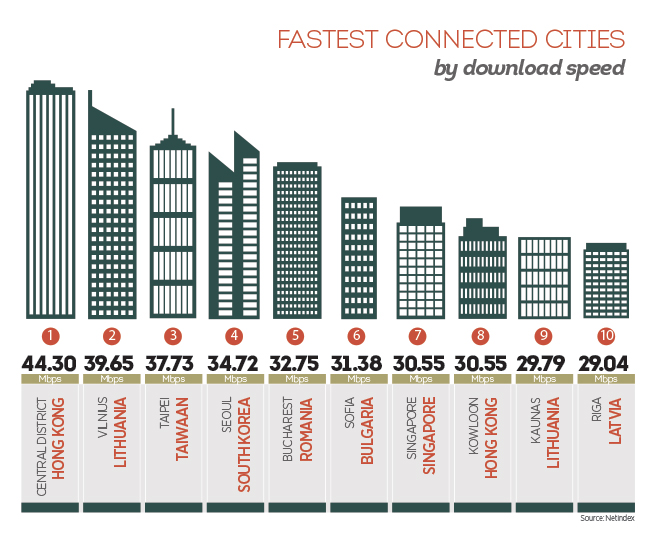
125 countries in the report saw year-on-year speed increases, up to the new global average of 2.6Mbps. Only 10 countries saw a decrease in speed. South Korea can boast the fastest average speed at 15.7 Mbps, followed by Japan (10.9 Mbps), Hong Kong (9.3 Mbps), the Netherlands (8.8 Mbps) and Latvia (8.8 Mbps).

German officials demand Facebook destroys database

German Data Protection Officials in Hamburg have accused Facebook of illegally compiling photo databases of users without the needed consent and have insisted that Facebook destroy its archive of files relating to facial recognition technology.

Facebook uses analytic software to study usersí photos and prompt them to ìtagî their friends. The software has proven very controversial in Europe where EU data protection laws require that users specifically opt in to the service.

Facebook, instead, automatically assumes user consent and goes ahead with the creation of digital files based on the biometric data of their faces. The group has acknowledged that it is compiling biometric data on users, but claims it doesnít have to cease the practice because it is legal in Ireland where Facebookís European operations are based.

In discussions with the Irish Data Protection Commissioner, the company was advised to notify users of the photo tagging software ñ which it has done. However, the Hamburg regulators have the option of issuing a fine of up to Ä25,000 or attempting to sue Facebook, which would prove legally difficult, as its headquarters is located in the US.

This isnít the first time that Facebook has fallen foul of German users. Last year, the German government found the Facebookí ëLikeí button illegal as a personís web movement and preferences could also be tracked from using it.

Intelligent traffic lights aid hesitant motorists

There is a name for that split second when you arrive at an amber traffic light, and you have the decision of powering through and hoping you donít get broadsided by a truck, or waiting at the red light. Itís called the ëdilemma zoneí, a phrase coined by Dr. Denos Gazis in 1959.

Belgium-based company Traficon has unveiled new technology to help drivers through the dilemma zone. It combines a video sensor with radar that can control traffic lights, keeping it lit amber until you are safely through the crossroads or T-Junction. Traficon also showed off a similar system that utilises thermal cameras to detect and allow cyclists safely through junctions. These technologies aim to increase safety while reducing congestion and fuel usage.

Both technologies were unveiled at the 117th International Municipal Signal Association ñ an annual traffic light convention. These are just two examples of a number of intelligent transportation systems (ITS) that will contribute to safer and more fluid traffic systems.

Further improvements in ITS may see navigational systems that warn of heavy traffic, real-time parking information, fee-based express lanes, and road sensors that warn drivers of stalled vehicles ahead, as have already been implemented in Japan.

Cleaning brain halts virus 

Researchers at the University of Rochester have discovered that a series of tubes, newly dubbed the ìglymphatic systemî, run alongside blood vessels. These tubes rapidly pump cerebrospinal fluid through them, carrying away waste accumulated in the blood vessels.

The glymphatic system, only now discovered by new imaging techniques known as two-photon microscopy, allowed the scientists to look inside the brains of living mice. By doing so they could see amyloid proteins, which are theorised to cause Alzheimerís disease, being carried away from the brain.

By ramping up the glymphatic systemís efficiency of purging waste from the brain, doctors may be able to reduce or prevent the onset of neurodegenerative diseases such as Alzheimerís or Parkinsonís. However, a cure for both diseases is still some way away.

Sports tech controversy

The London 2012 Paralympics saw a prime illustration of the contention surrounding technological advances in athletics after the menís T44 200m final.

Renowned South African sprinter Oscar Pistorius was beaten into second place by Brazilís Alan Oliveria, however Pistorius surprisingly voiced his discontent about the length of his rivalís running blades, stoking the long-running debate on the potential extent that technology can give competitors an undue advantage.

Oliveriaís height was increased from 177cm to 181cm in his new blades, which is legal within the International Paralympic Committee (IPC) rules. However, Pistorius competes at a height of 184cm despite being allowed to raise his height to 193cm.

Some sport scientists believe that the increased height for sprinters can effect stride length which usually makes them run faster. Yet, despite this, Pistorius actually look six fewer strides to Oliveiraís 98, with a higher average stride length.

The South African later apologised for his remarks, but it later emerged that Pistorius had expressed his concerns about the new raft of technology available for Paralympic athletes to the IPC prior to the 2012 Games.

Big pharma to outsource for fresh ideas

Many of the larger pharmaceutical companies dedicate huge amounts of money towards discovering the latest drugs that could cure ailments and heal balance sheets, with a large proportion of research and development conducted in-house.

However, with productivity yields from in-house research dropping alarmingly, many companies are spending increasing amounts on outsourcing to smaller teams of academics to help develop the next money-spinning medication.

According to MIT Technology Review, drug companies spend ten times more than they did on R&D since 1980, while the number of approved drugs entering the market each year has stayed relatively flat.

According to GlaxoSmithKline, nearly 60 percent of the drugs they have in late-stage testing have been developed by other companies, which represents a jump of 20 percent in just three years. They are also sending roughly half of their $6.3bn R&D budget to outside companies.

Glaxo’s head of R&D, Moncef Slaoui, told Technology Review: “It took a lot of work within R&D to make it really clear that reaching out to a team that we judge to be better than us to prosecute an idea, or because they have a great idea, is just one way of doing R&D in the company.”

The industry is suffering from a lack of discoveries in new drugs, coupled with countries like India that do not traditionally respect drug patents. While many firms have outsourced their R&D to companies in India, the effect of the government’s reluctance to enforce patents rules in the country means that many may divert funds away.

Marijn Dekkers, CEO of Bayer, who recently lost a patent application for a cancer drug, Nexavar, in the country, told Forbes: “The danger of pushing the prices of prescription drugs down, down, down is that at some point the business model of developing these drugs will lose its attractiveness…India is becoming very reluctant to respect intellectual property for Western companies and that is becoming a challenge for us.”