




The rise of the machines

rise-of-the

Technological innovation has led to many industries developing more efficient forms of production, but at the unfortunate cost of shedding employees. Those managing major corporations are understandably eager to reduce the costs of manufacturing: a great deal of which come from paying wages to huge numbers of employees.

The impact of automating such processes on local economies can often be hugely damaging. Job losses in many countries, particularly at a time of economic difficulty, are deeply unpopular. As the working environment changes and technology advances, many employees in traditional industrial jobs are finding themselves out-skilled and redundant.

However, allowing one machine to replace large numbers of human workers can, if done correctly, bring benefits not only to the private corporations, but also to the economic environment in which those corporations operate. Software algorithms can solve some simplistic actions and robots are able to carry out repetitive factory processes.
Some argue that the replaced workers will be able to focus on more creative-based work. Freeing up people to do less boring tasks could lead to a fundamental improvement in business innovation. Automation could also lead to improvements in time-management and worker efficiency.

Automatic future
It is likely the use of robots in the manufacturing industry will steadily increase. Some people believe this to be a natural progression of technology that will enable human workers to fulfil more suitable tasks. CEO of Adept Technology John Dulchinos said: “If you look out far enough, machines are going to win. The human body… was not designed to be a factory machine. It was designed to be a thinking machine.”

Although automating work processes will likely lead to a significant increase in productivity, while also improving quality control, some companies have increased their workforces in order to cater for the increased output. There are also companies, notably car manufacturer Toyota, which have sought to combine automation with an increase in human workers.

Innovation Matrix specialises in distributing Japanese robotic technology across the US. According to CEO Eimei Onaga, the use of robots in the workplace is only going to increase. He said: “The cost of machinery is going down, while labour costs are rising. Soon, robots could even replace low-cost workers at small firms, greatly boosting productivity.”

A number of other benefits have led many companies to look into implementing automated systems throughout their factories: from a reduction in waste to a lowering of costs and better use of energy. The use of machines to carry out manufacturing processes has been enthusiastically embraced in Asia, and in particular Japan. The Japanese government invests over $10m each year in developing key robotic technologies.

Europe has also been looking to adopt automation systems, with German and Swedish firms leading the way. Germany has 43 percent of Europe’s robot workforce, while exporting a great deal more than the rest of the continent.

Although the US lags somewhat behind the rest of the world in automating industries, there has been a stark increase in recent years. Millions of jobs over the course of a few decades have been outsourced from the US to cheaper markets. The number of domestic manufacturing jobs has decreased by 30 percent since 1990. Manufacturing output, however, has only dropped one percent in that time, reflecting a lesser reliance on human workers and an increase in automation.

Foxconn
Foxconn is one of the world’s most talked about manufacturing companies. It has come in for considerable criticism for the conditions in which its workers build the latest tech gadgets. Some of the most recognisable tech brands in the world use Foxconn to build their devices, including Apple, Hewlett-Packard, Sony and Dell.

A spate of suicides relating to highly controversial working conditions in their Chinese factories, coupled with the soaring demand for the smartphones and tablets that they make, has led Foxconn to begin looking at ways in which it can automate its manufacturing. In 2011, Foxconn President Terry Gou announced plans to replace one million workers with robots by 2014.

Updating the press on the company’s plans in November 2012, Gou spoke of the first batch of robots – called the ‘Foxbots’ – which were already operational in one factory. He added that by the end of 2012, there would be another 20,000 installed. Little is known about the Foxbots as the company has designed them in-house.

Foxconn has around 1.2 million employees. Implementing further automation is likely to dramatically reduce that figure, while potentially improving the cramped conditions in which the remainder work. Although each robot is reported to have cost Foxconn almost $25,000 – more than three times the salary of an average employee at the firm – labour costs in China are steadily rising.

The long-term attractiveness of employing robots to do much of the work is obvious. Salaries at Foxconn’s Chinese factories have jumped between 30 and 40 percent in the past year, and were expected to grow by another 20-30 percent by this year.

Many firms in Chinese industry are recognising the benefits of automation. They will be looking with interest at how Foxconn’s plans pan out. Vice-President of the China Machinery Industry Federation, Zhang Xiaoya, said: “Industrial robots can help Chinese enterprises save costs on company management, food, accommodation, insurance and social benefits for employees. It can also strengthen their competitiveness in technology innovation and product design.”

Amazon
Many firms that have emerged since the advent of the internet have been unburdened by the constraints that large workforces place on companies. Amazon is a particular pioneer of automation. The company recently expanded on its plans for automating its services. In March 2012, it acquired robotic warehouse operations company Kiva Systems for $775m.

Kiva has created a number of robot systems that make warehouse management considerably quicker than with just human workers. Kiva’s technology has been used by a number of other companies, including Gap, Stapels and Crate & Barrel. Amazon executive Dave Clark said: “Amazon has long used automation in its fulfilment centres, and Kiva’s technology is another way to improve productivity by bringing the products directly to employees to pick, pack and stow.”

The idea of bringing an automation company into the Amazon fold makes sense, according to observers. Analyst Scott Tilghman said: “This is a way to improve efficiency. Given the scale of Amazon’s operations, it makes sense to have this capability in-house.” It makes sense for an online retailer that stores a great deal of products in warehouses to use automation as much as possible, as speed in delivery is paramount to their service.
Amazon has been steadily increasing its number of warehouses around the world. Having its own advanced automation systems in place will keep down labour costs in different regions. Amazon has 18 ‘fulfilment centres’ in the US, 20 in Europe and 10 in Asia, allowing it to spread its network of operations across much of the globe, increasing delivery and sourcing speed, and turning the company into the world’s largest online retailer.

Canon
While some companies look to find a halfway point in the way they balance the combination of automation and human workforces, others seem eager to fully embrace an automated production process. Japanese camera maker Canon recently announced plans to move towards a fully automated system over the course of the next few years.
The company hopes that some of its camera factories will be entirely automated by 2015, but insists that the human workers being replaced will simply be moved into other areas to work. Canon’s spokesman Jun Misumi said: “When machines become more sophisticated, human beings can be transferred to do new kinds of work.”

Although the cost-savings of going fully automated are obviously attractive to firms, some feel there are serious downsides to removing a human workforce. While machines are able to piece together components and move products much faster than their human counterparts, they do not yet offer the innovation and flexibility provided by a traditional worker.

Professor Akihito Sano of the Nagoya Institute of Technology thinks the industry is not ready to be run entirely by automated systems. He said: “Human beings are needed to come up with innovations on how to use robots. Going to a no-man operation at that level is still the world of science fiction.” In short, someone has to tell the robots what to do.

Japan has by far the greatest proportion of industrial robots compared to manufacturing workers. Figures from 2008 show that for every 10,000 manufacturing workers there were 295 robots. The closest country behind Japan was Singapore with 169, followed by South Korea with 164. Not all Japanese firms are so enamoured with automation though, and some are looking at ways of balancing a traditional workforce with a mechanical one.

Toyota
Japan’s pioneering automaker Toyota is a company that has innovated in many areas of production over the years, and was one of the first to introduce a form of automation to the production of its cars. In recent years, however, the company has begun implementing a system that combines the efficiency benefits of automated manufacturing with the flexibility of a human workforce.

Known as ‘autonomation’, the process allows the company to prevent defective products and overproduction, and to adapt to any problems that arise. The University of Michigan’s Professor Jeffrey K Liker, an expert on the firm, said: “Toyota has generally backed off when it put in too much automation and added back more people. And its latest processes have even more people than a couple of decades ago.”

Adaptability is key when it comes to Toyota’s strategy, according to Professor Liker, with human workers capable of doing a number of different tasks. He said: “for many jobs [Toyota] believes that people are more adaptable, it can add or subtract people easily and move them around.” Too much automation led Toyota to discover it had created a “fixed cost” and therefore reduced its own flexibility.

Professor Liker said: “Toyota’s new global engine line has less technology than existing lines and its new assembly lines also have less technology. By reducing both overheads and technology, it is more flexible to adapt to changes in the environment. I believe Toyota has more of a balance between technology and people. And where it has technology, people in the work groups in the area are still at the centre as they maintain and have responsibility for the equipment.

“What I have observed is that when management treats people like cogs in a machine, workers will accept it as long as they are satisfied with pay and job conditions, but they will not contribute their ideas to improve the process. The last thing [Toyota] wants are people acting like robots that just do what they are told.”

robot-density

An age of reason

We expect companies that were born digital, like Amazon, to accomplish things business executives could only dream of a generation ago. But, in fact, the use of big data has the potential to transform traditional businesses as well. It may offer them even greater opportunities for competitive advantage (online businesses have always known they were competing on how well they understood their data).

As the tools and philosophies of big data spread, they will change long-standing ideas about the value of experience, the nature of expertise and the practice of management. Smart leaders across industries will see using big data for what it is: a management revolution. But as with any other major change in business, the challenges of becoming a big data enabled organisation can be enormous and require hands-on – or in some cases hands-off – leadership. Nevertheless, it’s a transition that executives need to engage with today.

Data-driven performance
The business press is rife with anecdotes and case studies that supposedly demonstrate the value of being data-driven. But the truth, we realised recently, is that nobody was tackling that question rigorously. To address this embarrassing gap, we led a team at the Massachusetts Institute of Technology Center for Digital Business, working in partnership with McKinsey’s business technology office and with our colleague Lorin Hitt at Wharton and the MIT doctoral student Heekyung Kim. We set out to test the hypothesis that data-driven companies would be better performers. We conducted structured interviews with executives at 330 public US companies about their organisational and technology management practices, and gathered performance data from their annual reports and independent sources.

One relationship stood out: the more companies characterised themselves as data-driven, the better they performed on objective measures of financial and operational results. In particular, companies in the top third of their industry in the use of data-driven decision-making were, on average, five percent more productive and six percent more profitable than their competitors. This performance difference remained robust after accounting for the contributions of labour, capital, purchased services and traditional information technology investment. It was statistically significant and economically important and was reflected in measurable increases in stock market valuations.

New culture
The technical challenges of using big data are very real, but the managerial challenges are even greater: starting with the role of the senior executive team.

Muting the Hippo: One of the most critical aspects of big data is its impact on how decisions are made and who gets to make them. When data is scarce, expensive to obtain or not available in digital form, it makes sense to let well-placed people make decisions – which they do on the basis of experience.

For particularly important decisions, these people are typically high up in the organisation, or they’re expensive outsiders brought in because of their expertise and track records. Many in the big data community maintain companies often make most of their important decisions by relying on the Highest-Paid Person’s Opinion (Hippo).
We believe that throughout the business world, people rely too much on experience and intuition and not enough on data. For our research, we constructed a five-point composite scale that captured the overall extent to which a company was data-driven. Fully 32 percent of our respondents rated their companies at or below three on this scale.
New roles: Executives interested in leading a big data transition can start with two simple techniques. First, they can get into the habit of asking: “What does the data say?” when faced with an important decision and following up with more-specific questions such as “Where did the data come from?” and “What kinds of analyses were conducted?” Second, they can allow themselves to be overruled by the data; few things are more powerful for changing a decision-making culture than seeing a senior executive concede when data has disproved a hunch.

Five management challenges
Companies won’t reap the full benefits of a transition to using big data unless they’re able to manage change effectively. We have identified five areas which are of particular importance in that process:

Leadership: Companies succeed in the big data era not simply because they have more or better data, but because they have leadership teams that set clear goals, define what success looks like and ask the right questions. Big data’s power doesn’t erase the need for vision or human insight. We must still have business leaders who can spot a great opportunity, articulate a compelling vision, persuade people to embrace it and work hard to realise it.

Talent management: As data becomes cheaper, the complements to data become more valuable. Some of the most crucial of these are data scientists and other professionals skilled at working with large quantities of information. Statistics are important, but many of the key techniques for using big data are rarely taught in traditional statistics courses. Along with the data scientists, a new generation of computer scientists are bringing to bear techniques for working with very large data sets.

Technology: The tools available to handle the volume, velocity and variety of big data have improved greatly in recent years. In general, these technologies are not prohibitively expensive. However, they do require a skill set that is new to most IT departments. They will need to work hard to integrate all the relevant internal and external sources of data.

Decision-making: An effective organisation puts information and the relevant decision rights in the same location. In the big data era, information is created and transferred, and expertise is often not where it used to be. The artful leader will create an organisation flexible enough to minimise the “not invented here” syndrome while at the same time maximising cross-functional cooperation.

Company culture: The first question a data-driven organisation asks itself is not “What do we think?” but “What do we know?” This requires a move away from acting solely on instinct. It also requires breaking a bad habit we’ve noticed in many organisations: pretending to be more data-driven than they actually are. Too often, we saw executives who spiced up their reports with lots of data that supported decisions they had already made using the traditional Hippo approach.

The evidence from our research is clear: data-driven decisions tend to be better decisions. Business leaders will either embrace this fact or be replaced by others who do. In sector after sector, companies that figure out how to combine domain expertise with data science will pull away from their rivals.

BIG DATA IN PRACTICE

Often someone coming from outside an industry can spot a better way to use big data than an insider, just because so many new, unexpected sources of data are available. One of us, Erik, demonstrated this in research he conducted with Lynn Wu, now an assistant professor at Wharton. They used publicly available web search data to predict housing-price changes in metropolitan areas across the US.

They had no special knowledge of the housing market when they began their study, but they reasoned that virtually real-time search data would enable good near-term forecasts about the housing market: and they were right. In fact, their prediction proved more accurate than the official one from the National Association of Realtors, which had developed a far more complex model but relied on relatively slow-changing historical data.

This is hardly the only case in which simple models and big data trump more elaborate analytics approaches. Researchers at the Johns Hopkins School of Medicine, for example, found that they could use data from Google Flu Trends (a free, publicly available aggregator of relevant search terms) to predict surges in flu-related emergency room visits a week before warnings came from the Centers for Disease Control. Similarly, Twitter updates were as accurate as official reports at tracking the spread of cholera in Haiti after the January 2010 earthquake: they were also two weeks earlier.

Getting started

Businesses don’t need to make enormous upfront investments in information technology to use big data (unlike earlier generations of IT-enabled change). Here’s one approach to building a capability from the ground up:

  • Pick a business unit to be the testing ground. It should have a quant-friendly leader backed up by a team of data scientists;
  • Challenge each key function to identify five business opportunities based on big data, each of which could be prototyped within five weeks by a team of no more than five people;
  • Implement a process for innovation that includes four steps: experimentation, measurement, sharing and replication; and
  • Keep in mind Joy’s Law: “Most of the smartest people work for someone else.” Open up some of your data sets and analytic challenges to interested parties across the internet and around the world.

Failure on take off

The announcement that British defence giant BAE Systems was in talks with European Aeronautic Defense and Space Company (EADS) about a possible merger came as a shock to all associated parties. Both companies had a unique and vast reach, as well as their own reasons to benefit from the arrangement. But it was not meant to be; competing interests and political deadlock meant EADS and BAE could not join forces.

There were any number of reasons the deal fell apart. There were critics at every level, including shareholders, government officials and industry analysts who had reservations about the prospects and power of the larger corporation, and feared for their investments in a changing industry.

Analysts have been left wondering what each side could have offered, what would have happened to competitors and could it really have, as chiefs of both companies announced in a joint statement, “produced a combined business that would have been a technology leader and a greater force for competition and growth across both the commercial aerospace and defence sectors”?

Merger talks within these industries are not uncommon and this is not the first time BAE has been through negotiations to protect its future. It has reportedly had discussions with EADS’s biggest competitors in the past, including Boeing, Lockheed Martin and Northrop Grumman. The current bid for collaboration started in early September. Terms of the deal gave shareholders in BAE and EADS 40 percent and 60 percent of the combined company respectively. There was an immediate call to renegotiate terms from investors on both sides, including BAE’s majority shareholder Invesco Perpetual. It had “significant reservations” and said it did not understand the “strategic logic” behind the deal.

Further obstacles emerged as the British, French and German governments began dialogue. The British requirement for a capped nine percent for each foreign government investor was heavily contested as both European partners demanded bigger shares in the new business. German Chancellor Angela Merkel also announced fundamental objections to the creation of the largest integrated defence and aviation company, giving little hope for completion. Unable to agree any workable solution, the deal collapsed.

For each side, the prospect of collaboration was filled with opportunity. For BAE it was a route back to the thriving civil aviation sector it had left years before, access to a wider audience across the Asia Pacific and the stronger balance sheet it needed to ride out the severe cuts in defence spending that were looming from its prominent American customer base.

EADS, home to successful plane maker Airbus, did not have the fears for the future that BAE had as its commercial market was continuing to grow. It did, however, see hope for expansion through the deal, exploiting the joint client collection and benefiting from expansion into a US market which it had yet to conquer.

EADS was also partial to the deal’s terms, which would have seen a distinct reduction in the influence the French and German governments had in its operation; the US’ terms for agreement meant there was a cap on foreign investment to limit involvement in closely guarded American security files. As it turned out, though, this particular contract condition would be one of the deal breakers.

In a changing economic climate, both companies saw an opportunity in collaboration to maintain their impact and grow in new regions and reach new markets. Both BAE and EADS have proven themselves successful for many years, have expanded progressively to build up their respective reputations and fortunes, and have sought to capitalise through synergy. EADS is a European corporation that unites the capabilities of four unique manufacturers, including: Astrium, Europe’s leading space programme; Cassidian, the defence and security arm; and Eurocopter, the world’s largest helicopter supplier. But by far the biggest earner for EADS is Airbus, a leading aircraft manufacturer that accounts for around two-thirds of the corporation’s revenues. Airbus and its US adversary Boeing have taken over the aerospace market, leaving little room for competitors, and have been in a constant war to rule the skies for decades.

The merger would have given Airbus a new sword edge with which to fight this close battle; for years the US market was out-of-bounds and strictly Boeing territory. Prospective partner BAE is Europe’s biggest security contractor for air, land and naval defence forces worldwide: its biggest market being the US military. It is also heavily involved in contracting the Pentagon and other intelligence services with the systems needed to maintain national security. These include advanced electronics, information technology and support services for computers, as well as armour for defence vehicles and aircraft. BAE and EADS have collaborated in the past and the security multinational produces a significant number of the systems on board Airbus aircraft. Current projects include the world leader in missile technology development, MBDA, and the Eurofighter Typhoon, which, despite controversy over its costs, is currently being used by numerous air forces including the RAF and Royal Saudi Air Force.

What wasn’t
The multi-billion-euro merger could have been immense despite its rejection by the majority of shareholders. A corporation that size would have had a significant impact on the industrial landscape. Both EADS and BAE have offerings that could have made the alliance a formidable player: one that accomplished Airbus’s original mission statement to “strengthen European cooperation in the field of aviation technology”. It would have presented a substantial rival to Boeing: which, despite being most famous for its leading aircraft manufacturing, gets around 30 percent of its proceeds from defence operations.

Pooled revenue figures reveal the size the merged company could have been initially, and presents a case for significant growth potential that could have overtaken rivals across both security and aerospace industries: on turnover at least. Figures from 2011 show EADS had takings of £39bn and BAE of over £19.1bn. This would have meant that the merged corporation had combined returns exceeding £58bn. Boeing’s £42.7bn in 2011 sales, combined with its 1997 merger with McDonnell Douglas Corporation, make it the largest aerospace company. Airbus’s latest report also presents more growth potential, particularly if research and development funding resources are pooled. The European airspace manufacturer is expecting its commercial market to escalate, predicting that, over the next 20 years, it will deliver around 27,900 new aircraft across its designs and mount » a market value of almost £2.2trn: bear in mind these figures do not include growth into competitive US territory as a result of a merger with BAE. This figure, combined with the prospective extension into new commercial and security aircraft markets, would have meant the merged corporation exceeded even Boeing’s expected demand by 2031 (it recently announced a predicted market value of £2.8trn).

The merged company could also have become an influential defence contractor to the US Army. Merging resources and client lists would have widened growth prospects as BAE and EADS also combined manufacturing. BAE Systems has a huge American client base and is the ninth-largest supplier to the US defence sector, making £4.5bn from its Paladin howitzer, various combat vehicles and naval gun sales. Market leaders Lockheed Martin and Boeing make triple that figure. EADS is yet to make its mark on the US defence market. Although it is a frontrunner in the commercial aircraft field, it remains a fledgling competitor in security, offering just UK-72 Lakota light utility helicopters to the American army. Merging EADS’s aeroplane capabilities with BAE’s massive US presence would have made a stronger force, more capable of competing effectively with rivals for US defence contracts.

The collaboration would have created a 220,000-strong workforce across the world and new markets to tap into as geographical scope widened and market leverage strengthened. In comparison, Boeing employs just over 170,000 people across its divisions in 70 countries. EADS currently boasts growing key markets across Brazil, Russia, China, India, Australia and the Middle East. BAE’s biggest markets are based in the US and UK, with unique access to national security documents. Although these are set to decline as military forces retreat from Afghanistan, there is an emerging interest from a new Saudi Arabian market. Together, the partnership would have taken over a huge part of both sectors, building upon respective reputations in their selective markets as a more powerful alliance.

Broken ties
As well as having the scope to take over a huge geographical base, an impending collaboration would have placed a further, more personal burden on Boeing, as BAE is one of its suppliers. In fact, BAE’s efforts in providing Boeing with military and commercial aircraft apparatus were commended in a recent awards ceremony, further signifying just how deep the disruptions could have been for the wider industries as a result of the deal. President and CEO of Boeing Defence, Space and Security Dennis Muilenburg said: “There are national security questions, industrial questions, and those will have to be dealt with… [This is] a serious matter that needs to be scrutinised.”

Among other things, BAE currently supplies the American corporation with automatic flight control systems for its V-22 Osprey tilt-rotor, a touch-screen attendant control panel on the 737 single-aisle airliner, and engine-control systems on the 767 and 787 Dreamliner jets. As it shared its research and development resources with Boeing’s rival, and helped boost its own credentials rather than reduce them, the merged company would have had an advantage in the market. EADS and BAE’s relationship would also have compromised competition confidentiality, as Boeing’s interests were no longer valued. BAE would most likely have shifted any shared plans for development to Airbus, helping develop and strengthen the competition. Boeing would have to have found an equally advanced, alternative contractor to replace electronics that are currently installed in more than 6,000 Boeing planes across 181 airlines.

Despite the prospects of the larger company, negotiations were terminated, leaving BAE and EADS’s futures uncertain. Some analysts have suggested there is a chance the two companies will try to restore their pact at some point in the future. BAE chief Ian King has reportedly said he “still believes in a full merger with continental aerospace group EADS” and would consider organising further discussions if “politicians, particularly those in Germany, could be convinced to change their views”.

In light of huge cuts in defence spending by US clientele (which account for around 40 percent of the company’s revenue), much of the discussion centres on BAE. Some analysts predict BAE will attempt to merge with another firm in the near future or consider other drastic options as it continues to struggle to maintain its business model.

Financial services provider Morgan Stanley said: “While BAE’s lack of near-term growth is well known, the proposed merger could be seen as an indication that the outlook for defence is more difficult than is currently expected. We therefore believe investors will now turn their focus to BAE’s next possible strategic move (e.g. a merger with a different party or [the] break-up of BAE).” tne

China’s year of the Jaguar

Jaguar Land Rover is to begin building vehicles in China after a £1bn joint venture was approved by Beijing. The British carmaker will partner with Chinese firm Chery Automobile to build a manufacturing plant near Shanghai, due to open in 2015. A research and development centre and an engine production facility are also to be built.

Sales of Jaguar Land Rover have risen in China by 80 percent for the first 10 months of 2012 and the company will be able to avoid costly import duties by producing the cars in the country. It will also aim to use the new plant to produce car models specifically designed to target the Chinese market.

In a joint statement, Dr Ralf Speth, Jaguar Land Rover CEO, and Yin Yongyao, Chairman and CEO of Chery Automobile Company, said: “We are delighted to have reached this milestone, achieved thanks to the understanding and foresight of the Chinese authorities and we want to thank them for recognising the potential of our joint venture in the fast-growing Chinese market.”

Jaguar Land Rover stressed that cars produced in the new Chinese manufacturing plant would be additional output and it had no intention to move its manufacturing base out of its traditional home in the UK.

Nintendo levels up the competition

Nintendo has come first out of the gate in the eighth generation of video game consoles. Its new Wii U gaming system features a unique touchscreen controller intended to entice gamers with ‘asymmetrical gameplay’, where the player’s experience changes depending on whether they are using the new controller or the old Wii remote. The touchscreen controller also allows the game to be played without a TV set.

With its new system, the Japanese company hopes it can rise to the challenge brought about by the recent surge in popularity for touchscreen gaming on tablets and mobile phones, while also outdoing the competition. Nintendo chief executive Satoru Iwata said: “The chances of consumers buying our software would be less and less if what we make isn’t so much different. We have to make games that smartphones or tablets can’t do.”

Nintendo’s traditional competitors Sony and Microsoft will be watching the performance of the Wii U eagerly as they are due to announce their own eighth-generation consoles. With the video game industry changing, Nintendo’s success or failure in attempting to compete with tablet and mobile phone games should provide them with a valuable insight. The response of the traditional players in this changing market will have a significant impact on their fortunes and further reveal the direction the industry is set to take.

Nintendo’s strategy to sell its console at a slight loss with the intention of recovering profits from game sales will also be of interest to the competition. This has traditionally been common practice in an industry where hardware is expensive to produce, so it is important to see if the strategy continues to work this generation. At the current price, however, most consumers only need to purchase one additional game for Nintendo to reap a profit.

Search for new battery continues

How to create safer and longer-lasting batteries that can power technology, from personal gadgets to industrial sized machinery has been a continuous area of research for many years. Engineers believe that reducing the price and improving efficiency could lead to a world reliant solely on renewable energy.

According to recent studies, researchers are close to making some breakthroughs. An article in this week’s Economist highlights The Joint Centre for Energy Storage Research (JCESR), a collaboration between universities and laboratories from across the US, which has received a $120m grant from the US Department of Energy. They have developed a white powder that they hope will act as an electrolyte and create much greater energy storage.

Elsewhere, scientists at the Oak Ridge National Laboratory (ORNL) have developed an electrolyte that could allow lithium-ion batteries to store up to ten times more energy than existing batteries. The nanostructured solid electrolyte could create batteries which are believed to be much safer than flammable liquid electrolytes, as found in Boeing’s 787 Dreamliner planes which caught fire recently.

The ORNLK’s Chengdu Liang, told the Journal of American Chemical Society: “To make a safer, lightweight battery, we need a design at the beginning to have safety in mind. WE started with a conventional material that is highly stable in a battery system – in particular one that is compatible with a lithium metal anode.”

Both sets of research are in the early stages of development, but if serious breakthroughs can be made then we could be set to far greater energy efficiency in all areas of life, and without the problems that have hurt companies like Boeing.

A new dimension


For 3D printing

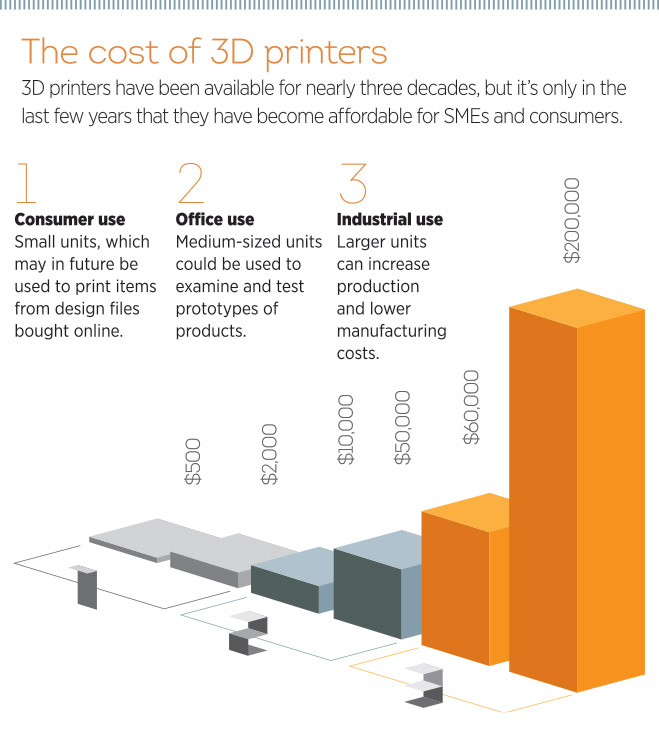
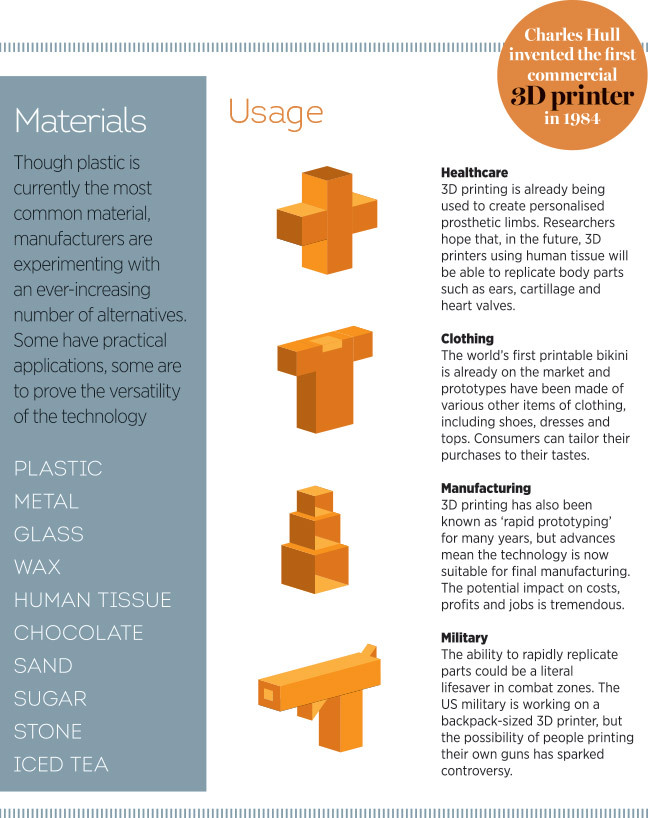
The concept behind 3D printing, the much-discussed new technology said to be on the verge of revolutionising industry, is often thought of as confusing, with some struggling to detach the thought of a traditional paper printer producing advanced physical objects. Also known as ‘additive manufacturing’, the process is widely regarded as the future of the manufacturing industry and is expected to transform the way in which a whole range of products are created.

While many sceptics believe the process will negatively impact upon the job markets, the advantages for both consumers and businesses are obvious. Companies as diverse as shoemaker Converse and Italian coffee manufacturer Alessi have been using 3D printing technology for a number of years to bring down costs and increase production speeds.

According to Converse, who use Z Corporation’s printing technology, production is 30 times faster. They have also been able to cut back eight annual trips to Asia, costing $12,000 per person, for design meetings. The cost of equipment required for production has also been dramatically slashed, with Converse saving $200,000 from its previous costs. A 70 percent decrease in costs, from shipping components and materials from overseas, allows for a far more profitable and efficient business.

“3D printing is set to totally reverse many countries’ overreliance
on manufacturing”

A considerable advantage of the speed with which 3D printing creates products is the allowance for on-demand manufacturing, which will sharply reduce the costs associated with unwanted stock. This should work in favour of smaller firms that don’t have the infrastructure to store and bulk-buy components, and especially those with just an online presence.

While online firms will benefit, a trend has emerged of shops with 3D printing machines springing up, offering clients the ability to customise their products in-store. They can select the colours, materials and size of whatever they are looking to buy.

Another advantage is the ability to cut down on the materials required to manufacture products. Aircraft manufacturers can waste up to 90 percent of the materials they use in making their planes. 3D printing requires less energy than traditional manufacturing processes and cuts down on waste. While this greatly reduces costs, it is also better for the environment. The 3D printing machines come with the added bonus of being multi-purpose. They eliminate the need for specialised machines and create a far more sustainable process.

As the world moves towards a more technologically advanced society and the tech-savvy youth begin to dominate the jobs market, the opportunities for developing new products through 3D printing software will be vast, while the need for traditional manufacturing and factory-based work will be less prominent. While this may reduce the employment opportunities for many current workers who may not be able to retrain, those entering the jobs market will be suitably skilled in many of the design applications and concepts involved in 3D printing.

Economies over the past century have been underpinned by their manufacturing industries due to the employment and output figures they produce. 3D printing is set to totally reverse many countries’ overreliance on manufacturing, creating more streamlined, efficient, greener and personalised industries.

Against 3D printing

Every few years, a new invention or technology comes along that has techies falling over themselves with excitement. In no time at all the media is up in arms, declaring a ‘new industrial revolution’ is imminent. The revolutionary technology du jour is the so-called 3D printer.

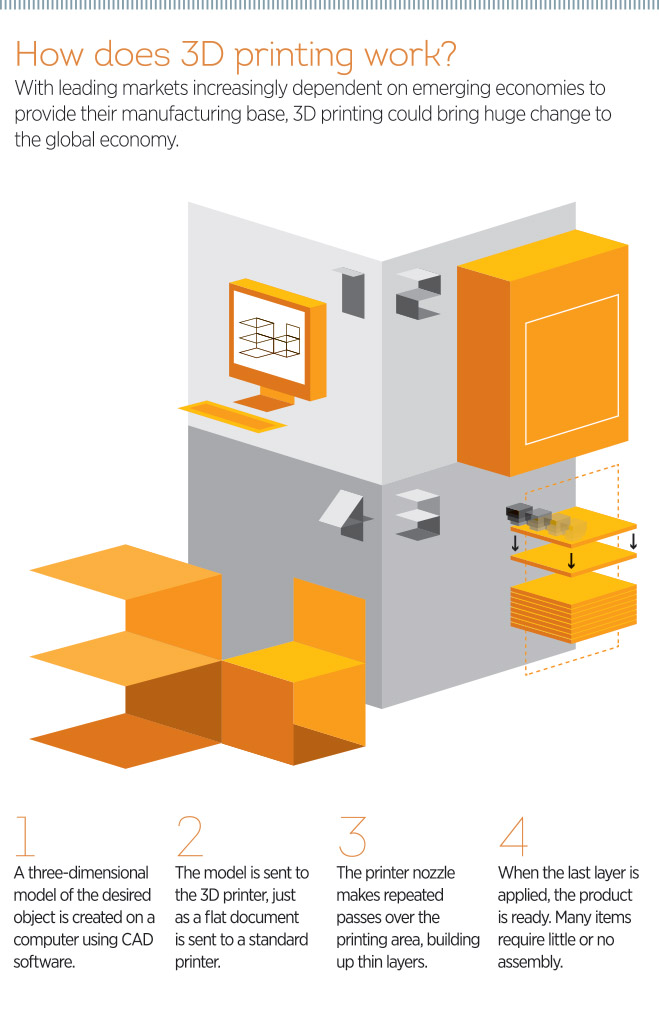
Of course, it’s not a printer at all. In fact, the technology produces a three dimensional object from a digital model by layering microscopic layers of plastic, resin or metal. The printer itself is essentially a gantry that allows a depositor to travel around 3D space, creating objects. In the future, as this technology is developed, it might well prove useful in some precision technology industries where the human hand is just not steady enough: but reports of its wider usefulness have been greatly exaggerated.

It has been suggested that these devices might soon be able to craft objects out of biological tissue, allowing doctors to produce cartilage, heart valves and other human bits-and-bobs. One group of scientists in the US is working on printing a human ear, but they estimate it will take around 20 years for the process to be perfected.

And that’s just the problem with 3D printing as we know it today: it is just not as diverse a technology as it has been made out to be. Most 3D printers use plastics, resins or powdered metals to produce the objects because they can only print things made of one particular material. Anything more complex than an intricate vase, a phone cover or a Star Wars action figure will have to be assembled using bits not made by the printer. Suddenly, it’s not looking so useful.

“The benefits of 3D printers do not outweigh the potential damage to the labour sector”

In fairness, these issues are likely to be overcome as the technology develops. By far the more important concern is the effect this cheap method of mass production will have on the labour market and manufacturing. When these machines are being touted as universal producers, the effects their widespread use could have on the manufacturing labour market are potentially catastrophic – and this at a time when many governments are already fighting to preserve their manufacturing industries.

3D printer-based production puts the designer in the centre of the manufacturing line and completely cuts out the manual labour element of the process. Billions of people work in factories and manufacturing jobs around the world, all of whom could potentially be left unemployed if cheap machines can print anything from guns to bras. Essentially, 3D printing can provide the skilled labour to produce complex designs, but without the need for a worker.

Furthermore, if the use of 3D printing becomes widespread, it would severely restrict the variety of skills required in the industry. All steps in the manufacturing process would be left in the hand of designers and perhaps engineers, further limiting the employment market. For the time being, the benefits of 3D printers do not outweigh the potential damage to the labour sector and, by extension, the political and economic spheres.

As the technology develops, 3D printing will be better suited to the precision industry than to widespread use in manufacturing. After all, consumers are already willing to pay a premium for ‘homemade’ or ‘handcrafted’ goods. No machine will be able to replace the superiority of a handcrafted object because human skill and creativity will always be the most valuable commodity.


A quick guide to sustained and relative innovation

There’s no instant formula for innovation success. It requires a comprehensive approach starting with strategy, supported by strong processes, an efficient organisation and resources and an innovative culture and it can take a long time to achieve.

But what if you don’t have the time, resource or the mandate to create new innovation strategies? Here, we provide a brief round up of some widely used tools that have a good track record of success.

Innovation boot camp
An immersive experience in which small teams of managers are tasked with developing and then pitching a new product, service or process idea to a senior management “Dragon’s Den”-style panel. It typically takes place over a period of two to three weeks, with team members taken to an offsite location.

Strengths

  • Engaging, intensive experience that has the potential to excite and inspire
  • Should achieve real results with tangible business value
  • Promotes entrepreneurship

Limitations

  • Only involves small group of staff
  • Cost of taking managers offline
  • Hard to conduct frequently

Key success factors

  • Have a mix of skills and experience in the team
  • Make teams cross-functional/cross-divisional
  • Senior leaders need to support strongly and be prepared to invest
  • Outside experts can help kickstart content and/or run process

Innovation sandpit
A team-based exercise that brings participants together from across functions and disciplines, including external organisations. Through an intensive four-to-five-day workshop, there is a deepening understanding of the challenge, a clear definition of the problem and generation of a suite of prioritised, peer-reviewed solutions.

Strengths

  • Engages multi-disciplinary and multi-functional teams
  • Helps to redefine the problem and challenges
  • Enables the “building” of ideas as each participant adds to the solution

Limitations

  • Not every challenge can be solved with this tool. Challenges must be holistic and support input from across disciplines
  • Not everyone is suited to being involved in a sandpit

Key success factors

  • Participants must be free-thinking, collaborative in nature and work well in a team
  • Funding must be readily available for the outcome or participants become demotivated

Innovation coaches
Innovation coaches are tasked with engaging different parts of the organisation in innovation-orientated activities such as idea management, coaching in good innovation practice, implementation of award schemes and exchange of knowledge and insights.

Strengths

  • Helps to diffuse innovation culture through large organisations
  • Provides a network of local focal points to enable and drive implementation of innovation-related activities

Limitations

  • Creating the role itself will only have limited effect unless there is a well-managed innovation programme to be implemented
  • More suitable for larger organisations

Key success factors

  • Need enthusiastic coaches with the right experience
  • Select coaches with excellent networking, communication, creativity and analytical skills
  • Train coaches well in best-practice innovation management and change management
  • Keep the network active through frequent initiatives and activities

Innovation jams
Time-limited, web-based, large-scale cross-sector discussions about specific hot topics, likened to a musical jam session in which the participants react to and spark off each other’s contributions. Typically conducted internally within large corporations and can be intensive, lasting only a few days.

Strengths

  • Actively involves cross-functional, cross-regional staff in innovation activities
  • Helps to build networks and strengthen knowledge sharing
  • Generates valuable outputs in terms of new ideas and projects

Limitations

  • Needs commitment to take ideas forward and to communicate progress
  • Topics must be relevant, challenging and engaging
  • More suitable for larger organisations

Key success factors

  • Ensuring knowledge generated from the discussions is collected and actions taken, visibly
  • Integrating the Jam approach into the innovative culture of the company – repeating it
  • Contributors recognised with increased visibility

Expert networks
An inability to capture and integrate isolated pockets of expertise is a common barrier to innovation. Corporations are increasingly applying enterprise social media tools to strengthen networks of internal and external experts.

Strengths

  • Easy access to expert knowledge for global staff
  • Drives transfer of information rather than just capture
  • Exploits the growing usage of social media
  • Provides fast response and dialogue

Limitations

  • Is only as good as the usage and quality of discussions
  • More suitable for larger organisations
  • Is not a substitute for personal contact and teamworking

Key success factors

  • Effective moderation to ensure that urgent matters are dealt with, discussions are closed out, experts are engaged and successes are publicised
  • Integration with other knowledge management and learning activities to attract engagement and avoid dilution
  • Focus on low effort for access and keep the system simple
  • Have a clear policy on its use and purpose, including privacy details for the users and the content of messages

Award schemes
Encourage staff innovation efforts through either a recognition-based or results-based award.

Strengths

  • Helps to publicise the innovation message
  • Can be tailored to focus on important company priorities
  • Can be used to promulgate examples of “good innovation behaviour”

Limitations

  • Needs long-term senior commitment, otherwise can be seen as “window-dressing” by staff
  • Only limited number of staff participate
  • May actually increase the perception that innovation is an “extra” outside the day job

Key success factors

  • Ensure that the scheme is properly, systematically and transparently managed
  • Public recognition is often more effective than monetary reward
  • Link to business goals and award substantial innovations only

Target schemes
The practice of setting corporate, team and individual innovation-related targets, and measuring progress using suitable metrics.

Strengths

  • Provides direct and visible measures of innovation performance
  • Can be linked to bonus or incentive payments
  • Demonstrates senior commitment to innovation

Limitations

  • New systems or processes may need to be developed to capture the metric data
  • Care needs to be taken that metrics do not cause unwanted side-effects
  • Staff need to be able to directly influence the achievement of the targets

Key success factors

  • Use a suitable balance between input/process/output metrics
  • Ensure the metrics are suitable for your business rather than applying the same metrics from “leading innovators”

While there are certainly no shortcuts to innovation excellence, quick-win tools can play a useful role in building momentum and demonstrating results.

View the full article at www.adl.com/prism-intro.html

Home entertainment exit for Philips

Philips, the company that invented the audio cassette 50 years ago, has announced plans to sell off its loss-making home entertainment business in an effort to reduce costs and to concentrate on healthcare and the more profitable home appliance market.

The Dutch firm says it hopes to receive more than €150m for its audio and DVD arm, as well as licenses, in a sale to Japanese company Funai Electric. The announcement came as the Philips revealed losses of €355m for the last quarter of 2012.

Last year, the company sold off its struggling television business to Hong Kong’s TPV in order to create greater efficiencies after a difficult year, which was blamed on the internet and competition from Asia.

Chief Executive Frans van Houten told reporters: “The market in this area [consumer entertainment] has shifted so much to the internet and mobile devices, and with so many Asian competitors in it, we feel we can no longer distinguish ourselves through innovation. It’s a mature market and we need to move on.”

The company’s new focus will be on healthcare equipment, as well as its popular shaving and toothbrush products.

Phase 2 of UK’s high speed rail unveiled

For a country that pioneered rail transport across the world, the UK’s creaking network has been in desperate need of an upgrade for decades. Soaring ticket prices, unreliable services and monopolies over key lines has led to many in the country bemoaning what is a vital part of transport infrastructure.

While many have called for further investment in improving the existing network, others within the industry and politicians in Westminster have more ambitious proposals, in particular the high speed rail systems that have proved so successful in other countries, most notably across the Channel in France.

This morning, the coalition government announced further plans for the proposed High Speed 2 rail network that it hopes will bridge the north-south economic divide between London and regions north of Birmingham. The second phase, announced by Transport Secretary Patrick McLoughlin, will extend the London to Birmingham line north towards key cities like Manchester, Sheffield and Leeds.

Although existing lines serve the north of England from the capital, the government believes that a new high speed link will unlock economic growth in the north by nearly halving the time it takes to travel there. It will also simplify and speed up access to the continent, as well as boosting capacity to the entire network.

McLoughlin told reporters: “It’s not just about journey times, it is also about capacity. We are finding the railways are overcrowded. We’ve seen massive growth in rail passenger numbers, so this is taking HS2 so it serves the north. This is the first railways to be built north of London for 120 years.”

The government also hopes that improving the rail infrastructure will reduce peoples need for short-haul air travel, significantly cutting carbon emissions, while Chancellor George Osborne also highlighted the impact such a large-scale infrastructure project will have on jobs and the economy. Osborne said: “It’s also about the new stations, the prosperity that’s going to come, [and] the jobs that are going to be created around this infrastructure.”

While there has been cross-party support for a new high speed line, the plans have been met with stiff resistance from environmental and conservation campaigners.

WEF in Davos: Green infrastructure spending vital

As the world’s political and business leaders congregated at the World Economic Forum in Davos this week, they have been urged to pump huge amounts of money into boosting the a global network of green infrastructure.

A new report published by the Green Growth Action Alliance, in partnership with consultancy firm Accenture, called on leaders to invest as much as $5.7trn a year to stimulate greener markets that could help fuel the necessary economic growth lacking in many economies.

Instead of spending the usual money on traditional infrastructure projects based around fossil fuels, the report wants leaders to divert the investment into cleaner technology projects. The former Mexican president and co-founder of the group, Felipe Calderon, said that the long-term economic growth was entirely reliant upon a refocus on green infrastructure.

He said: “Economic growth and sustainability are inter-dependent, you cannot have one without the other, and greening investment is the pre-requisite to realising both goals.”
The report also states that green infrastructure projects should not prove to be as expensive as previously thought, and the long-term benefits meant that they provided better financial value than traditional projects, and so should prove attractive to private investors.

It says: “Green infrastructure investment provides attractive long-term, risk-adjusted returns. Private investors should not wait for perfect public policies to remove any reasonable risk.”

Alstom and the smart way to energise

The global appetite for sustainable energy continues to grow, and with it the need to develop more distributed renewables to allow this new type of energy to enter national grids in efficient ways. For all the benefits that renewable energy brings, there are also many challenges. Renewable energy sources, like wind and solar generators, frequently produce energy intermittently and at varying rates, so today, more than ever, it has become imperative to dispatch that energy in an intelligent and efficient way. Alstom is one of the world leaders in energy grid management and is developing grid solutions to help overcome some of these challenges and optimise energy consumption towards a more sustainable, effectual system.

Alstom has been investing not only in grid technology but also in renewable energy production. Electrical grid systems are extremely complex systems delivering electricity to millions of homes and business in any given city. Technology is limited when it comes to storing energy in large amounts, so managing the flow of electricity around an urban area grid is vital to keep energy consumption and costs down. “What we see, is that the energy grid in cities is much more exposed to intermittent usage,” explains Laurent Schmitt, Vice President of Smart Grid Solutions at Alstom Grid. “In order for the grid not to be oversized, there needs to be new mechanisms to interconnect energy users and energy infrastructures, so that they may moderate their consumption depending on the grid conditions, the pricing of the electrical energy as well as the energy carbon footprint.”

According to Schmitt, significant constraints have been plaguing urban grids, stemming from the ever changing energy consumption patterns. “We see the generation of energy in cities is changing with the introduction of significant amount of renewable at building level, for instance, buildings turning to zero-net or energy-positive buildings,” he explains. In order to avoid oversized grids, urban areas must redefine how grids are operated and combine all elements in a dynamic way. “The demand side of the equation must converse with the renewable and electric vehicles charging systems in an efficient way.”

Interactive energy
The other aspect of the changing grid dynamics revolves around new usage of energy progressively entering the city environment. Electrical vehicles and car-charging facilities are going to put significant new constraints, in terms of capacity, on the size of energy grid which is required to distribute – especially if charging is made during the peak period of consumption. “What we see, is that the grid in cities is much more exposed to intermittent usage – electrical vehicles on the one side and renewable energy sources on the other – the consumers will need incentives to moderate their consumption depending on the energy availability in the grid system,” explains Schmitt.

Alstom supplies much of this technology for grid energy management. “We supply technology to utility companies to help them control their grids and interact with end user and generation portfolio operators” says Schmitt. “Our software for energy management has been historically developed from the transmission side of the grid, but we are seeing  our historical applications become relevant for distribution typically to better integrate renewable models, and be able to predict the intermittency of wind or solar production.”

Alstom is also investing in new concepts to deploy new energy management concepts to the consumer level. “Three years ago, we acquired a company in the US that is the leader in demand response system so that we can interconnect both the influx of renewable energy and demand response, and change the way we control the grid to include a much more active participation from energy users.”

One of the most important components in urban grid evolution is the smart grid technology, already being rolled out in parts of Europe and the US. “A smart grid is a grid that can, in real time, balance the amount of intermittent renewable energy with the existing energy generation portfolio, that means the traditional energy sources: hydro, gas and coal, which are used as ‘baseload’ generation,” explains Schmitt. In effect, a smart grid uses a complex IT infrastructure to gather and act on information like consumption and production patterns. To be simple, smart grids can help maximise the usage of renewable energy, and make sure energy consumption is maximised during periods of the day when renewables are available. “Given the amount of intermittency that is introduced into grid infrastructures, this technology will increase the grid flexibility through end-users’ interactions with the grid.”

Fuelling front-line services
Many cities around the world have set goals to increase the amount of renewable energy entering the grid. Those goals can be as high as 30 to 80 percent by 2050, according to Schmitt, and will require a significant reinvestment in grid infrastructure, such as wires and copper line. The parallel roll out of smart grid technologies will ensure cities do not overinvest in grids. “Overall, for the citizen, it will be a more efficient way to develop urban infrastructures as compared to the alternative,” says Schmitt.

During this period, consumers will be faced with recurrent energy price increases. Schmitt attributes this to the “choice to bring more renewable energy into the European grid as well as to the fact the cost of base load generation assets is increasing, and that will imply rate increases. We are already observing that in several European countries, and it is a trend that for sure will continue to grow in the coming years. I would say that the smart grid technology should be used as a way to mitigate this increase and to avoid overinvestment in the energy system overall.”

For Schmitt, smart grids should make up an integral part of the energy networks in the future. He says: “Germany, for instance, invested significantly in adding renewable energy to the grid, but they did not really deploy smart grid technology, and as a result, they have to curtail some of their renewables during low load periods,  precisely because their distribution grid is not smart enough and cannot absorb renewable energy through grid conditions as before.

“Denmark, on the other hand, has started to deploy new generation control centres for several years already, so they are able to more accurately model the amount of renewable generation injection into their grids. They are also investing in what we call ‘new step,’ combining the demand response side and renewable into virtual power plants.”

Alstom has also been on the forefront of developing technology to integrate microgrids into the wider urban or national grids. These are no more than miniature versions of any energy grid. The key difference is that these can disconnect from the main grid and still remain operational. Microgrids have become fundamental parts of the city landscape, and ensure energy is delivered reliably to hospitals, military bases and data centres, for instance.

Schmitt says: “Smart grids will end up as constellations of microgrids. Microgrids are appearing within cities in a way that is facilitating the directional exchange of information and energy from the transmission down to the consumers. One building can exchange energy with its neighbour and vice-versa.

“This new microgrid concept is very important because it is describing the need to better coordinate the distribution of energy at the low-voltage tail of the network.” Schmitt also points out that in emerging countries microgrids have become invaluable investments. He says: “In countries like India, China or Brazil, you very often have cases of urban development where the grid is behind the property development. In which case, you see cases where microgrids are isolated from the national or city grid.”

Future technology
Alstom has also been committed to developing renewable energy generation and the company holds many investments in wind, tidal solar, biomass and other new technologies. Schmitt says: “We have a strategy to continue developing conventional forms of energy production, but we are committed to making them more efficient. In city environments, it is important to combine heat and power, using turbines or other mechanisms to supply heat and electricity in the same way. For urban areas, this is by far the most efficient way of producing energy today. It is not totally renewable, but it is healthier than the historical use of coal plants and other plants like that.”

The company has also risen to become one of the market leaders in the development of hydropower. “We are looking at expanding our hydro-portfolio to smaller scale turbines, which could be connected to rivers flowing through cities, for example. We also invest heavily in wind energy and have launched one of the largest offshore wind turbines – the Haliade 150 with 6 mega-watts – which is currently being tested around the Belgian cost.

“Alstom has also invested quite a lot in thermo-solar technology, by far the most efficient way of generating energy from solar panels. Today, we are building the largest thermo-solar plant in the US in partnership with Bright Source, which will produce 50-100 megawatts. And, of course, in terms of new and future technology, we do have many investments in tidal wave energy and we do have various prototype projects on that technology.”